Commuting clause on motor insurance

er-minio

Well-known member
UKGSer Subscriber
Joined
Mar 10, 2008
Messages
10,487
Reaction score
3,483
Location
London/Rome
I generally almost always add the "commuting" option to motor insurance for my bikes and cars to have all bases covered.
I do not commute regularly (read: almost never) by motorbike or car to work as I prefer to cycle to work (I'm lucky I can), use the tube, or only resort to the motorbike if the weather is so so, or I have to carry something, and these are fairly rare cases. Also: I work from home most days.

There's been a couple of times where I didn't add the commuting option to one of my insurances contract in the last few years. This was due to the commuting option costing ~3/400 extra pounds o a 1k policy.
It varies from insurer to insurer and that was an edge case. In most cases it's just a negligible add-on cost-wise. But still sometimes a very expensive commuting option comes up in quotes.


Now, to my question. And, just to be clear, I'm asking to understand better how it works, not to game the system.

My understanding is that the commuting option is (from the internet):
If you are commuting to work you will likely be driving on busy roads during peak hours, at times when accidents may be more likely which is why this class of use could affect the price of your policy.
All good.


So part of the risk of commuting is the peak hours drive, etc. Makes complete sense.

What happens if the vehicle is used every once in a while (once every few months) to drive/ride to a specific (non fixed) location for work, where also using your own vehicle is voluntary and non expensed?
Will that still be classed as commuting even though it is not repetitive? How is that established?
And what if you are traveling for work and/or private use, see: travel to a location on a Friday and then continue your trip.

Question is to try and understand if next time a very high commuting option cost comes up, if it makes sense to just look for another insurer, put up with the extra cost, or just use a taxi or other means of transportation in case.

Thanks.
 
Last edited:
https://www.admiral.com/magazine/guides/car-insurance/which-class-of-use

they clearly say this is their policy and that a different insurer might have a different definition - note riding to a train station is considered commuting and going to several different places of work is business use.

as ever with insurance, read the contract before you buy

I believe @Wapping posted on this matter not so long ago, as he visits the office occasionally. I believe his view was that an occasional visit to the the office would not constitute regular commuting to a place of work but I would be reading *my* contract carefully.
 
We are talking insurance companies here - so anything is possible with them as a reason not to pay up ........

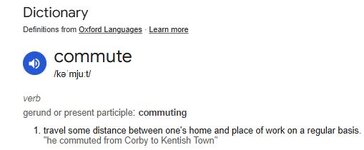
However, they use the word commute in their description, so
commute.JPG
in my view (and what the hell do I know!)
if the vehicle is used every once in a while (once every few months) to drive/ride to a specific (non fixed) location for work
there is nothing regular and so your description is not commuting ????
 
It a good question, I too cycle to work, but have wondered if I'm going elsewhere afterwards, and thus ride or drive in, how is that considered?

Driving to work because you're taking the car to the garage at lunch
Driving to work because you're leaving for the weekend straight from work,

That kind of thing, could happen 4 times a year...

I don't know the answer but I'd be interested to know it!
 
Last edited:
I believe @Wapping posted on this matter not so long ago, as he visits the office occasionally. I believe his view was that an occasional visit to the the office would not constitute regular commuting to a place of work but I would be reading *my* contract carefully.

Yep, I guess you are right and this is the case.

Issue is... while doing all the quote dance, it's impossible to have a straight answer from the various call centre peeps and you will never know until you paid for a contract. I know you can cancel it within the cooling off period, but it would be a faff.


Again, a few months ago we were setting up something at the office.
I was going out for dinner in SW London with friends and going by car. This is a Sunday or Saturday.
I left around lunchtime, swung by the office to help the other folks with the office set-up, then left for dinner later during the day.
I would not class that as commuting.

Every once in a while I travel abroad for work. Sometimes, if I'm staying longer or I can stay over the weekend, I prefer to take my own car rather than the train or plane.
I get the chunnel tickets and fuel (to/from, not the rest of the trip) reimbursed by work.
I travel to the location, park, work, use the car for the rest of my time there on private matters. I do not get reimbursed per mile or stuff like that. I prefer to have the car so I can move around easily after work.
This could happen a couple of times a year. I wouldn't class this as commuting as well. There is no repetition, travel is usually away from peak times/etc. But I see this less clear in the eyes of an insurer.

Again, the problem is easily solved by having the commuting clause. And in most case it's inexpensive to just have the peace of mind.
But this was just a bit curiosity (lazy Monday morning :D ) and also a good to know in those (rare) cases where the commuting option is very expensive, to understand if totally necessary or not.
 
Last edited:
I very occasionally head up to to our UK site in my personal car or on the bike, on a friday (office is 180 miles north from home!) before then continunig onwards to Northumbria or Scotland for some fun for the weekend.

Adding communting to my car policy doubled it!

Hopefully all is good unless the works forklift crushes my bike in the car park !
:eek:
 
A lot of insurers state commuting to a single place of work, if it's more than one place of work they will probably say it's business use whether paid or not. I would ask your insurer's definition of commuting if you're that bothered, rather than trying to interpret or justify it to your own understanding.
 
IMHO..
The following seems to sum up your approach..
You mainly cycle to work, but only use the motor vehicle when the weather is poor.

So…
It can easily be assumed that in a year the weather is bound to be poor several times?

That being the case…

You know that for any given year you are going to be using your motor vehicles to commute several times.

Sounds like it could be construed as regular?
 
This is a mine field and the answer depends on who and why you're asking, and what you're hoping to get.

I used to work 5 days a week at factory A, then it was 4 days at site A and 1 day at site B. I wouldn't go from A to B, but only ever from home and back again. That apparently is business use according to the Insurance company, but it's ordinary commuting according to the tax office. If I went from site A directly to site B, that is business use and not commuting according to insurance people and the tax office.

As I no longer have a site A, I split my time between 2 days at site B and 3 days at site C. I have business use but I'm not insured for commercial traveling.. although I understand commercial traveling is collecting payments?

A word to the wise which came to me from a blokes dad, his son didn't have commuting use, but had an accident at a supermarket near to his office and although they honoured the claim, it was tricky trying to prove he wasn't going to work.
 
You know that for any given year you are going to be using your motor vehicles to commute several times.

Sounds like it could be construed as regular?

Yes. And on the motorbike I'd want to have the commuting option (I do have it on the GS, not on the other two as I don't see myself using those) even for those few occasions.

Question was more about car use in cases like the ones listed above, and we are talking just a few per year (if any) generally. Again, I do have the cover, but it was a curiosity as renewal is not that far away and I will have to shop around again.
 
Every once in a while I travel abroad for work. Sometimes, if I'm staying longer or I can stay over the weekend, I prefer to take my own car rather than the train or plane.

this is business use, a level beyond commuting
 
Once or twice a year.

I'll ask the insurer.
But it's a bit like asking the barber if you need a haircut I fear. :)
 
We are talking insurance companies here - so anything is possible with them as a reason not to pay up ........
Exactly this.

Last year I probably went to work on my bike 10 times at the most, I still had commuting on my insurance though as I don't want to give the sneaky bastards an excuse not to pay out.
Even though it was almost as safe at work as it was at home, I used to ride it straight into the warehouse and lock it up out of the way.

These things are not put on the website to be clear, they are put there in the hope you don't click them.
Then as you make payment the whole insurance office shouts "Gotcha!"
 
Yes. If you're stopped by the police or have an accident on the way to work on your bike, it doesn't matter if you ride every day or if its one day a year that you ride to work, you're commuting.

If you want to risk having your bike seized, being prosecuted and/or your insurance company not paying up for your losses in an accident....
 
Insurance you go to work to one place commuting, more than one business.

Just pay for social domestic pleasure and when you crash, you are just off out for a ride. To the shops etc.
 
A lot of insurers state commuting to a single place of work, if it's more than one place of work they will probably say it's business use whether paid or not. I would ask your insurer's definition of commuting if you're that bothered, rather than trying to interpret or justify it to your own understanding.
This is what I’ve been told when I’ve asked brokers. Becuase we don’t have an office in the UK, we use Regis in different locations and this then counted as Class 1 business, as did driving or riding to meetings on customer site even if it’s only once.

In the event of a claim you’ll be asked the purpose of the journey and if it’s one of the above and you’ve not declared it they’ll refuse the claim.
Now it also seems to me that commuting every day is a very different thing to riafing to the office once a month or so, but that’s insurance companies.

I would ask for a clear definition of their interpretation.
 
Agree with all the above.
As said, I will ask my insurer(s). Thanks!

Basically my question is based on this. Stupid example: you do have a policy with commuting. You commute to work normally.
One day they ask you to complete a training course, another location 2 miles from the main office.
Without thinking too much about it (as any sane person would :D ) you drive to that location.
According to what we said in here, that would be classed business use. And you'd be driving without cover.

😲
 
Agree with all the above.
As said, I will ask my insurer(s). Thanks!

Basically my question is based on this. Stupid example: you do have a policy with commuting. You commute to work normally.
One day they ask you to complete a training course, another location 2 miles from the main office.
Without thinking too much about it (as any sane person would :D ) you drive to that location.
According to what we said in here, that would be classed business use. And you'd be driving without cover.

😲

don't forget, insurers are subject to contract law like any others and as Wapping has pointed out their T&C have to pass the reasonableness test. That's why there is an ombudsman to arbitrate if some jobsworth tries it on.

If you are a HGV driver and are required to take a medical periodically, which is not going to be at your normal depot then it is not unreasonable to use your own car to travel to the medical centre to undertake the medical. The same would apply to an apprentice attending college one day a week or you attending a first aid course in a scout hut once every 3 years.
 
Yep, that's what I was thinking as well.

I'll ask anyway on travel outside London (it's fixed addresses) if it needs business use or it's reasonable travel given the circumstances.


Back
Top Bottom