
Crash Damage - rewelding pillion footrest bracket to frame

  • Thread starter Thread starter dom68
  • Start date Start date

dom68

Guest
I had a spill on my R12000GS the other morning in the rain and ended up following the bike up the road face down.
The bike mainly sustained damaged on the R/H side from traveling down the road on it's side!

I've taken the bike into my local BMW dealer and they've quoted over £5000 to put the damage right as they want to replace the sub frame as the pillion footrest bracket has snapped off the frame plus they've also quoted for replacing any parts that are scratched up.

I'm now umming and aahing if to put the repair through my insurance and lose my no claims etc. or if to carry out the repairs myself.

The parts that are scratched don't really worry me too much but I would need to get the pillion bracket welded back onto the frame.

Does anyone have any experience of rewelding this bracket back onto the frame succesfully and also of any pitfalls involved in welding the frame?

Thanks in advance
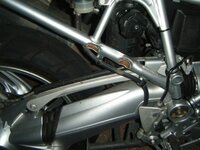
DSCF615011.JPG
 
Let the insurance do it,what do you think you pay for!

Unless of course the bike is only worth ten bob,then do it yourself.Any decent welder will stick that back on for you in half an hour.

Sorted:thumb2
 
Christ,it looks like the bracket must have been hanging on by a wing and a prayer anyway. :eek

The paint ..thin as it looks..is possibly thicker than the subframe tube sidewalls. :augie


If you`re getting it welded back on,remove the paint from the areas to be welded...on bracket and subframe.


Disconnect the battery prior to any electrical type welding work.
 
Welding it back on

If you wish it Neatly welded back on again, get it Tig welded on.
It will take around 10 mins for a good welder to do it. - Plus around 15 mins preparation before hand, cleaning all of the paint off round where all welding is to take place plus a point for the welder earth.
Almost no burning, good penetration, and a perfect finish.

Once finished, no dressing will be needed.

Gas will burn rings round it, and Mig is a mess to tidy up afterwards.

Ignore all the naysayers and doom mongers regarding battery disconnection.
It is safer left connected.
They are speaking without knowledge.
The important thing is the earth path. Just make sure that the earth is onto the frame ajacent to where the welding is to take place, and that the earth point hs had the paint removed.
( I have had many such welding jobs done, all without problems)

Regards
Myke
 
If you wish it Neatly welded back on again, get it Tig welded on.
It will take around 10 mins for a good welder to do it. - Plus around 15 mins preparation before hand, cleaning all of the paint off round where all welding is to take place plus a point for the welder earth.
Almost no burning, good penetration, and a perfect finish.

Once finished, no dressing will be needed.

Gas will burn rings round it, and Mig is a mess to tidy up afterwards.

Ignore all the naysayers and doom mongers regarding battery disconnection.
It is safer left connected.

They are speaking without knowledge.
The important thing is the earth path. Just make sure that the earth is onto the frame ajacent to where the welding is to take place, and that the earth point hs had the paint removed.
( I have had many such welding jobs done, all without problems)

Regards
Myke

Hmmm I'd quote a 24 pack of Carling for that job! If the vehicle has can-bus make sure the battery is disconnected.....Ignore the BS advice above!

Personally I've never had any welding done for me......I've been welding for over 35 years and was trained by Ford on Can-Bus systems.....Electronics diploma aside check out Claudio can'trideabike's result of aforementioned ignorance on long way round for the results of leaving the battery connected....fubar!
 
Hmmm I'd quote a 24 pack of Carling for that job! If the vehicle has can-bus make sure the battery is disconnected.....Ignore the BS advice above!

Personally I've never had any welding done for me......I've been welding for over 35 years and was trained by Ford on Can-Bus systems.....Electronics diploma aside check out Claudio can'trideabike's result of aforementioned ignorance on long way round for the results of leaving the battery connected....fubar!

I don't disagree with the advice, but the word on the streets is that Claudio and the luvvies managed to forget to redo a connector after the welding and that was all that was wrong with his bike.
 
The original weld must have been poor if it snapped clean off like that, probably poor penetration or a very brittle heat-affected zone around the weld.

With ANY form of arc welding, the eddy current around the weld site is minimal compared to the huge surge when the arc is initially struck. This induced surge effect is what fries semiconductors.

Disconnect the battery and remove it from the bike, you having nothing to lose by doing so. This will isolate the electrics/electronics and also prevent a hydrogen fire if your battery is gassing. Better safe than sorry, a 5 minute job to do and the only 'hassle' is the TPS reset and instrument clock display to reset once the battery is reconnected.

As already stated, TIG welding would be much neater with much better control over weld penetration in skilled hands and give an almost factory finish (which is machine MIG welded by computer controlled robot). Shouldn't cost much.

I believe the factory frame paint finish is a hard epoxy.

If you wanted to replace the subframe yourself, you could try the popular breakers for a decent used item eg Sherlocks, Motorworks etc or look for a guy called R.C.Mawer on ebay who breaks 1200's. It's only spanner work and new cable ties after all.
 
I don't disagree with the advice, but the word on the streets is that Claudio and the luvvies managed to forget to redo a connector after the welding and that was all that was wrong with his bike.
Ahhh....so the new cheapo bike was a waste of money! :beerjug:

The original weld must have been poor if it snapped clean off like that, probably poor penetration or a very brittle heat-affected zone around the weld.
It's a big heavy bike......welds never gave but something had to!
 
DON'T FFS LEAVE THE BATTERY CONNECTED.:blast

I'm not even going to justify that post with a comment.
 
DON'T FFS LEAVE THE BATTERY CONNECTED.:blast

I'm not even going to justify that post with a comment.

i had my footrest hanger welded and left the battery connected. no problems were encountered. perhaps i was just lucky :nenau
 
As I said, those without knoweldge

Just look at the string of people who "talk" supposedly knowlegeably about disconnecting the battery & canbus.

A little knowledge is a dangerous thing.

A lot helps on such a repair.

These naysayers cannot provide a valid reason for disconnecting the battery, or why it should prevent damage to the electrical system.

If you look at my post, it emphasises the importance of the location of the welding earth path. This is all that counts.

In actual fact, disconnecting the battery increases, not decreases the likelyhood of damage due to welding, which is most unlikely in any case.

The reason is that the battery acts as an enormous capacitor, preventing any surges or "spikes" generating dangerous voltages.

Anyway, the canbus system is NPN switched on all inputs, which reduces the probability of failure, and can take incredible abuse. If you take any signal going into the canbus system, E.G. any handlebar switch, & touch it to 12v or earth, it doesn't matter, you cannot do any damage.
This system is, effectively, bulletproof for all normal stupidity.

Myke
 
So,you'll now all about arc blow then,and how it can reverse the polarity of an alternator for example.

Been there and seen it on a hugley expensive rally car (only a quarter of a million quids worth though!) As well as having a very large bill,he was out of a sprint he was leading in Belgium,and all the twat of a welder had to do,was throw the isolator switch.Still,I suppose he's still happy pushing a broom about.

I presume you'll pay for any damage that might occour if people follow your advice!

That's my last post on this thread,the bullshite is getting a bit deep for my liking and I only have a little knowledge of welding thirty years after finishing my apprenticeship:rolleyes:
 
Remember Denis Thatcher

Yes, he should be remembered for the following:

It is better to keep your mouth shut and be thought an idiot, than to open it and confirm their suspicions.

Myke
 
Re: Disconnecting battery prior to welding. Looks like all the car/truck manufacturers are wrong too. Why do they all warn you to disconnect the battery then?
 
So,you'll now all about arc blow then,and how it can reverse the polarity of an alternator for example.

In the "old" days of positive earth cars you had to polarise the generator/alternator to match your vehicle. very simple to do, and to reverse if you got it wrong :D.

Re: Disconnecting battery prior to welding. Looks like all the car/truck manufacturers are wrong too. Why do they all warn you to disconnect the battery then?

Simple catch all get out clause in case someone tries to weld who hasn't got the "earth" in the right place.
 
In the "old" days of positive earth cars you had to polarise the generator/alternator to match your vehicle. very simple to do, and to reverse if you got it wrong :D.


Simple catch all get out clause in case someone tries to weld who hasn't got the "earth" in the right place.


I would still recommend disconnecting the battery as a precautionary measure. :thumb
 
Easy to polarise a dinamo which was on positive earth cars. Try it with a altinator. I thought the reason of disconecting the battery was to protect the altinator but in the quest for safety I would remove the battery(did u ever see one explode?). More inportantlly I would remove all brake fluid -revisors pipes callipers- from the area. Brake fluid has a lower flash point than petrol and will not vaporise off like petrol will. Dont tey this at home but petrol can vaporise off a hot exhaust manifold brake fluid will not it will immadetly burst into flames. I know this to my cost. JJH
 
be careful

be careful of any neibours who claim to have a mig welder and they just happen to have a mate who can weld it up
these type of so called freinds usually turn out to be proper tossers :thumb
 
I have finally got my bike back from the repaires having sustained the same damage. I foolishly got caught out by a new back tyre and when turning right from stationary at a junction lost the back doing a 180 in the process. The repairers rekon they do approx 200 gs's a year with the same damage which I was surprised at. I did wonder if having the side boxes on would have cushioned the blow but looking at the mounts I think they would simply punch the frame in just the same.
It does seem remarkable that such a small off can cause so much damage.
The most annoying part of it was I let Carol Nash use their own repairers in Dagenham, Essex and it took a staggering 10+ weeks to get the bike back so not happy with the service. Still shes back now and I'm getting reaqainted.
 
Did your bike have engine bars by any chance?

I dropped my 2004 model R1200GS in Australia on a wet roundabout and the aftermarket Hepco & Becker bars ground down nicely and absorbed the impact/slide, hence the rear footrest hangers only lightly skimmed the tarmac and weren't damaged (just a scuffed end on the pillion peg).

I think that engine bars would probably prevent this problem in the majority of falls/slides (based on bitter experience).


Back
Top Bottom
