Current Draw

Peter04

Registered user
Joined
Jan 6, 2009
Messages
53
Reaction score
0
Location
Colchester
Hi Guys

Does any one know what the current draw is on a 07 1200gs with a OEM battery ( I have lent my current clamp to a friend that has lost it) as I want to make up a set of jump leads to carry with me on long trips. having just come bake from a 5 day off road trip in the Oman and had a flat battery and had to get a jump from a KTM not good.

Peter
 
If you mean 'what does the starter motor draw', then it's usually in the range 60A with a hot engine up to 180A on a cold morning.
 
thanks

Yes that exactly what I mean. Many thanks is there any facts and figures any were or is it in the workshop cd manual as I am waiting for this to arrive.

Cheers Peter
 
Jump leads would be handy but I'd be more concerned with why the battery went flat though.
 
If you mean 'what does the starter motor draw', then it's usually in the range 60A with a hot engine up to 180A on a cold morning.

I think I'd double that.

The solenoid probably takes 10A on its own; a motor on the bench probably takes 30A. I might check the resistance of mine when I get home - I'll bet it's pretty low!

Greg
 
.

It may have just been the cold that had made the battery flat as we at 2000 ood meters in the Oman. The battery is a few years old and some were on the bike is a tracker system fitted in the UK from the owner before me. As we had no jump leads we used some house hold wire from an old Omani guy didnt get hot as the battery was not that flat. Its only the fact that I dont have a my Current Draw Clamp that i asked the question to see if any one have made up a set of jump leads or know's for a fact the exact draw from the starter.

Cheers
Peter
 
It may have just been the cold that had made the battery flat as we at 2000 ood meters in the Oman......or know's for a fact the exact draw from the starter.

The battery should be able to start the engine in the cold (unless you were way below zero). It's most likely yours is getting old and tired. The best and simplest option is to fix that and not worry about jumpers

As mentioned, the exact draw from the starter depends on many factors and is highest when it's cold.

A typical figure for cold cranking capacity of the GS battery is 200 amps which represents the maximum current you'd need to accomodate. If you were playing safe you'd simply copy the diameter of the starter motor cables used on the bike.
 
. If you were playing safe you'd simply copy the diameter of the starter motor cables used on the bike.


I love a simple answer! There was me trying to work out the current draw of a DC Series motor under different loads:bow
 
.

Hi Rob

You carry on you will proberley come up with the answer i would like as I fully understand all about the need to sort out the battey and to find if there is a elec draw from somewhere all i asked if any one knows the current draw as I WILL be making a set of motorcycle jump leads. I just want to carry a smaller set than a set for a car. ( not sure why people have to give so much other info) But many thanks keeps me smiling.

Peter.
 
Hi Rob

You carry on you will proberley come up with the answer i would like as I fully understand all about the need to sort out the battey and to find if there is a elec draw from somewhere all i asked if any one knows the current draw as I WILL be making a set of motorcycle jump leads. I just want to carry a smaller set than a set for a car. ( not sure why people have to give so much other info) But many thanks keeps me smiling.

Peter.

Well, there's a lot to consider before we even get to the load.The wire gauge is a logarithmic scale base on the cross sectional area of the wire. Each 3-gauge step in size corresponds to a doubling or halving of the cross sectional area. For example, going from 20 gauge to 17 gauge doubles the cross sectional area (which, by the way, halves the DC resistance).

Then we move to CCA (cold cranking amps) for worst case scenario, chuck a few other things into the equation, starter wear, engine wear, price of tea at Tescos, resistance of your connections, who'll win X factor, is Gillean McKieth for real and I come to the conclusion -

16mm squared area conductors under 3 meters (ie 1.5 meters each lead) using an quick connector socket (Anderson) permanently fitted to your bike would give you the best in size and weight for touring yet still give you 300 amps peak.

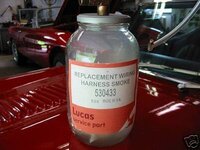
Just remember, all things electrical are secretly run by hidden smoke inside and if you let the smoke out they wont work again.
 
Well, there's a lot to consider before we even get to the load.The wire gauge is a logarithmic scale base on the cross sectional area of the wire. Each 3-gauge step in size corresponds to a doubling or halving of the cross sectional area. For example, going from 20 gauge to 17 gauge doubles the cross sectional area (which, by the way, halves the DC resistance).

Then we move to CCA (cold cranking amps) for worst case scenario, chuck a few other things into the equation, starter wear, engine wear, price of tea at Tescos, resistance of your connections, who'll win X factor, is Gillean McKieth for real and I come to the conclusion -

16mm squared area conductors under 3 meters (ie 1.5 meters each lead) using an quick connector socket (Anderson) permanently fitted to your bike would give you the best in size and weight for touring yet still give you 300 amps peak.

Just remember, all things electrical are secretly run by hidden smoke inside and if you let the smoke out they wont work again.

Ah but Rob you can get the Lucas service part


Neil
 

Attachments

  • LucasSmoke.jpg
    LucasSmoke.jpg
    65.6 KB · Views: 71
.

Hi Guys

I have done a current draw test this affertoon 170 amps cold and 155 amps when the motor is warm.

So what do we all think now.


Peter


Back
Top Bottom