DIY Servicing : the do's & don'ts

  • Thread starter Thread starter gyro_nyc
  • Start date Start date
it's not sealed from air which contains water' not 100% sure, but i think there's a breather in the reservoir cap too. anyway, there is air trapped in the reservoir above the fluid.

more info


Moisture will also get in through condensation.

This is also true of fuel injection systems, so a fuel treatment like Forte or Havoline is prudent every so often too (perhaps once a year or so). The fuel treatment will chemically bond to the water molecules, break them apart and flush them through and burn them off with the fuel.
 
you can buy electronic testers to measure the water content in situ. the only one i've used said the fluid was shagged after a couple of months :rolleyes:
 
I am sure we are getting our knickers in a twist over this.........in truth just how much moisture in the air are we really talking about and how much air is there above the fluid in the master cylinder anyway? It must be tiny.

I am certain that most 'older' vehicles (bikes & cars) running around almost never have their fluid changed.

Besides, if as and when you do want to change the fluid I see no reason why you can't do your own fluid on the ABS systems (excpet maybe the servo brakes). Regardless of actuating any valves in the modultaor there is no reason that you can't simply bleed using traditional methods.
 
i would certainly bleed them myself, but i'd do it regularly.

i've rebuilt neglected brake systems before and it's not cheap. and that was without ABS units.
 
Moisture will also get in through condensation.


Condensation from where?............condensate is only water that has condensed out of air - where is this air pocket in a sealed brake system?......and an air pocket large enough to contain an amount of water sufficient to contaminate the brake fluid.
 
Condensation from where?............condensate is only water that has condensed out of air - where is this air pocket in a sealed brake system?......and an air pocket large enough to contain an amount of water sufficient to contaminate the brake fluid.

The air pocket is in the top of the reservoir. Also no brake system is absolutley air tight (seals and gaskets). With rubber brake lines (braided are no different) you also have air ingress through the rubber (over time as rubber is permeable to an extent). Add to that the fact that brake fluid is hydroscopic (ie it doesn't just mix with water, it activley atracts and absorbs it ) and, again over time, moisture will build up in the system.

I agree that some peeps worry toooooo much but, for the sake of what is a straight forward job (well, on most bikes ;) ) it has to be worth doing every two to three years :nenau

Andres
 
Look at it another way. If you were designing some kind of machine that used a hygroscopic fluid as part of a mechanism that was exposed to the elements, could you prevent the fluid absorbing moisture indefinitely? No I thought not.
 
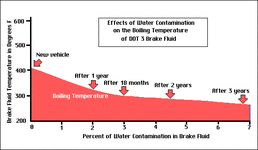
One point that's not been mentioned so far and is probably the most important - if you do a lot of heavy braking, the temperature of the brake calipers can rise to a point where badly contaminated fluid will boil (at a much lower temperature than fresh fluid) and create a bubble of vapour behind the pistons.

Next time you put on the brakes you'll find there's nothing there as all you do is try and compress the bubble. Not clever if you've been hammering down an alpine pass for the last 20mins and just approaching a big hairpin...

This is the main reason to change, this is what all the fuss is about, and quite a valid reason I reckon! The other reasons, like wear on components is also valid unless you want to reduce the life of the brake system

Sure many old cars may never have had their fluid changed and most people never have problems because under normal driving conditions they aren't stressing the brakes very much so they get away with it.

As to the 'how', there's a good post somewhere, maybe advrider? about changing fluid on an servoed 1150 which is done with the ignition on such that the fluid is pumped around using the servo motor itself simply by gently squeezing the brake lever.
 
Back to the original post I think its a case of having a go but being fully aware of the consequences of foul ups. Start by doing an oil change, work up to doing the tappets and leave bleeding (bleedin') ABS brakes until you are confident doing the other stuff. As long as you don't cross thread the sump bolt doing an oil change will not pose a risk of killing you. similarly you'll know if you have got the valve clearances right cos they feel right. If you have a good servicing manual / dvd then follow the procedures to the letter and you will be fine. As you get more experienced you will know whee to cut corners.

Changing brake pads is easy but the consequences of getting it wrong could be high. That said its usually obvious if the new pads are where they should be so as long as your ultra careful you'll be fine. As one poster said, mechanics in BMW dealers aren't super human - if they can do things so can we.
 
As above it's all about confidence, no buckets and shims or water cooling to worry about, basic maintenance on the BM is not difficult. However if you strip or cross thread a bolt or spark plug it could be expensive and could put you off any future maintenance. My advice is take your time photograph anything you are unsure of and use a torque wrench. It's a great feeling knowing that the job has been done and done properly.

Regards

Cusi

Never sacrifice position for safety
 
One point that's not been mentioned so far and is probably the most important - if you do a lot of heavy braking, the temperature of the brake calipers can rise to a point where badly contaminated fluid will boil (at a much lower temperature than fresh fluid) and create a bubble of vapour behind the pistons.

Next time you put on the brakes you'll find there's nothing there as all you do is try and compress the bubble. Not clever if you've been hammering down an alpine pass for the last 20mins and just approaching a big hairpin...


post 11 :augie
 
The air pocket is in the top of the reservoir. Also no brake system is absolutley air tight (seals and gaskets). With rubber brake lines (braided are no different) you also have air ingress through the rubber (over time as rubber is permeable to an extent). Add to that the fact that brake fluid is hydroscopic (ie it doesn't just mix with water, it activley atracts and absorbs it ) and, again over time, moisture will build up in the system.

I agree that some peeps worry toooooo much but, for the sake of what is a straight forward job (well, on most bikes ;) ) it has to be worth doing every two to three years :nenau

Andres

Air pocket above the fluid? It's tiny, besides there is a membrane effectively sitting on the fluid that also adds to the seal. As of leaking through the rubber brale lines.......the fluid is more searching than the gas so if air was getting in the fluid would be getting out at a greater rate. I understand that brake fluid is hygroscopic.....but I still do not see where the moisture is coming from in any volume high enough as to contaminate the fluid.

And as for boiling the brake fluid in a GS - come on, are you serious?

Sorry to keep banging on about this but I still have not seen an acceptable explanation as to how the fluid in a sealed system can become contaminated to an extent that it effects the fluids performance and therefore requires changing so frequently. Which brings me back to my comment that the need for changing the fluid as part of a regular service is really needed? Is it not just another exagerated service schedule? Why do the dealers charge for new gaskets every time they adjust the valves..........because they can! My dealer even charges for a new 'O' ring around the oil filler............and on the way home oil leaked out.

So, this is why most people with the inclination should be able to home service a BMW with a few tools and a book and a little confidence and a nice cup of tea:rob Essentially there is very little to do.

 
Air pocket above the fluid? It's tiny, besides there is a membrane effectively sitting on the fluid that also adds to the seal. As of leaking through the rubber brale lines.......the fluid is more searching than the gas so if air was getting in the fluid would be getting out at a greater rate. I understand that brake fluid is hygroscopic.....but I still do not see where the moisture is coming from in any volume high enough as to contaminate the fluid.

And as for boiling the brake fluid in a GS - come on, are you serious?

Sorry to keep banging on about this but I still have not seen an acceptable explanation as to how the fluid in a sealed system can become contaminated to an extent that it effects the fluids performance and therefore requires changing so frequently. Which brings me back to my comment that the need for changing the fluid as part of a regular service is really needed? Is it not just another exagerated service schedule? Why do the dealers charge for new gaskets every time they adjust the valves..........because they can! My dealer even charges for a new 'O' ring around the oil filler............and on the way home oil leaked out.

So, this is why most people with the inclination should be able to home service a BMW with a few tools and a book and a little confidence and a nice cup of tea:rob Essentially there is very little to do.

FFS! you're in denial.

just because you can't see how it happens doesn't mean it doesn't :rolleyes:

you can dismiss it as much as you like, but you'd be better off just servicing your bike properly. getting someone else to do it might be a good idea if you're just going to make up the service schedule.

and yes, i have seen fluid boil in the caliper leaving no brakes (ducati 888). thankfully i wasn't riding.
 
Ok, ok..............I get the message.:thedummy

I am off to convert my brakes to cable operation:augie
 
Curious of your source?? DOT 3? and a scale in degrees F and not C?

Dot3 just happened to be what was quoted on the link in my post (that's the source)

The only difference between DOT3 and 4 is the boiling point, as I understand it the boiling point is still reduced by the same amount as more water is absorbed over time. The starting point is just higher with DOT4.

Anyway, this thread is starting to scare me, it's getting way to 'pipe n slippers' for me :D

Andres


Back
Top Bottom