A bit of advice and a some advice needed.
The issue on my bike is unlikely to be affecting low mileage bikes.
During a post service test ride a vibration was noted through the foot pegs. The service tech pulled the driveshaft and noticed that the bearing was notchy when swivelling the UJ end. Ok, the bike has done 30k and it was well looked after.
Here is the thing that is probably overlooked on the drive shafts seeing everybody is concerned about rusty splines. Due to the engineering of a UJ the drive transmitted through it is phased. Unlike a CV (constant velocity) joint.
The power transmitted is linear with the shaft in a perfect straight line. When the drive is required to change through an angle the physics gets more interesting. With the UJ perfectly aligned in the vertical and horizontal plane there is negligible loss of drive, as the UJ rotates the 2 swivels can't really cope with the drive transmission, ie there is drag or resistance up to a maximum at 45° angle of rotation from where the drag decreases until the UJ are in a perfect vertical/horizontal plane. This happens for every 90° of rotation.
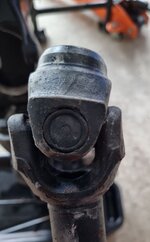
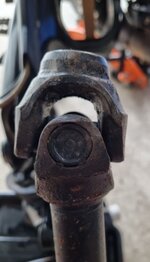
Over time the bearings wear a grove and play develops. This play introduce a vibration that will accelerate wear in the bearing as it rotates. As Steptoe has said before, the problem is not at the gearbox output shaft but most certainly at the final drive. Whilst you lubricate the splines on your high mileage bike, it might be worth feeling if there is any wear in the bearing itself. As you can see in the pics below there is not a lot of movement were the wear is. Moving the UJ past that point there is noticeable difference in how tight the bearing feels.
The issue on my bike is unlikely to be affecting low mileage bikes.
During a post service test ride a vibration was noted through the foot pegs. The service tech pulled the driveshaft and noticed that the bearing was notchy when swivelling the UJ end. Ok, the bike has done 30k and it was well looked after.
Here is the thing that is probably overlooked on the drive shafts seeing everybody is concerned about rusty splines. Due to the engineering of a UJ the drive transmitted through it is phased. Unlike a CV (constant velocity) joint.
The power transmitted is linear with the shaft in a perfect straight line. When the drive is required to change through an angle the physics gets more interesting. With the UJ perfectly aligned in the vertical and horizontal plane there is negligible loss of drive, as the UJ rotates the 2 swivels can't really cope with the drive transmission, ie there is drag or resistance up to a maximum at 45° angle of rotation from where the drag decreases until the UJ are in a perfect vertical/horizontal plane. This happens for every 90° of rotation.
Over time the bearings wear a grove and play develops. This play introduce a vibration that will accelerate wear in the bearing as it rotates. As Steptoe has said before, the problem is not at the gearbox output shaft but most certainly at the final drive. Whilst you lubricate the splines on your high mileage bike, it might be worth feeling if there is any wear in the bearing itself. As you can see in the pics below there is not a lot of movement were the wear is. Moving the UJ past that point there is noticeable difference in how tight the bearing feels.