Silversurfer
Registered user
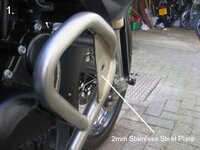
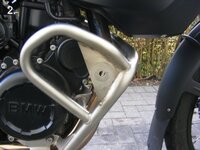
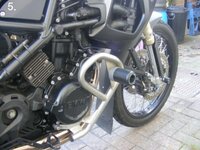
When I bought my F800Gs new I ordered all the extras with it, (as yer do), including the BMW engine bars. What I didn't realise at the time was that they would offer no protection to the plastics were I unlucky/careless enough to drop it. If I had known I would have gone for the Givi’s that extend upwards to protect the plastics, even though I consider them to be aesthetically quite ugly. I do a lot of motorway/autoroute miles and was considering looking for some suitable Highway Pegs to clamp onto the engine bars to allow me to stretch my legs whilst riding, (dreaded DVT warnings), I thought why not see if I could fit some suitable crash bungs to the engine bars and kill two birds with one stone as it were. Did a bit of research on the internet and could find nothing suitable that would clamp straight onto the engine bars so thought I would have a go at fitting some brackets onto the bars to take some bungs. See photos one and 2 below.
I chose what I think is the strongest part of the engine bars and also the most suitable position for Highway Pegs, and made some stiff cardboard templates first so I could get the bends right in order that the bungs would be level when the bike was upright then cut and drilled the plate brackets. Fastened the bungs to the brackets then held them up to the bars in order to mark the bars for position. So as not to take the risk of damaging the bikes electronics the engine bars were removed from the bike for welding hence making sure that the position of the brackets was suitably marked. (Couldn't bear the thought of riding around with cock-eyed bungs).
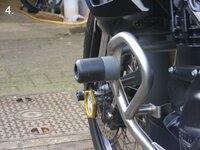
The bungs I used were from an early Yamaha R1 and were of different lengths but I got them cheap so I used them anyway. Because of the difference I had to use some steel plate washers to get them out as far as I wanted to both make sure that if the bike was dropped the plastics would be protected and to ensure that they would be comfortable as Highway Pegs. (If anyone decides to do the same if you take some time to look around at the various types of crash bungs that are available you would probably find some that are much more suitable than the R1 type I used but they are not cheap, around £50/60 a pair).
Since I fitted the crash bungs originally I was lucky enough to come across "ironandsteel" on this forum who has since made me some spacers out of hard nylon, which are the grey bits on the end of the bungs, to replace the steel plate washers I had been using. As he only charged cost and postage and did an excellent job I think he deserves a mention. TopMan.
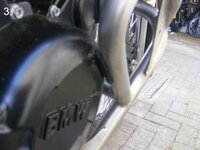
One thing I did notice when I was doing this was how close the engine bars on the R/H side were to the engine casing – no more than 3mm clearance. (see photo 3).
I am sure that if that part of the engine bar was to contact the ground first in the event of a drop then the crankcase would likely be damaged, especially as the engine bars are fitted with what look to be designed as shock absorbing,(as in collapsing), mounting lugs.
As a precaution I have inserted some rubber strip between the engine bar and the casing to absorb any blow but I am sure having the crash bungs fitted will prevent that from happening.
In the case of the BMW engine bars for the F800 GS I don't think BMW put much thought into what engine bars are supposed to be fitted for.
So far I have not dropped the bike yet so as protection they remain untested but as Highway Pegs they are brilliant. (Like riding a Harley but without the noise, vibration and lack of performance).
I chose what I think is the strongest part of the engine bars and also the most suitable position for Highway Pegs, and made some stiff cardboard templates first so I could get the bends right in order that the bungs would be level when the bike was upright then cut and drilled the plate brackets. Fastened the bungs to the brackets then held them up to the bars in order to mark the bars for position. So as not to take the risk of damaging the bikes electronics the engine bars were removed from the bike for welding hence making sure that the position of the brackets was suitably marked. (Couldn't bear the thought of riding around with cock-eyed bungs).
The bungs I used were from an early Yamaha R1 and were of different lengths but I got them cheap so I used them anyway. Because of the difference I had to use some steel plate washers to get them out as far as I wanted to both make sure that if the bike was dropped the plastics would be protected and to ensure that they would be comfortable as Highway Pegs. (If anyone decides to do the same if you take some time to look around at the various types of crash bungs that are available you would probably find some that are much more suitable than the R1 type I used but they are not cheap, around £50/60 a pair).
Since I fitted the crash bungs originally I was lucky enough to come across "ironandsteel" on this forum who has since made me some spacers out of hard nylon, which are the grey bits on the end of the bungs, to replace the steel plate washers I had been using. As he only charged cost and postage and did an excellent job I think he deserves a mention. TopMan.
One thing I did notice when I was doing this was how close the engine bars on the R/H side were to the engine casing – no more than 3mm clearance. (see photo 3).
I am sure that if that part of the engine bar was to contact the ground first in the event of a drop then the crankcase would likely be damaged, especially as the engine bars are fitted with what look to be designed as shock absorbing,(as in collapsing), mounting lugs.
As a precaution I have inserted some rubber strip between the engine bar and the casing to absorb any blow but I am sure having the crash bungs fitted will prevent that from happening.
In the case of the BMW engine bars for the F800 GS I don't think BMW put much thought into what engine bars are supposed to be fitted for.
So far I have not dropped the bike yet so as protection they remain untested but as Highway Pegs they are brilliant. (Like riding a Harley but without the noise, vibration and lack of performance).