


You are using an out of date browser. It may not display this or other websites correctly.
You should upgrade or use an alternative browser.
You should upgrade or use an alternative browser.
First stage of DeGarminification
- Thread starter Berin
- Start date

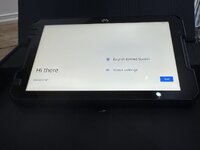
First impressions. This is not a rugged tablet, it’s a navigation device that runs the Android OS. It has zoom buttons on the front and top, and what I assume are 4 shortcut buttons on the top.
It has ports on the back for power and remote, and for expansion modules- no doubt I’ll learn what those are soon - and for an external ariel, which I guess is for its group ride function.
There’ll be an interlude while I charge it and sign up for a Google play account.
It has ports on the back for power and remote, and for expansion modules- no doubt I’ll learn what those are soon - and for an external ariel, which I guess is for its group ride function.
There’ll be an interlude while I charge it and sign up for a Google play account.
Reading the bumf, it has a usb c take off so 2 USB sockets can be added without going near bike wiring, and it can plug into the OBD for bike data if needed too.
Llofetime DMD is included and pre installed, I need to understand what maps that includes
Llofetime DMD is included and pre installed, I need to understand what maps that includes
Comes with 1 lockable powered mount
Unfortunately as there’s no British software industry everthing is English (United States). SadlyEnglish (United States)... Ominous start...

A little word...
Why must the old be thrown away
when it still works as well today?
Why pay the price to change the frame,
then dress the extra cost as gain?
The older model does the job,
but newer things are dressed to rob—
of sense, of thrift, of what we knew,
all for a brighter shade of new.
We polish buttons, smooth the screen,
and call it progress, sleek and clean.
The bill grows larger, month by month,
but somehow that is called a plus.
Perhaps we simply like the shine,
the newer shape, the brighter line.
We pay much more to feel renewed
for something the old one always did.
And when the newest thing arrives,
we praise the change, we praise the drive—
then quietly, without surprise,
begin to want the next disguise.
The old tool works, or so it seems,
but learning takes more time than dreams.
So rather than admit we’re wrong,
we blame the tool for being long.
“It’s outdated. It’s hard to use.
A newer one would surely do.”
So out it goes, and in comes new,
with polished parts and brighter hue.
We praise the change, we praise the cost,
convinced that nothing has been lost.
But then the shine begins to fade,
and once again we feel betrayed.
We never learned the first one through,
and now we cannot work the new.
So out it goes, and in comes more—
another tool we must explore.
Another manual left unread,
another fault we’ll shift instead.
And round and round the cycle turns:
we blame the tools,
the money burns.
Not every problem needs replacing.
Sometimes the fault is simply—
Could it be we stopped learning?
Why must the old be thrown away
when it still works as well today?
Why pay the price to change the frame,
then dress the extra cost as gain?
The older model does the job,
but newer things are dressed to rob—
of sense, of thrift, of what we knew,
all for a brighter shade of new.
We polish buttons, smooth the screen,
and call it progress, sleek and clean.
The bill grows larger, month by month,
but somehow that is called a plus.
Perhaps we simply like the shine,
the newer shape, the brighter line.
We pay much more to feel renewed
for something the old one always did.
And when the newest thing arrives,
we praise the change, we praise the drive—
then quietly, without surprise,
begin to want the next disguise.
The old tool works, or so it seems,
but learning takes more time than dreams.
So rather than admit we’re wrong,
we blame the tool for being long.
“It’s outdated. It’s hard to use.
A newer one would surely do.”
So out it goes, and in comes new,
with polished parts and brighter hue.
We praise the change, we praise the cost,
convinced that nothing has been lost.
But then the shine begins to fade,
and once again we feel betrayed.
We never learned the first one through,
and now we cannot work the new.
So out it goes, and in comes more—
another tool we must explore.
Another manual left unread,
another fault we’ll shift instead.
And round and round the cycle turns:
we blame the tools,
the money burns.
Not every problem needs replacing.
Sometimes the fault is simply—
Could it be we stopped learning?
Last edited:
 ... coat...
Very poetic. But if it’s aimed at me, you’ll see from the other threads that the old stuff is no longer doing the job I want it to….

It’s doing a lot of updates at the moment…

Brick by morning ...It’s doing a lot of updates at the moment…

Rather liked that . . . and a lot of truth in it!A little word...
Why must the old be thrown away
when it still works as well today?
Why pay the price to change the frame,
then dress the extra cost as gain?
The older model does the job,
but newer things are dressed to rob—
of sense, of thrift, of what we knew,
all for a brighter shade of new.
We polish buttons, smooth the screen,
and call it progress, sleek and clean.
The bill grows larger, month by month,
but somehow that is called a plus.
Perhaps we simply like the shine,
the newer shape, the brighter line.
We pay much more to feel renewed
for something the old one always did.
And when the newest thing arrives,
we praise the change, we praise the drive—
then quietly, without surprise,
begin to want the next disguise.
The old tool works, or so it seems,
but learning takes more time than dreams.
So rather than admit we’re wrong,
we blame the tool for being long.
“It’s outdated. It’s hard to use.
A newer one would surely do.”
So out it goes, and in comes new,
with polished parts and brighter hue.
We praise the change, we praise the cost,
convinced that nothing has been lost.
But then the shine begins to fade,
and once again we feel betrayed.
We never learned the first one through,
and now we cannot work the new.
So out it goes, and in comes more—
another tool we must explore.
Another manual left unread,
another fault we’ll shift instead.
And round and round the cycle turns:
we blame the tools,
the money burns.
Not every problem needs replacing.
Sometimes the fault is simply—
Could it be we stopped learning?

What is it? I expect there was a previous thread and I should know but I don’t!
I bought a cheap Chinese thin recently and it’s ok but I don’t expect it to replace a proper gos unit.
I bought a cheap Chinese thin recently and it’s ok but I don’t expect it to replace a proper gos unit.


Can you take it to Germany and ride down a road with a road closure.
See if it asks you to take a different exit off the roundabout?
This will save you riding 11 miles down a road, only to ride 11 miles back!
Asking for a friend
PS
My Garmin didn't, live traffic my arse!
That's one thing Garmin are missing a report option to warn other road users.... although that would have been too late for my mate who followed me
See if it asks you to take a different exit off the roundabout?
This will save you riding 11 miles down a road, only to ride 11 miles back!
Asking for a friend
PS
My Garmin didn't, live traffic my arse!
That's one thing Garmin are missing a report option to warn other road users.... although that would have been too late for my mate who followed me



Similar threads

- Replies
- 158
- Views
- 5,853


- Replies
- 29
- Views
- 2,660


- Replies
- 2
- Views
- 531

