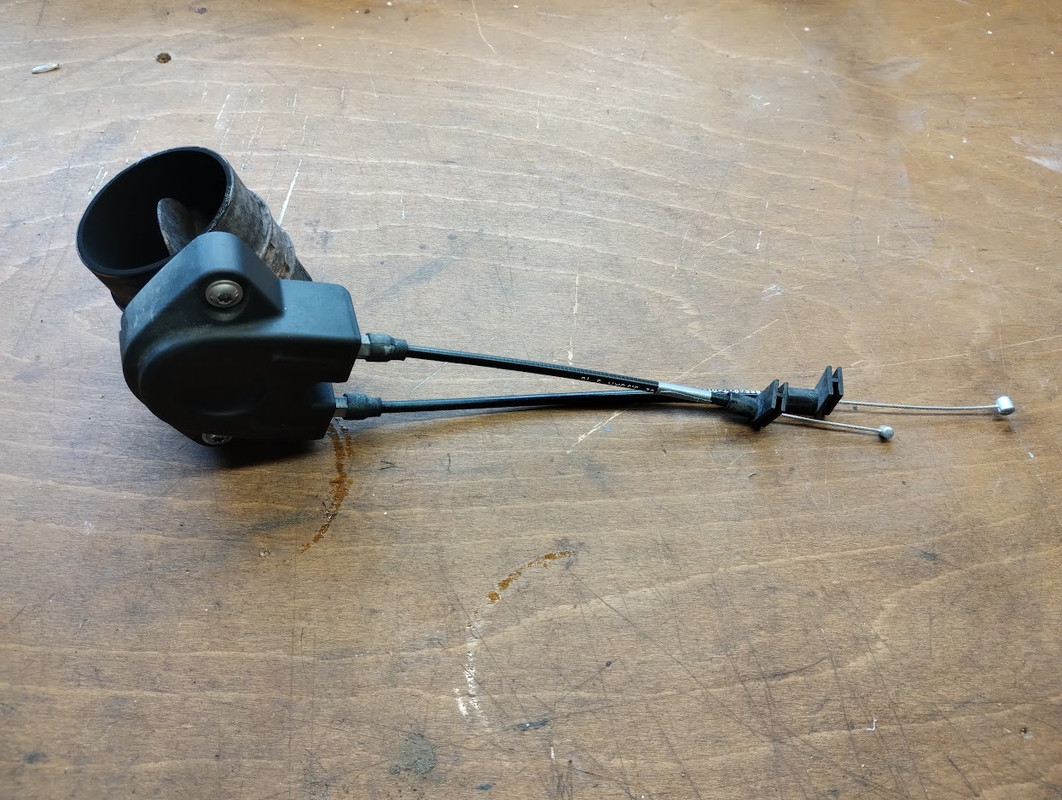
Flappy valve ? i dont get it

Santa-2512

Omnipotent one
UKGSer Subscriber
Joined
Aug 3, 2016
Messages
13,635
Reaction score
3,234
Location
North Pole
So the bike has been sounding louder than normal,

First thought flappy valve stuck,

Whipped the cover off, it appears to move.

dropped the exhaust off , and yes the flap is moving on the startup cycle, and moves when you blip the throttle

if its a DB / noise killer why is the default position open? and only appears to close either as you blip the throttle , or come off the throttle from high revs?

Odd
 
I would assume that because if it fails in an open position there's no issue as it is only for noise control, not back pressure/power purposes. Where as in a closed position you'd create far too much restriction/back pressure there would be mechanical issues if it failed.
 
It makes sense that it is wide open at idle (less pumping losses) and to be open if the controlling mechanism fails. You would need to see what it does under load before you could work out what it's trying to do.
 
It makes sense that it is wide open at idle (less pumping losses) and to be open if the controlling mechanism fails. You would need to see what it does under load before you could work out what it's trying to do.
Close lol
 
there's a setup/calibration thing in the GS911
 
It’s to suppress drive-by noise at the official Euro-bollocks test, something like 70dba at 2000rpm or whatever is marked on the homologation plate so will close at part throttle when under load.
 
So the bike has been sounding louder than normal,

First thought flappy valve stuck,

Whipped the cover off, it appears to move.

dropped the exhaust off , and yes the flap is moving on the startup cycle, and moves when you blip the throttle

if its a DB / noise killer why is the default position open? and only appears to close either as you blip the throttle , or come off the throttle from high revs?

Odd
This sounds a little like my own experience. I too reached a conclusion that noise out the tail pipe is louder. And like you, I checked the flappy valve, which seemed to be working just fine.

Meanwhile, I bought an almost new silencer from in here.

But Botus has got me thinking... didn't think of that... Maybe it just needs recalibrating

Sent from my SM-S908B using Tapatalk
 
it says to do it frequently - goes on about cable stretch and something else -

new version just out
 
I'll give it a go , but tbh, there isnt much load on the cable to stretch it lol
 
Its not a DB killer. It's there to increase back pressure at low revs and to make your exhaust tone "more pleasurable". And arguably, it helps with emmissions tests.

It's default position is open. I've seen HUNDREDS of seized flaps. And they have always been seized open.

There should be a fair bit of free play in the cables. Adjusted at the flat under the plastic cover. You can remove the cables and see if the flat moves easily by hand. It should be very easy to move and snap back under it's spring pressure.
 
It is for noise reduction purposes - its been proven to be seen operating at the exact engine and road speed required for the bike to pass the EU drive-by noise test, this is why it`s open at idle and increased throttle openings/road speeds because under those conditions there is no requirement for the exhaust`s volume to be reduced.
And what is this `back pressure`?
`Back pressure` is a myth. There is no such thing or a requirement for an engine to have `back pressure`.
Exhaust gas velocity is the key to efficient engine design and without getting into too much detail the characteristics of exhaust design that determine that is such things as header length/diameter and general flow/dynamics.
Generally what happens is squids fit huge silencers or innapropriately-sized exhaust pipes on their vehicles and notice a drop in performance - this is not due to a lack of `back pressure` but a reduction in exhaust gas velocity and the related cylinder scavenging effect.
 
Mine began sounding a bit noisier and I thought a sticky flappy valve might be the cause. Having eliminated that I've now decided it's just the silencer "maturing with age".
 
Its not a DB killer. It's there to increase back pressure at low revs and to make your exhaust tone "more pleasurable". And arguably, it helps with emmissions tests.

It's default position is open. I've seen HUNDREDS of seized flaps. And they have always been seized open.

There should be a fair bit of free play in the cables. Adjusted at the flat under the plastic cover. You can remove the cables and see if the flat moves easily by hand. It should be very easy to move and snap back under it's spring pressure.
Back pressure is important on 2 strokes, as it helps to seal the exhaust port in the cross over window between exhaust and injection.

On a four stroke the cylinders are sealed when the valves close, so back pressure has no effect.

As for a more pleasurable sound, thats debatable ;)

Interestingly though, why is the flappy a separate item on the twin cam, but integral on the LC,

Surely cost savings would make having the flappy as a separate item the more preferred solution?

At least ive excluded it from the cause of the louder exhaust (y)
 
It is for noise reduction purposes - its been proven to be seen operating at the exact engine and road speed required for the bike to pass the EU drive-by noise test, this is why it`s open at idle and increased throttle openings/road speeds because under those conditions there is no requirement for the exhaust`s volume to be reduced.
And what is this `back pressure`?
`Back pressure` is a myth. There is no such thing or a requirement for an engine to have `back pressure`.
Exhaust gas velocity is the key to efficient engine design and without getting into too much detail the characteristics of exhaust design that determine that is such things as header length/diameter and general flow/dynamics.
Generally what happens is squids fit huge silencers or innapropriately-sized exhaust pipes on their vehicles and notice a drop in performance - this is not due to a lack of `back pressure` but a reduction in exhaust gas velocity and the related cylinder scavenging effect.


back pressure - is a horrible term referring to restrictions within the overall exhaust system hampering exhaust gasses from freely escaping...

exhaust design - like downpipe diameter, length, shape, and how each join up helps with power curves and scavenging at various rpm ranges - (where a 4 into 1 gives more tope end, vs 4 into 2 into 1 more mid range etc.)

turbo vehicles don't want back pressure as it reduces its effectiveness (and with much of the violent combustion noise energy being turned into more boost, turbo vehicles are fairy quiet - especially around the window breaking noise frequencies which are hard to silence) all of which is why kids run 6" waste pipe

without variable valve timing, and with a large rev range (like a GS with usable grunt over a 6k rpm band) we get fairly wild cams, meaning half the combustion gases fall out the exhaust before 5k rpm, losing power and pushing emissions through the roof.... a budget flap in the exhaust, is actually very effective at helping fiddle the noise test, helps with emissions and improves the shape of the power curve - hence Yamaha's EXUP valve on the FZR1000s

But I expect BMW did it just to have a really irritating idle noise, and add something to break later on so they can charge more for service work... back then I don't think they knew how to make an engine run well, and so improving its rideability won't have been far up the chart
 
Last edited:
Sums up why my 1250 barks noisily into life at idle, but then purrs up my steep driveway quietly at revs, before barking noisily again in the street at idle and awakening my neighbours. Stupid flappy valves.
 
Sums up why my 1250 barks noisily into life at idle, but then purrs up my steep driveway quietly at revsYes,
Yes, it’s quite noticeable the way the exhaust sounds on a cold start on the 1250’s and then quietens down when the idle drops after ten seconds or so.
I always assumed this reduction in exhaust volume after the idle speed was reduced was due to the flappy valve closing simultaneously as the ECU reduces the idle speed but there may be more to it than that.
My 1250 has a completely gutted and de-baffled standard exhaust can and Healtech servo eliminator yet still displays this reduced exhaust sound when the idle speed is reduced even though the flappy valve is redundant, and it’s not simply a case of higher exhaust volume due to higher engine/idle speed as increasing the idle speed manually with the throttle does not give the same bark/throaty sound.
 
Yes, it’s quite noticeable the way the exhaust sounds on a cold start on the 1250’s and then quietens down when the idle drops after ten seconds or so.
I always assumed this reduction in exhaust volume after the idle speed was reduced was due to the flappy valve closing simultaneously as the ECU reduces the idle speed but there may be more to it than that.
My 1250 has a completely gutted and de-baffled standard exhaust can and Healtech servo eliminator yet still displays this reduced exhaust sound when the idle speed is reduced even though the flappy valve is redundant, and it’s not simply a case of higher exhaust volume due to higher engine/idle speed as increasing the idle speed manually with the throttle does not give the same bark/throaty sound.
The start fast idle / is to warm the cat to operating temperature - once its there it drops the revs
 
It’s a piece of crap. Most people will be unaware of its failure unless they have access to a fault code reader as it doesn’t give any visible fault indication on the 1200. So be wary of it.

In my case it was making all those normal sounds on start up etc, but when I interrogated it with the GS911, I had numerous occurrences of it faulting.

When I did a visual, it was stuck fast at half closed, and took some effort to move the flap in any direction. So I removed both the valve and the control box. I still get the fault codes of course, but at least I now know why… :D


Back
Top Bottom