Fork Stanchion recall?

I doubt you would be able to get enough suspension movement while riding one handed to be able to feel any movement. Maybe shoving some bluetack in there and seeing how much it deforms would give a better impression (literally!) ?

Fred

I went over quite big bumps one handed :) and fingers are quite sensitive but it wasn't a very scientific test. I'd love to see a drawing of the exact BMW geometry, it's actually quite difficult to measure the bike accurately enough to draw up a meaningful diagram from.
 
As I understand it the older oil head bikes had a rigid connection to the top yoke if they had the shorter suspension travel of roadsters or tourers. The GS(A) had a flexible rubber coupling as the increased wheel travel and associated angular movement of the telelever caused too much flex for the rigid connection. I can't speak for the LC bikes but would expect them to be the same.

This problem is simply further evidence of BMW's engineering by accountants.
 
I went over quite big bumps one handed :) and fingers are quite sensitive but it wasn't a very scientific test. I'd love to see a drawing of the exact BMW geometry, it's actually quite difficult to measure the bike accurately enough to draw up a meaningful diagram from.

65% of the way down this page is an animation;
There is a change of angle in the "top mounts". If it was fixed , it would not work as designed !

http://www.dynamotion.it/eng/dinamoto/8_on-line_papers/Telelever or forks/Telelever_eng.html
 
The movement of the front axle is not in straight line, it moves through an arc.

Wasn't this sorted by the duolever design?
 
The movement of the front axle is not in straight line, it moves through an arc.

Wasn't this sorted by the duolever design?

Yes - I think the Duolever is effectively a double wishbone arrangement so doesn't need any stanchions. The top yoke just connects to a steering arm. I've never tried a bike with this but tend to feel it should be superior to the Telelever which seems to be a hybrid design somewhere between forks and Duolever. Telelever probably costs less and looks more "normal" if not hidden under bodywork though.
 
I have seen it but I am not convinced that it is accurate.

For someone who has remarked where are the facts, show me the evidence, i am not convinced we need proper engineering stress figures and drawings i cant rely on hearsay, and then come out with something like this,

(quote) As I rode to work this morning I did an experiment - I placed my finger tips (carefully) between the fork stanchion tops and the underside of the triple clamp, I did this several times on smooth roads and bumpy roads - there was no discernible angular movement between the two - so the geometry of the telelever and the wishbone ball joint must be such that there is zero or almost zero movement at the point where the stanchions connect with the triple clamp.

This how I would expect the design to be.

That seems to smack of stupidity. Sorry but thats how it seems.
 
As I rode to work this morning I did an experiment - I placed my finger tips (carefully) between the fork stanchion tops and the underside of the triple clamp, I did this several times on smooth roads and bumpy roads - there was no discernible angular movement between the two - so the geometry of the telelever and the wishbone ball joint must be such that there is zero or almost zero movement at the point where the stanchions connect with the triple clamp.

This how I would expect the design to be.

When I went out yesterday, I also conducted a test. To see how hard the front wheel slams down when the ABS cuts in, on hump back bridges and crests in the road. The answer, very hard. No wonder there's an issue.
 
For someone who has remarked where are the facts, show me the evidence, i am not convinced we need proper engineering stress figures and drawings i cant rely on hearsay, and then come out with something like this,

(quote) As I rode to work this morning I did an experiment - I placed my finger tips (carefully) between the fork stanchion tops and the underside of the triple clamp, I did this several times on smooth roads and bumpy roads - there was no discernible angular movement between the two - so the geometry of the telelever and the wishbone ball joint must be such that there is zero or almost zero movement at the point where the stanchions connect with the triple clamp.

This how I would expect the design to be.

That seems to smack of stupidity. Sorry but thats how it seems.

Uh? I would like to find an accurate drawing of the geometry so that I can work out how big the angle change is at the 'bush' at the top junction - that's all, what's wrong with that?
 
Uh? I would like to find an accurate drawing of the geometry so that I can work out how big the angle change is at the 'bush' at the top junction - that's all, what's wrong with that?

Nothing wrong with that at all but you then go and say you have done an experiment using the not so accurate device as your fingers to confirm what you thought to be how the design works.
 
Nothing wrong with that at all but you then go and say you have done an experiment using the not so accurate device as your fingers to confirm what you thought to be how the design works.

At least one other has said that there is significant angular movement between the fork stanchion and the top clamp - my simple crude experiment tells me there is not - an accurate geometric diagram is needed to determine whether there is or is not significant movement - simples :)
 
Define what in this case is significant angular movement, you can not because you do not know the tolerance that BMW have put in to the design, so you not being able to feel any movement with your accurate (not) finger test, may well be out of the ball park by a long way, as the movement that BMW are allowng for may be that slight you would not be able to feel it any way. but it maybe that any movement that you can not feel above there tolerance is to much. therfore your simple test can not possibly determine that there is not (Quote) significant angular movement between the fork stanchion and the top clamp, simple.
 
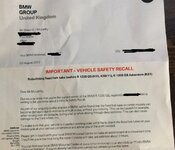
Came in the post today... love the pot holes bit, its the UK so thats just about everyone!!!
 

Attachments

  • bmw.jpg
    bmw.jpg
    108.2 KB · Views: 414
Took my bike in for the recall today (scheduled by BMW several weeks ago) and was told that they don't have the parts! Will 'get another call' when the parts are delivered and need to book in, again. What a waste of a booking and my time. BMW need to ensure that they have parts for customers they've booked in for the scheduled recall.

That being said, they couldn't get the smallest of feeler gauges in, so my MY2017 TB GS was well within spec after 8k miles. Regardless, it seems important for safety to get the supporting bush/clamp installed. BMW need to get the booking process improved.

If your bike has been booked in for the recall, call them ahead to ask if they actually have the parts in stock...
 
I received the recall letter this morning... it wasn't redacted like the one above. Is wokkaman a secret agent?
Alan R
 
When I went out yesterday, I also conducted a test. To see how hard the front wheel slams down when the ABS cuts in, on hump back bridges and crests in the road. The answer, very hard. No wonder there's an issue.

Hooligan! :)
 
Got my letter this morning.

One BMW Dealer STILL doesn't have any stock of the collars and suggested I call back in 2 WEEKS time

One BMW Dealer's machine that fits the Collars is Broken. Suggested I call back in 1 WEEKS time.

What a complete shambles :blast
 
Estimated 3 Hours work for every bike. That's a hell of a lot of wasted BMW Paid Man Hours.

Plus an extra 1 hour (at least) of customer inconvenience getting their bike back and forth from the dealers.

How many bikes were affected by this again? :blast


Back
Top Bottom