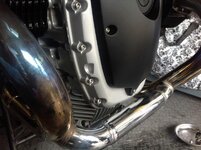
Front engine case q

Piston broke

Member
UKGSer Subscriber
Joined
Apr 19, 2016
Messages
46
Reaction score
0
Location
bishops stortford England
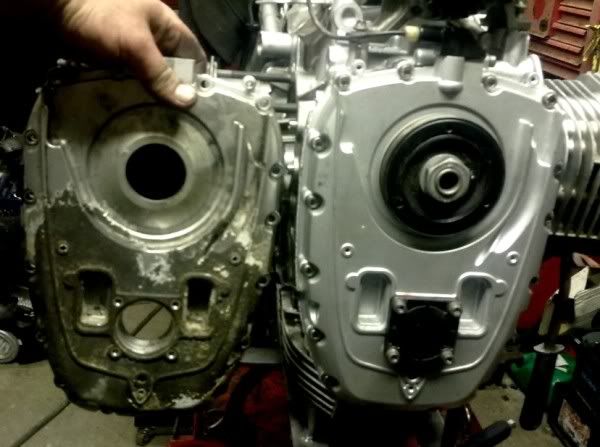
Have recently bought my first gs, and it has the usual corrosion on front engine case.

So the question, how difficult is this to remove / refit
And is powder coating the best option?

Thanks in advance Dave
 
Have recently bought my first gs, and it has the usual corrosion on front engine case.

So the question, how difficult is this to remove / refit
And is powder coating the best option?

Thanks in advance Dave

Ukgser's resident 1200gs corrosion and refinishing expert will be able to help you with this one .:D
Bendy to the front desk please.
 
If you are good with spanners It's okay

Although The front covers weren't too bad price wise and cheaper than blasting and coating last time I checked for someone

edit Yes 70 quid for up to 2007 (i.e. a Mk I 1200 Hexhead )

LINKY

Image0259.jpg


DSC02352.jpg


Image0261.jpg
 
Front cover

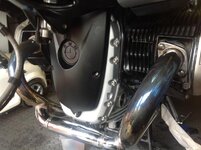
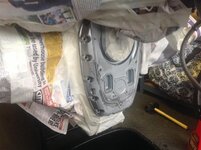
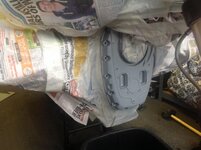
There are many posts on here if you search on the merits of paint v powder coating . I painted mine in place .... Spend time preparing , prime with etch primer and halfords smooth silver is an excellent match ... Enjoy !! Oh and treat yourself to some stainless bolts to finish it off.
 

Attachments

  • image.jpg
    image.jpg
    61.4 KB · Views: 738
  • image.jpg
    image.jpg
    59.4 KB · Views: 897
  • image.jpg
    image.jpg
    55.6 KB · Views: 728
  • image.jpg
    image.jpg
    64 KB · Views: 740
I tried to buy a new one last year, on back order for months, none in the countryy I was told then none in Europe, ffs
In the end I cancelled the order and mikeyboy powder coated mine when it was being serviced, sorted and still nice a year later.
 
I had mine powder coated but the bottom edge where corrosion was worst has gone bubbly as the corrosion pits cant have been fully cleaned out. Next time I would chemical stop it (Biostrip) just the same, but would have grit blasted and heated to remove all posture etch then etch prime and paint. This is easy to touch up if needed. Powder coat is not repairable.

This pic shows how the corrosion has started from the under the plastic belt cover, but the bottom centre is untouched The problem is corrosion from around the steel screw holes and the edge of the belt cover fretting at the paint. I have trimmed the belt cover edge and put washers under the screws. The keeps the edge from touching and damaging my nice powder coating.

attachment.php
 
The covers also corrode badly at the top where the crank position sensor fits. It can be bad enough to cause eat sensor O ring to leak.

IMO it is false economy to paint the cover in situ. Just remove it from the bike and do the job properly. You can also file the sharp edges at the joint face. Then paint the joint face and the front face. This stops corrosion geeing under the paint from the bare metal at the machined joint. The cover has no precision alignments so use a good quality anaerobic gasket sealer and it will be fine. IMO Loctite 518 is the best option.

Always use the correct etch primer and use anti seize paste all the way up the screw heads so any metal to metal contact is protected. Doing the screw threads only is not enough.
 
I had mine powder coated but the bottom edge where corrosion was worst has gone bubbly as the corrosion pits cant have been fully cleaned out. Next time I would chemical stop it (Biostrip) just the same, but would have grit blasted and heated to remove all posture etch then etch prime and paint. This is easy to touch up if needed. Powder coat is not repairable.

This pic shows how the corrosion has started from the under the plastic belt cover, but the bottom centre is untouched The problem is corrosion from around the steel screw holes and the edge of the belt cover fretting at the paint. I have trimmed the belt cover edge and put washers under the screws. The keeps the edge from touching and damaging my nice powder coating.

attachment.php

Mine is worse than this, but all the corrosion seems to have started at fixing points
 
Last edited:
When you do take it off 1/2 your engine oil will pour out so time the job with an oil drain change.

I never made this mistake and poured oil all over the garage floor :blast
 
On the galvanic scale... Mild steel is less reactive with aluminium than stainless steel so surely that's the better option?

I always thought so and it explains why engine case screws can be rusty. But it doesn't explain why some of them have had enough alloy corrosion to cause problems. It also doesn't explain the sometimes considerable aluminium corrosion from around the screws on BMW front covers.

Stainless certainly will cause galvanic corrosion on aluminium and that can seize the fattener solid. I always use a high spec anti seize paste/grease all the way up the bolt and under the head. I do this with stainless and zinc plated mid steel fasteners. I have also used copper washers under the M6 screw heads. To date nothing seems to have changed. The alloy looks fine and the screws are fine and there is not blue copper staining. Have I found "the cure" who knows. Perhaps the metallurgists can explain the benefits or folly of the idea.
 
Repainting your timing chest

Heres one of the original posts (how to) on the subject by me :D

http://www.ukgser.com/forums/showthread.php/136102-Front-cover-corrosion-pics

Hope you find some useful info there, painting is the way to go imho, it is indefinatly touch-up-able unlike powder coat which involves removing the case and all that involves and is not easy to maintain.

I would not mask to the edge of the cover it will leave an obvious demarcation, mask the barrels if they are a different colour otherise just let overspray on to the crankcas join for a better effect.


.
 
After reading all the good stuff on this subject,
I think I will go the etch primer and paint route, but will remove from machine
I think it will be easier to prepare for paint on the bench.

Thanks again for reply's
 
I had mine powder coated and it does look really good. But that blown area (probably caused by corrosion pits) is not repairable. It would have to be re coated.

If I ever do need to redo it (or indeed another cover), I will use paint and etch primer. Also I will round off the cut edge with a fine file and paint the joint faces to avoid creeping corrosion at the the joint face.

On the other hand I had my swing arm and FD case powdered and they look really great in a high gloss finish. No problems after 6K miles and 18 months of use. My mileage is silly low these days. That job just has to stop.
 
As per the OP, there are loads of how-to for painting the cover in-situ - but is there a how-to for removing the timing cover ?
 
TBH, I used a Haynes manual though it's no help when you can't get your 33mm socket on the timing gear nut.
Basic process:
Remove alternator belt cover front and top
Remove alternator belt
Remove pulley nut. I have the bike on side stand with bricks chocking the back wheel. Weight of the bike allows enough space for the socket and long breaker bar. Put left foot on back brake with box in top gear.
Drain the oil.
Remove all cover screws
Remove the cover. DO NOT disturb the timing gear.
I removed the petrol tank because the crank position sensor was too tight to shift otherwise.
Bad corrosion pits will need to be properly cleaned out, etch primed and filled. If it's bad it's not suitable for powder coating.
While it's off fit a new oil seal and sensor O-ring. I's very easy to flip the oil seal edge. I found it more reliable to fit the seal after fitting the cover to the engine.
The pulley nut torque is on many bike spec websites. I do mine in two stages with the same chocked wheel and back brake method.
The alternator cover edge frets against the paint. I trimmed off the thin edge and sat it on washers so it can't rub. The three cover screws also corrode.
I used Loctite 518 on the joint face. It's important to get that right as it includes oil galleries to the cylinder heads.
Use a good quality anti seize paste on the cover screws all the way up to the head. I've also used copper washers. I've had no more corroded screws but don't know if that's because of the washers or the high quality copper paste.


Back
Top Bottom