Fuel + spark + air = no combustion

SimonSays

Registered user
Joined
Aug 29, 2017
Messages
23
Reaction score
7
Location
Surrey, UK
Hi - this exact post was also made to R1200GS.info so apologies if you see this twice…

Hey all - 2008 GS, ran without any problems for years of ownership and then one day wouldn’t start. It ran and stopped, then coughed on turnover but no start… and then just turned over with no sign of life.

I changed the fuel pump over as I happened to have a new one and the priming-on-ignition sounded a bit weedy. That made no difference aside from removing that maintenance item from the near-future.

For one reason or another it then sat for around 18 months in a dry workshop, on a battery charger - and I’ve just managed to get back to it this weekend. Here’s what I’ve tested:

  • Fuel pump - the connections on my fuel pressure meter have gone, but judging by the enthusiasm or the fuel spurting out of the bad joints, there is pressure there;
  • Injectors - pulled the injectors from the throttle bodies on both sides and fuel is spraying out of both on turnover. I’ve no point of comparison to say whether it’s the right amount of fuel coming out or at the right time, but there is fuel getting into both cylinders;
  • Spark Plugs/coils - pulled all 4 plugs, cleaned and spark tested in the coils against a ground. All 4 sparking (the secondaries looked like stronger sparks FWIW). Again, I’m nit sure how I can measure the strength and timing of the sparks but there are sparks in both cylinders.

I don’t have the kit to measure compression but there is compression based on a basic covering the spark plug cavity with hand on turnover test.

I don’t have a GS911 to read any error codes - if anyone knows of one in my area (Godstone, Surrey) I’d love to talk to the owner 👍

Cheers
 

Fuel + spark + air , no combustion = check compression​


no tester - try to bump start it - if 1 and 2 lock the back wheel up, and by 3rd it turns over you probably have normal compression - if you can turn the engine over easily on the centre stand when in 1st gear by turning the back wheel, pull rocker covers off and look to see if valve train is opening and closing - might as well check valve clearances

a compression tester is a simpler way
 
Last edited:
no tester - try to bump start it - if 1 and 2 lock the back wheel up, and by 3rd it turns over you probably have normal compression - if you can turn the engine over easily on the centre stand when in 1st gear by turning the back wheel, pull rocker covers off and look to see if valve train is opening and closing - might as well check valve clearances

a compression tester is a simpler way
Thanks - got compression... valve clearances checked.

How old is the fuel, see if your lawnmower will still run on it. :)

Fresh! My lawnmower will run on anything so that wouldn't be a good test anyway 🤣
 
Check that both throttle cables are seated correctly in the plastic splitter box beneath the fuel tank, check them all the way to the throttle bodies. Be sure the cable ends at the throttle bodies are correctly seated in their respective adjusters.
 
Pull a fuel injector out of the throttle body and pour in some neat fuel and press the starter and see if it briefly fires on that cylinder
 
You sure it didn’t conk out 18 months ago after adding the wrong fuel eg diesel ?

Are you sure you set the valve clearances on the compression stroke and not the exhaust stroke ?

Not trying to teach you to suck eggs or cause offence, just hoping to help eliminate stuff.
 
You sure it didn’t conk out 18 months ago after adding the wrong fuel eg diesel ?

Are you sure you set the valve clearances on the compression stroke and not the exhaust stroke ?

Not trying to teach you to suck eggs or cause offence, just hoping to help eliminate stuff.
None taken!

It’s definitely not had the wrong fuel in it. And aside from the inevitable self-doubt (just because you asked), I’m certain the valve clearances were set on TDC compression stroke. Supporting evidence for that is that there was almost exactly the correct gap on both ports and sides when I checked/set them and you have to back the screws almost out to their stops to get any gap set on the exhaust stroke, I recall from a previous check.

Check that both throttle cables are seated correctly in the plastic splitter box beneath the fuel tank, check them all the way to the throttle bodies. Be sure the cable ends at the throttle bodies are correctly seated in their respective adjusters.

Yep - done 👍
 
Pull a fuel injector out of the throttle body and pour in some neat fuel and press the starter and see if it briefly fires on that cylinder

I will try that but I’ve run out of time today. Off for a week away tomorrow AM and I’m being encouraged to contribute to the prep for that… 😭
 
I’ve also tried bypassing the Fuel Pump Controller (ie. Wiring the pump directly to the ignition). Priming sounded more enthusiastic (I tested just over 10V coming out of the controller, vs the ~13V from the ignition) but still not so much as a cough. As a point if interest, I read that the blue wire is hot coming out of the pump controller but it’s definitely yellow that is hot on mine…

I also borrowed a camshaft position sensor to rule that out - I’ve ruled it out (although I did get some slight coughing when I first changed that). I’ve got a borrowed crank shaft sensor as well but I may not get time to test that today. Would I even get a sparks at the plugs if the crank sensor was fritzed?

I’m aware that I need to pressure test the pump output - although I replaced the pump myself when the problem first occurred 18mths ago - but I can’t seem to find the correct fuel couplings to put onto my pressure rig… and I’m not super-happy about the idea of paying £110 for a set of metal ones/£40 for a pair of plastic ones.

Any wisdom on a workaround for the pressure rig? I suppose I’ll have to use clips and brass hose unions to make a semi-permanent arrangement for the pressure test if I can’t find reasonable connectors.
 
The Q/D fittings are the easy route but expensive, you could remove the hose from the delivery line Q/D and fit a T for the gauge feed .
Don`t be tempted with the Chinese look alike Q/D connectors as they are 0.5mm different in size ,:blast don`t ask me how I know.
This was a temporary lash up before fitting a permeant gauge on the dash. Used small nylon tube to gauge with push fit connectors.

Screenshot 2024-08-23 074200.png
 
Last edited:
Don`t be tempted with the Chinese look alike Q/D connectors as they are 0.5mm different in size ,:blast don`t ask me how I know.
Don’t ask me how I know you’re right! 🙄

Thanks for the above - this is what I’ll do… can you recommend (sizes at least) of T I should source? And you’ve just closed the gauge output line (or yours isn’t a through/inline gauge like mine)?

Cheers
 
I have a big Kit with loads of fittings and large gauge.
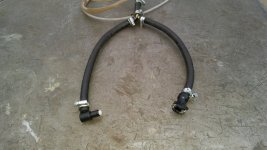
Here is a photo of the temporary fitting hose with Q/D`s .
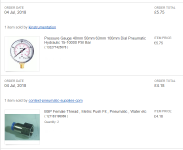
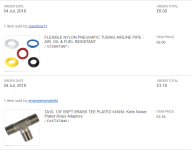
Also 2 photos of the parts used for the permanent installation parts from ebay.
As you can see the permanent gauge has been on for 6 years, as the bike has done over 100k miles it has proven handy a few times.
20181109_085409.jpg

Gauge & fitting.PNG
Gauge & fittings 2.PNG
 
I have a big Kit with loads of fittings and large gauge.
Here is a photo of the temporary fitting hose with Q/D`s .
Thanks for the pics and detail! I’ll follow suit when I’m back…

Of course, diagnosing the fuel pressure is only going to be stage #1 as I’ve already replaced the pump… if the pressure is good (~100PSI?) then I just go further down the system. Regulator would be one suspect given that both cylinders became inactive simultaneously.

If the pressure isn’t good then I suppose I’ve not replaced the pump correctly or the new pump is also frizzed but it wasn’t a complex operation so that’s not my primary thought.
 
If you have a good spray at the injectors I would doubt it would be the pump.
But ... I fitted a cheap ebay pump around £24 and the fuel pressure was too high. ( should be 3.5 bar pre- twin cam and 4 bar twin cam).
The pump delivered 8 bar with the return blocked ( This is what the relief valve in the pump was set at).
With the regulator in circuit it was over 5 bar. problem turned out to be the pressure relief valve orifice in the ebay pump was a lot smaller than the oem pump and it was swamping the pressure regulator.
Ended up purchasing an OEM pump from Motorworks It turned out to be made by the same people as oem with the right lower pressure relief and large orifice in the pressure relief.
I had one pump start to lose pressure 80 miles from home it was down to 1 bar by the time it limpet home but it was still running ( just).
 
Update:

I have tested the fuel pump pressure - slightly under ~90-95PSI observed under cranking.

I think this rules out the fuel pump? I think it also rules out the fuel pump controller (which I had bypassed as an easy test anyway, so I'm now pretty confident that isn't the issue either).

Moving further up the fuel system, I'm thinking the next suspect is the fuel pressure regulator? A failure there would explain both cylinders dying simultaneously...

Thank you, folks!

Fuel pump pressure video
 
can't we pull an injector connect everything else as normal and press the starter button and see if its spraying a decent pattern - then do the other side for good measure?

if yes - re check spark,

if both those behave likely mechanical fun that lays unresolved... when doing the valve clearances did you observe all 8 open and close and nothing bent, no funny clearance readings etc.

...if that was OK - come back with compression PSI both cyls after 5 seconds each

and or

crank and cam position sensors need attention
 
can't we pull an injector connect everything else as normal and press the starter button and see if its spraying a decent pattern - then do the other side for good measure?

if yes - re check spark,

if both those behave likely mechanical fun that lays unresolved... when doing the valve clearances did you observe all 8 open and close and nothing bent, no funny clearance readings etc.

...if that was OK - come back with compression PSI both cyls after 5 seconds each

and or

crank and cam position sensors need attention
I'd already pulled both injectors and observed fuel emitting from them, but have just re-pulled and sprayed onto some dry blue-roll to get a slightly more quantitative idea... interesting:

The left (clip here) seems to be pretty even - I've no idea about volume but it looks like a feasible amount to me.

The right (clip here) looked to me as if it splurged to begin with and the bike actually started coughing (the left injector was reinstalled at the time) once the 'splurge' happened. The blue-roll was at a more oblique angle to the injector on the right (only one pair of hands to hold, film and operate the starter!) so the pattern looks worse than the left but the visible spray itself seems conical after the initial.

You can hear the bike start to cough after the right hand injector splurges and it's now sounding like it's firing on one cylinder during turnover but still won't run. Progress, though.

Fuel system blockage looking more likely as a contender?

FWIW, I've already swapped out the cam sensor for another one and it made no difference (prior to today's maintenance). It looks like getting to the crank sensor bolt is a right b&stard so i'd be delighted to find the problem before getting to that 😬

For completeness: primaries rechecked for spark. All valves observed moving and all clearances were broadly correct when I checked them (I adjusted them even so). No sign of anything seriously amiss like bent/broken stems. I don't have a compression meter but have just ordered a modest one to test this at the weekend.
 
For one reason or another it then sat for around 18 months in a dry workshop, on a battery charger - and I’ve just managed to get back to it this weekend. Here’s what I’ve tested:
👍

Cheers
modern fuel is TERRIBLE, bike shop near me says it doesn't last 28 days and budget garages get 3 week old fuel when its pumped in !!! - now that's pushing it in my mind - but 3 months and ethanol infected rot is trash - 18 months likely won't burn nicely - if its not just jelly and acetic acid rusting the insides of the pump and injectors

get the old stuff out and throw in a skip / mix with 10 gallons of good stuff for a car.... and fill the bike with fresh BP 97 on an empty tank and purge the rot out before trying to start it - you might get lucky !!!
 
I’ve already emptied and refilled the tank… I’m also wondering if what is in the lines, regulator and injectors is jelly.

Is there an easy way to clear the fuel system through without dismantling it? I’m sure the answer is no but I like to amuse myself by asking…


Back
Top Bottom