Gamin 276

  • Thread starter Thread starter koelblin
  • Start date Start date

koelblin

Guest
Hi everyone!

I need a GPS unit for my motorcycle and was about to buy the 2610. However there are a few things I really like about the 276:

1. Bigger display.

2. It seems that the maps are more colourful and nicer to look at. Maybe I'm mistaken by the standard picture of the 276 which displays a sea map? Does a map from City Select / City Navigator look the same as on the 2610?

3. Although PanEuropean warns about not having the "right tool for ones purposes", I quite like the idea of having the option to use my 276 occasionally on my small boat. (Main use would be on my motorcycle though.)

However, some issues make me think and maybe there is somebody out there who had the same worries and wants to share the answers:

1. Memory. When you buy the 276 (without automotive kit), does it come without data card at all? Or does it have the standard 128MB data card?

2. Could I upgrade the 128MB with a 3rd party data card, e.g. offers like this one on eBay: http://cgi.ebay.de/ws/eBayISAPI.dll?ViewItem&category=10665&item=5702295577&rd=1&ssPageName=WDVW ?

3. In one of the threads I red a description of what the different MapSource products are capable of. PanEuropean wrote (I hope I remember correctly) that the City Navigator is the ONLY one that offers voice prompts?? Does that mean I would not hear somebody telling me "In 200 meters left" if I used City Select on my 276?

4. If I bought the European automotive kit (City Select Europe) and in addition spend some money on the Worldmap, would it make sense to get the 276 from the US with a US basemap? (I'm aware that the Worldmap does not the same job as the basemap in terms of autorouting.)

5. Would the 128MB data card be enough to store the Worldmap plus a considerable part of Europe? Or should I plan to invest in a second/bigger data card?

6. Is there any difference between 2610 and 276 in terms of data processing speed?
 
Good luck getting all the answers...

Can of worms springs to mind...

I'd buy the 276C over the 2610 coz I also want to use mine on boats. But I am unable to answer your questions...

I have used a 2610 and a 60 which is a very small brother of the 276. It is just as quick as the 2610 on my field test but I have not timed it...
 
Koelblin:

I'll try to answer some of your questions. A good source of information about the issues you raise is the topic Garmin 276C. I can see that you have been through that thread already, I'm just putting the link here in case someone stumbles across this thread in a month's time, and the Garmin 276C discussion has by then rolled off the first page.

1) Visual Display - 276C vs 26xx The display on the 276 is much higher quality than the display on the 26xx, simply because there are more pixels per square inch on the 276C display. Both of these units use the same number of colours in the palette that they draw the picture with, so no difference in that respect.

My experience (one month of a 296 on the bike, almost one year of a 2650 on the bike) is that the 276/296 screen display is more detailed, and under some circumstances can be easier to read in daylight, but the 26xx screen is easier to read when the sun is behind you, because the 26xx screen has sort of a matte finish on it, whereas the 276/296 screen has a shiny finish.

From a point of view of "getting you where you are going", they are both up to the task. I own both units (296 and 2650) - when I go out riding on my motorcycle, I always take the 2650, it's easier to operate on the bike and gives me more capabilities (for example, customizing my routing preferences). It's also smaller - it doesn't stick out like a racing dog's balls when I mount it on the handlebars.

2) Primary Use The 276 was designed to be a primarily marine GPSR. The 296 was designed to be a primarily aviation GPSR. The 26xx series were designed to be automotive GPSR's. The 276 and 296 can accomplish most, but not all of the tasks that the 26xx series can do. The pure automotive GPSR's - such as the 26xx - offer more software functions that are specific to automotive navigation. The 276 and 296 offer a full selection of software functions appropriate to marine, or, aviation and marine navigation, and MOST of the functions appropriate to automotive navigation.

Just in case the message isn't clear - remember, the PRIMARY design consideration for the 276 was marine use. Automotive use on the 276 and 296 is a 'secondary bonus'.

3) Data Cards

I don't know what size of data card the 276 and 296 ship with, if in fact they even ship with a data card at all. But a quick look at the Garmin website will give you the answer to that question. Garmin has in the past increased the size of the data cards that GPSR's ship with over the history of the product - the early SP III's shipped with a 32 meg card, today they ship with 128 meg cards. The size of the data card included with the GPSR can also vary by region - for example, SP 2610's sold in North America ship with a 128 meg CF card, but some of the GPSR's based on the SP 26xx platform sell in Europe with a 256 meg CF card. So check the Garmin website for up to date information.

4) Voice Prompts

Whether the GPSR will give voice prompts depends on the (internal) software in the GPSR, not so much on the mapping product. AFIK any GPSR that supports automatic route calculation and ships with a speaker will provide voice prompts from either CityNavigator or CitySelect cartography. Whether they will provide voice prompts from MetroGuide cartography (assuming a manual route has been created and is active) or from WorldMap cartography (same assumption) I don't know - I've never tried it.

I was in South Africa last month, using the 296 with CitySelect South Africa, and it gave me voice prompts when in automotive mode.

5) Data Storage Needed

A 128 meg data card is only sufficient for local (domestic) navigation in Europe, it's just not big enough to support international touring. For international touring in Europe, with autorouting capability, you need at the very least a 256 meg data card, but ideally a 512 meg or 1 gigabyte data card. It's a pretty safe bet to expect that the minimum required sizes of data cards will increase yet again when the next version of the mapping products is released - this has been the historical pattern.

6) Processor Speed

My experience observing the 296 and the 2650 is that they both take about the same time to calculate a route. Garmin does not advertise processor speed for the GPSR's, because it can be very misleading - many other factors affect route calculation speed besides the hardware itself.

Suffice to say the 276 - 296 - SP 26xx units all have similar speed of performance for automotive navigation purposes.

Hope this helps you,

PanEuropean
 
PanEuropean said:
[B}
Hope this helps you,

PanEuropean [/B]

Top man. Always delivers. If there were Oscars for GPS advice this man would be up there on the podium.
 
Thanks Whatton, it's very kind of you to say that.

In my "day job", I spend a lot of my time in classrooms and simulators training pilots to use the Garmin 430 and 530 Flight Management Systems - these are the professional panel mount devices that are installed in the aircraft. I really have no recreational interest in the aviation side of GPS, that's just "plain work" for me.

My hobby during my time off is riding my moto, and I enjoy using GPSR's to help me find the twisty roads, and ride more of them every year - I average about 20,000 miles a year of touring. I'm happy to have discovered this GS board - of all the moto BB's around, this one has the most active and most interesting discussions of GPSR use on motos.

I'm also thinking of perhaps trading in my ST1100 for a BMW dual sport moto sometime in the future - so I might come back to all of you for advice about that purchase in the future.

PanEuropean

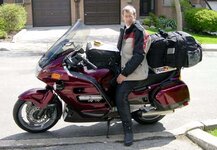
PS: Yeah, I know it looks overloaded, but this was the first day of a 4 month tour through Central Europe last year...
 

Attachments

  • 640 wide.jpg
    640 wide.jpg
    62.2 KB · Views: 168
Thank you guys very much for all that information! It was really helpful.

I think I will go ahead with my idea to get the Garmin 276C. (I don't mind not having the option to exclude certain roads or other custom routing preferences.)

I ride a Yamaha 1100A Classic and wonder which one of those many mounts would be the right one for me. I read somewhere that the shock-absorbing Touratech mounts are not really necessary for someone who stays on the road. (And I better should with my bike!)

What different additional parts does one need in order to fix the 276C on the handlebar? (RAM arm + plate?) I would prefer to have the GPS as close to the handlebar as possible. (Compared to it being elevated and closer to my eyes.) (I don't use my tank rucksack very often and there are no other obstructing objects on top of the handlebar. I guess that makes things easier.)

Here's a picture of my bike (not ideal for giving advice on a mount, I know):
http://www.mv-kollmarsreute.de/images/001 image0001.jpg

And here is a 360 degree view:
http://www.yamaha-motor.com/products/mcy/media/vr/04/vstar11classic/vstar11_vr.html#

Explicit views and general comments appreciated!
 
koelblin asked:
What different additional parts does one need in order to fix the 276C on the handlebar?

The 276C comes with a very nice marine mount. For use on your mc you can take most of this off and Ram202 will attach directly to whats left.

http://www.rammount.com/ramwebcompthumb/ram202.jpg
 

Attachments

  • dscf0097.jpg
    dscf0097.jpg
    24.1 KB · Views: 132
Koelblin:

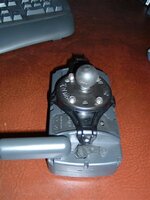
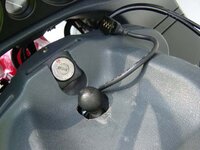
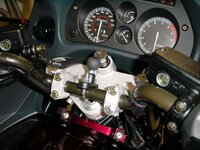
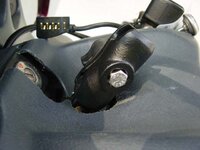
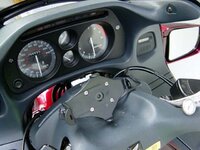
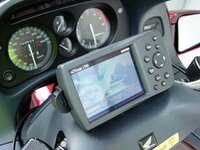
Here are some additional photos showing how I attached a 296 (same form factor) to my motorcycle. Hope these are of use to you.

In addition to the "marine mount" that Garfieldus mentioned (I think that this part comes with the kit), there is a "yoke mount" available for the aviation models (196, 296) that could perhaps be worth considering if you want a one-piece installation that you can just clamp onto the handlebar, then remove when you don't want it there. The yoke mount is designed for aircraft installations, but can be used on any moto that has an exposed tubular handlebar.

PanEuropean
 

Attachments

  • 296c moto mount 3.jpg
    296c moto mount 3.jpg
    35.5 KB · Views: 119
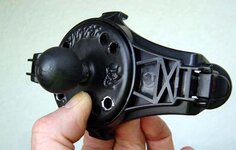
This shows the "other" RAM ball, which is attached to the tubular handlebar.
 

Attachments

  • ram ball.jpg
    ram ball.jpg
    51.6 KB · Views: 115
This shows how the ball in the photo above attaches to the tubular handebar. This is a RAM part.
 

Attachments

  • ram-mount ball install.jpg
    ram-mount ball install.jpg
    45.2 KB · Views: 114
You can then use a RAM arm to connect the ball on the motorcycle handlebar to the ball on the back of the mount. The arms are available in different lengths, 1.5 inches, 3 inches, and 6 inches. They are not that expensive so it probably makes sense to order both a 1.5 inch and a 3 inch one, that way you can experiment to get the fit and positionning you want.

When ordering RAM parts, be careful to make sure that all the parts you order are for the same size ball head. RAM makes three different size balls - the one inch ball is the most suitable for motorcycle GPSR use.

Also, RAM makes the arms in either cast metal or high impact plastic. I prefer the high impact plastic, because it doesn't chip and look scrappy after a while. Both are solid black and pretty much look identical.
 

Attachments

  • ram arm.jpg
    ram arm.jpg
    40.3 KB · Views: 112
It's quite important to ensure that you have the ability to tilt the GPSR up and down through about a 30° arc once it is in place, this allows you to adjust it to reduce light reflections off the screen - a fairly annoying problem when riding eastbound in the afternoon. Hence the suggestion to get the two different sizes of arms - it's possible that the shorter arm will give a neater fit, but not allow the required room to tilt the unit. Depends on your handlebar design.
 

Attachments

  • 296c moto mount 5.jpg
    296c moto mount 5.jpg
    51 KB · Views: 109
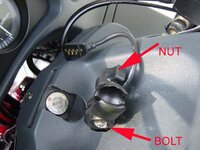
After you have had the whole kit installed on your bike for a few hundred miles of riding, you can, if you wish, remove the bolt and thumb-turn nut that RAM supply, and replace them with a bolt that uses an Allen head and a conventional (rather than thumb-turn) nut. This will give you a better level of protection against theft of the bracket and RAM arm assembly, so you don't have to worry too much about removing these components from the moto when you park it.
 

Attachments

  • bolt and nut.jpg
    bolt and nut.jpg
    55.6 KB · Views: 108
If you are not familiar with the RAM Mount product line, you can view their catalog on-line at this link: Ram-Mount Catalog.

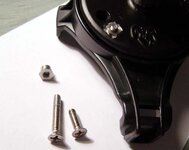
When ordering, ask for a package of bolts and special nuts that are used to secure the Garmin bracket to the RAM backing plate. These are provided at no charge. If you use the fasteners that RAM supply, the back side of the mount will then have flush-mount nuts (they are special well nuts) that do not stick out and catch clothing, gloves, keys, etc. on your motorcycle.

The photo below shows the longer of the two bolts installed. The longer bolt is used for the SP 26xx series, the shorter bolt for the SP III and 276/296. When the shorter bolt is installed on the 276/296 mount, everything is flush.
 

Attachments

  • ram fasteners.jpg
    ram fasteners.jpg
    30.4 KB · Views: 68


Back
Top Bottom