Graphs at last

Speedy1959

Registered user
Joined
Apr 14, 2015
Messages
202
Reaction score
0
Location
Stalmine, Lancashire
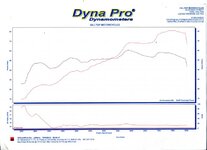
I have been meaning to put my before and after "Hilltop" graphs on here for ages.. The problem is that I dont have a scanner..
I finally remembered to take the graphs to work and scanned them today.
You can see at the bottom of the original "Before" graph that the mixture is weak by default (as Geoff said)..
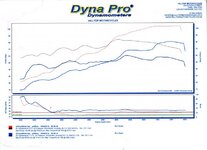
The 2nd graph shows both before and after..
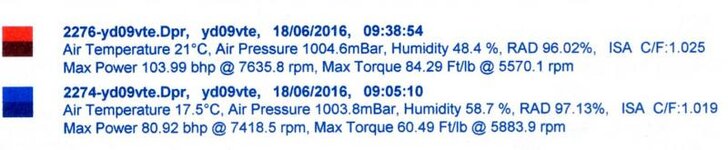
Blue & Dark Blue are before (Blue = Power, Dark Blue = Torque)
Red & Brown are after. (Red = Power, Brown = Torque)
 

Attachments

  • Dyno 1.jpg
    Dyno 1.jpg
    41.6 KB · Views: 456
  • Dyno 2.jpg
    Dyno 2.jpg
    53.6 KB · Views: 433
What are the figures cant see when you zoom in.


Sent from my iPhone using Tapatalk
 
I have been meaning to put my before and after "Hilltop" graphs on here for ages.. The problem is that I dont have a scanner..
I finally remembered to take the graphs to work and scanned them today.
You can see at the bottom of the original "Before" graph that the mixture is weak by default (as Geoff said)..
The 2nd graph shows both before and after..
Blue & Dark Blue are before (Blue = Power, Dark Blue = Torque)
Red & Brown are after. (Red = Power, Brown = Torque)

These graphs show a limited amount of information but still raise questions.

First, notice that from 2000 RPM to about 3500 RPM, the AFR is artificially high. There is no chance that the actual AFR was upward of 18-19:1 at WOT at 2000 RPM. (At an AFR of 22:1 it's fresh air.) What's happening is that the TB and intake tract is recharging itself with fuel and having been starved while the bike decelerated from the prior run. This can be overcome by applying a small load at 2000 rpm and insuring that the bike is in closed loop at 14.7:1 before the throttle is opened.

Since it takes a while to re-wet the intake tract, the points from about 3500 rpm onward seem to have a stable AFR. However, was the AFR probe at the exhaust outlet? I'm betting it was and that the catalytic converter made both sets of readings appear leaner than they actually were.

At WOT from 3500 rpm to 7500 rpm, it takes the engine only a couple of seconds to spin up the Dyno drum. During that time" only about 5 points of the roughly 300 in the fueling map are tested. So we see little of the changes to the fuel or spark maps.

Going further, the before AFR from 4000 to 7500 rpm was measured at about 14.5:1. If you put Wideband probes ahead of the cat, you would see much richer readings. More likely around 13:1 or richer, I say this based on measurements from several R1200s measured on the road, as opposed to the Dyno.

Therefore these graphs say that by richening the fueling from 14.5 to 13.5, and whatever changes to spark advance, the torque increased by about 40% at 6500 rpm or about 30%-plus from 4000 to 7500 rpm, does that sound right to you?

I don't mean to suggest that your bike hasn't changed and that it isn't better since your trip to Hilltop, that's for you to tell us. All I'm trying to explain is what the graphs show.

 
600cc is a big cylinder so relatively small mixture weakening can make a big difference.
The power increase when the very weak 4000 to 5000 range is included will be high because the OEM map has a huge flat spot.

Why don't you visit hilltop and discuss your issues? Even better do some physical tuning on the cylinder heads, air intake etc and then get Geoff to do a remap. The gains could be even better.


Sent via iPhone so expect strange words
 
These graphs show a limited amount of information but still raise questions.

First, notice that from 2000 RPM to about 3500 RPM, the AFR is artificially high. There is no chance that the actual AFR was upward of 18-19:1 at WOT at 2000 RPM. (At an AFR of 22:1 it's fresh air.) What's happening is that the TB and intake tract is recharging itself with fuel and having been starved while the bike decelerated from the prior run. This can be overcome by applying a small load at 2000 rpm and insuring that the bike is in closed loop at 14.7:1 before the throttle is opened.

Since it takes a while to re-wet the intake tract, the points from about 3500 rpm onward seem to have a stable AFR. However, was the AFR probe at the exhaust outlet? I'm betting it was and that the catalytic converter made both sets of readings appear leaner than they actually were.

At WOT from 3500 rpm to 7500 rpm, it takes the engine only a couple of seconds to spin up the Dyno drum. During that time" only about 5 points of the roughly 300 in the fueling map are tested. So we see little of the changes to the fuel or spark maps.

Going further, the before AFR from 4000 to 7500 rpm was measured at about 14.5:1. If you put Wideband probes ahead of the cat, you would see much richer readings. More likely around 13:1 or richer, I say this based on measurements from several R1200s measured on the road, as opposed to the Dyno.

Therefore these graphs say that by richening the fueling from 14.5 to 13.5, and whatever changes to spark advance, the torque increased by about 40% at 6500 rpm or about 30%-plus from 4000 to 7500 rpm, does that sound right to you?

I don't mean to suggest that your bike hasn't changed and that it isn't better since your trip to Hilltop, that's for you to tell us. All I'm trying to explain is what the graphs show.

Intresting reading...

A Hilltoped bike feels better, it does not feel massively more powerful, it just feels better and they seem to perform very well...

There is a lot of talk about how can a remap produce such dramatic increases from my perspective the end result graph seem to reflect how the bike feels so maybe the question is do the before runs really reflect the before and your post suggests that being a little hurried on taking the first readings could give the wrong 'worse than it really is' readings.

Hilltop buyer types
Those that want to see an improvement on paper
Those that want the end result
Those that wanted to see an improvement on paper but then realised that was shallow and it's all about the end result
 
I don't care about max power bragging rights, if I did I wouldn't have a GS! But since Hilltopping my bike is smoother, more responsive and definitely faster. Peak power isn't an issue as I don't often rev it past 7,000. The only slight downside is that throttle response at low revs is slightly snatchy, but I'm more than happy with that trade off. My dyno curves are similar to the OPs though a tad less lumpy and slightly lower power and torque (on the original exhaust)
 
..

Why don't you visit hilltop and discuss your issues? Even better do some physical tuning on the cylinder heads, air intake etc and then get Geoff to do a remap. The gains could be even better.


...

It's a long ride from Boston, MA. ;) But to your point, my comments about the Dyno charts apply to most that I see, not unique to Hilltop. My physical tuning is all set. I used the good VE map from the factory, required the coils for more voltage and richened it all by 8%. My bike pulls like a tractor in all gears from about 2K on up.
 
Let's not get all defensive.
All Roger is trying to do is explain the ins and outs of dyno maps. No one is saying that a Hilltop re map doesn't produce the goods. Any more or any less than a PCV or AF-XiED units do.
I find it interesting to learn about the pros and cons of using a dyno. Bit like learning how changing jets or tweaking your ignition settings in the olden days.
If anyone else can explain them any better, then lets hear about it.
 
The other "Little" thing to note is that my bike DID NOT HAVE A CAT!!!
So the blurb about cats means didly squat!

Okay, since you don't have a cat, it means the 14.5:1, "before" AFR measurement is less plausible. If you take a stock R1200 and measure AFR on the road at wot you'll find it runs in the low 13s or high 12s. Mistacat has a lot of data from his bike and I've published data from other R1200s.
 
AAAAAaaaaaarrrrrrgggggghhhhhhhh...........

No

AAAAAAAAAAAARRRRRRRRRRRRRRRRRRGGGGGGGGGGGGGGGGGGHHHHHHHHHHHHHHHHH

Why are there unbelievers ?

Regarding the charts my before and after figures were well down on the above Geoff said this was because it was over 33 degrees in the dyno chamber effecting the bikes performance.

If the maps were being "fixed" why did he not fix mine ?
 
Very good point lawvar..
Also the fact that god knows how many bikers keep going to him largly via word of mouth means something.
Yes the lines on my map are wavey..But thay are wavey at a higher level hooo hah ha ha haaaa


Back
Top Bottom