GS died on the motorway - looking for help diagnosing

So just fire it up dry and see what happens to the hose or should immerse the pump in fuel?

No need to immerse in fuel, there should be a bit of fuel still in the pump, literally just needs a second or two and look for fuel leaking from the pipe as the pump spins.
 
Cheers, will give that a go. Given the tank internals weren't anywhere near as bad as I was expecting I'm thinking the tank internals may not be the issue.
 
Removed the tank, drained it and got the fuel pump / filter assembly out.

The curved hose looks OK. There's some small cracks on the surface but they don't seem too deep. Does this look serious enough to cause my issues?

fuel%20hose%202_zpswou6dmuh.png


I also discovered the fuel filter is ancient (dated 2002) so I'm going to replace that. I'm assuming it wasn't done at the 36k mile service.

The small cracks on the surface were all I saw on a totally failed hose. I couldn't see the larger cracks until I cut the hose in half.

Don't run the pump when it's not immersed in fuel. Still the best test to perform is the return-flow test but since you've got new hoses coming you might just as well replace them. Make sure to replace all three with submersible hose.
 
Thanks, I've got the hose from Motorworks so is definitely the right type (I know I overpaid but don't really care at this point!) It's all arrived so tomorrow morning I'll reassemble and test everything.
 
Bike's back together but no change. Cranks fine and sounds like it wants to fire but just won't quite catch. While trying there was a backfire and it almost caught if I gave it enough throttle but it sounded ropey.

Think I might ship it off to an expert next weekend. Neil, how's your diary?
 
Bike's back together but no change. Cranks fine and sounds like it wants to fire but just won't quite catch. While trying there was a backfire and it almost caught if I gave it enough throttle but it sounded ropey.

Think I might ship it off to an expert next weekend. Neil, how's your diary?

I've got a spare hall sensor if you want to try it. It's got this type of plug.

712574.jpg
 
Thanks for the offer, I would typically take you up on it but I think at this point I'm going to see if I can get the bike delivered to Steptoe to solve. I'll let you know if that plan changes!
 
Thanks for the offer, I would typically take you up on it but I think at this point I'm going to see if I can get the bike delivered to Steptoe to solve. I'll let you know if that plan changes!

No problem, probably a wise move.
 
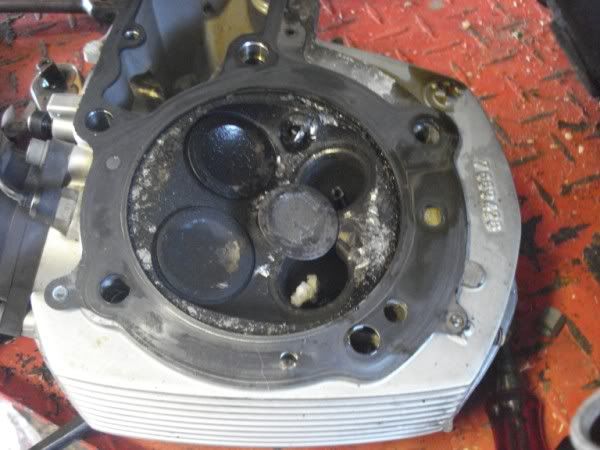
Give yourself a pat on the back if you suggested no compression due to a burnt exhaust valve. :D

2qwq5uf.jpg
 
R/H side.

Valve clearances were all good.

Just that small section missing, no other "hot" marks to suggest it was running hot for a long period.
 
It does seem to crop up every now and again but I've not seen any consistent theories on the cause other than the usual clearances or over heating. In this case the bike was recently serviced and the clearances were spot on, and the plugs are clean.

I am running a y-piece and standard can but haven't changed the chip. There was a jumper lead as a cat code plug until recently when I took it out as it seemed to run better without. To cut a long story short, I noticed the fuel pump connection was almost rusted out so I'm not sure the bike was even getting the correct amount of fuel. Once that was fixed it ran better without the CCP.
 
It only needs a tiny leak of air around the valve seat to allow hot exhaust gases to seep past which then creates a hot spot on the valve.
That causes the lip of the valve to get burnt away which in turn increases the heat and which leads to a vicious circle until the valve has lost enough surface area to lose compression.

Better than the other much more expensive scenario of the valve head falling off and bouncing around in the combustion chamber.
 
That oil leak looks bad in pic No-1 ;)

I watched this the other night thinking some of these ideas would benefit the boxer engines. Maybe not the scatter cams and mods to work around the five port head issues but good stuff all the same. Presented in 1994 but mechanical tuning is just as relevant today.


Back
Top Bottom