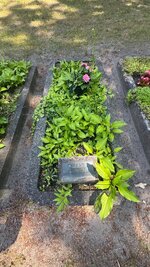
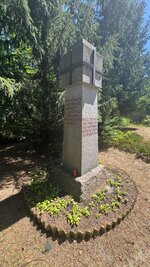
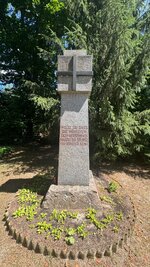
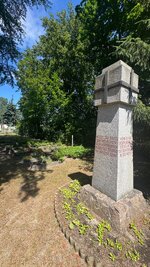
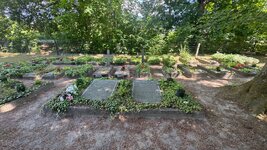
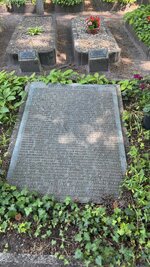
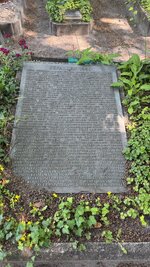
The earliest mention of a Jewish resident in Seelow dates from the protective Jew Wolf Levin from 1737. Levin released Zobel Aron, a foreign Jew imprisoned in Seelow, on bail. According to the local chronicler Michael Schimmel, some historical sources mention the founding of a Jewish community in Seelow around 1830. A rule book of the Jewish community Seelow from 6. However, October 1841 suggests that the municipality was already well established at that time and had its own burial place at the end of the 1838 extended Hinterstraße.
The community grew over the years, so that in 1861 18 families, with 57 Jews, lived in Seelow. In 1866 they bought the old sacristan's house and set up her synagogue there. In the period from 1862 to about 1880, the community had its own religion teacher and fore-beer S. Lewenthal employed. In addition, she was able to use the municipal school building for Jewish religious education. Around 1880 was the heyday of the Jewish community of Seelow and its surroundings. There are 20 families with 67 members.
After 1880, the decline of the community began by emigration to Berlin and other cities. In the early 1930s, it had shrunk to only five families and the synagogue, which was now in poor condition, was sold. The remaining Jews were the Reissner family in Berliner Straße 20, the Philippsborn family in Berliner Straße 46, the Irmlig family and the Wangenheim family in the Kleine Kirchstraße 9 and the dentist Dr. Felix Abraham in the Küstriner Straße.
After the First World War, Hugo Simon, a well-known Jewish banker, bought the Schweizerhaus, but lived mostly in Berlin. According to a report by Joachim Reissner, his father Louis tried to persuade Mr. Simon to join the Jewish community, but he refused. After the synagogue was closed, the Reissner family visited the synagogue in Frankfurt an der Oder.
The Reissner family lived in Seelow since the 1860s, after Jakob married Henriette Wolff, who was born in Seelow. They started a family and ran a furry business in the village. Previous generations of her family, the Itzig / Irmlig family, lived since the early 18th century. century in Seelow. According to a conversation with Joachim Reissner, which Monica Lowenberg recorded in 1998, his grandfather Jakob Reissner was a fur seller and founded a company in the small town of Seelow around the 1870s. His sons and daughters, who were born in Seelow, remained active in the same trade and continued the business.
As a child, Joachim loved to jump around in the collected furs. They bought all kinds of skins from the butcher, in the slaughterhouses and from foresters of Frankfurt (Oder) and surroundings. Then these were prepared for resale so that furs could be made from the skins. In the 1930s, Jakob Reissner ran his business with two horses and half a dozen different carts. Therefore, the Reissner family was known and recognized in the district.
During the First World War, Joachim's father Louis Reissner had been a soldier of the German Army and, after his return, entered the same business as his father Jakob. Louis belonged to the local Rifle Guild, all of whose members had fought for Germany in World War I and were very proud of it. There were very few anti-Semitic statements in Seelow at that time. In 1930 everything was mixed, the Jewish children were also integrated and played, among other things, in the local football team as equal members.
When Joachim Reissner was 12 years old, he took the threat and persecution emanating from the Nazi state for the first time. Old customers secretly came to his father Louis Reissner after the 1936 Olympic Games to tell him that they were no longer allowed to be seen with him without ruining their own business. Joachim's older brother Willi was avoided by his classmates at the Friedrichs-Gymnasium in Frankfurt (Oder) right after Hitler took power. Many came to school in the uniform of the Hitler Youth. Likewise, Willi was ignored by his class teacher and never questioned by him again. He also gave him back the homework again and again without a grade. In answer to questions from Jewish students, the teacher said, "Go away, Jude!" reacts.
Many were afraid. After a shocking speech by Goebbels on the radio in 1937, Louis Reissner went to the mayor and complained about it, whereupon he told him: "You are right, Louis, but shut up." For Joachim Reissner, the great problems began with the destruction of the Jewish shops in Seelow and the arrest of his father Louis and other relatives on 10. November 1938. The day before, the postman had picked up the phones and thus announced the damage to the Jewish houses by the Nazis.
SA men beat on the 9th. In November 1938, the windows of the Jewish families were destroyed and the housing facilities were destroyed. Max Philippsborn complained about this to the mayor and was arrested because of it. He and Louis Reissner received an ultimatum: either they reported themselves as arrested or they were shot immediately. They were then deported to the Sachsenhausen concentration camp, physically abused and imprisoned for four weeks - but released prematurely due to their use in the First World War.
According to Joachim Reissner, their sons, the not yet 18-year-old cousins Willi Reissner and Heinz Philippsborn were taken into custody and locked up in Seelow prison. Joachim, on the other hand, was allowed to stay with the wife of the Seelow police officer, Mrs. Loose, who was friends with the Reissners, due to his young age. Karl Heinz Wangenheim was also sent to Sachsenhausen and released a month later.
The family struggled to recognize the differences between the people, but accepted the fact that well-known Nazis hated the Jews for some reason. They accepted that there was no future for them in Germany – and that is why Joachim should emigrate. Willi Reissner and Heinz Philippsborn fled to England in April 1939. Three days before the start of the war, i.e. at the end of August 1939, Joachim was able to flee to England with 111 boys and teaching staff as part of child transports and be rescued. Max's brother Georg Philippsborn and his wife Erna had already fled to Shanghai. Moritz Reissner was also able to flee to Shanghai with his wife Anna and daughter Ilse via the Trans-Siberian Railway and then emigrated to the USA, to San Francisco in 1947.
Willi and Heinz reported to the Pioneer Corps, a regiment of the British army, which consisted mostly of Jewish refugees. Joachim attended the O.R.T. Technical Engineering School, today in Leeds. With postcards and letters they maintained contact with their family, which they sent through a relative in Norway.
Such a letter reveals the dramatic changes, a last family reunion, before all their fate should change dramatically. It offers a microcosm of life, the situation of the family in Seelow and their desperate attempts to escape. Martha Reissner had written to him on 25. July 1939, just one month before the outbreak of war, to her son Willi in England: "On Sunday, Heinz and Hilde Irmlig and Aunt Julie, Uncle Max and Aunt Adel were all here together. That hasn't happened for a long time." Martha thought about the sad reality that her house would soon no longer belong to them and they were forced to sell it. She wrote to her son: "We still haven't found anyone for the house, we've even advertised it. Now we only have the administrators, but we will work to change this in the next few days.”
According to the city decree of 22. In September 1942, the property of the Reissner family was sold to Charlotte Buchholz, owner of the local hotel "Schwarzen Adler", and the property of the Philippsborn family to Deutsche Post. This was also reported by the Seelower Tageblatt on the 4th. January 1943. The status of the house of Irmlig is unclear, but already in February 1939 its operation was dissolved by the state.
The Last Jews of Seelow
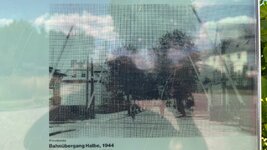
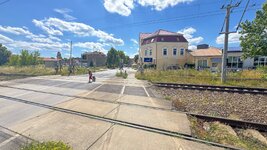
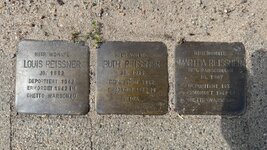
On the 2nd April 1942, all the remaining Jewish citizens who had not been able to escape had to find themselves at the Seelow station forecourt with packed bundles: Among them were the spouses Louis and Martha Reissner, Bruno Garau, Hildegard and Karl Heinz Wangenheim as well as Adelheid Philippsborn. A day later they were deported from Frankfurt (O.) to the Warsaw ghetto, where their tracks were lost. On the deportation list of the XII. Transport to Warsaw, there were also three forced laborers, with Heinz Bran, Hans Jakobstamm and Chaim Rosenzweig. A letter from the German Red Cross proves that Adelheid and the Reissner family stayed in the Warsaw ghetto and disappeared. Julie and Isidor Irmlig were killed on 25. August 1942 from East Prussia via Theresienstadt to Treblinka deported and murdered.
Ruth Reissner (born 1915), sister of Willi and Joachim, looked after children in the Jewish orphanage in the Berlin district of Pankow. The home and the school existed until December 1940 and were then merged with the Prenzlauer orphanage to form the Jewish orphanage. Some of the orphans were able to escape with the help of their teachers. In August 1942, Ruth was deported together with 14 educators and 282 infants and children by the Gestapo via the assembly camp in the Levetzowstraße synagogue to extermination camp in the occupied eastern territories. The trains were destined for Riga, where SS members shot most of the deportees in the woods.
Berthold Irmlig, son of Isidor (born 1900), was a veteran of the First World War and awarded the Iron Cross. He was arrested and imprisoned in 1939 for a sexual relationship with Else Gruszcyk, a non-Jewish woman. In Brandenburg-Görden prison, he suffered from severe malnutrition. According to the family history, his father Isidor had obtained him a visa for the United States, but it was already too late. He was imprisoned on November 30, 1940 in the Sachsenhausen concentration camp under prisoner number 34382 and "shot on the run" on 5.12.1940. He was buried at the Weißensee Cemetery in Berlin.
Willi Reissner and Heinz Philippsborn both joined the British army and fought against the Nazis. In 1940, Willi wrote in a letter to his cousin Freidel Blumklotz: "I think it's right what I did [...] I always wanted to do as much against the Nazis as I could." Willi belonged to the interpreter pool of the pioneer corps of the 43rd. Division, served in 1940 and 1944 in France as well as in Belgium and Germany and reached the rank of a sergeant. Heinz was a cook and served in France and Germany.
The Legacy of the Seelow Jews
After the war, the three cousins founded their own families in Britain. Here, as well as in the USA and Canada, more than 45 descendants of the Reissner and Philippsborn families live today.
In the 1990s, Joachim Reissner managed to have his parents' house in Berliner Straße returned to him. He recalled, "What else can you say? It's good to be alive! The war killed us, they killed us [...] I am not an expectant person. I think the idea is that the reparations will one day be useful to make tzedakah (charity/justice).”
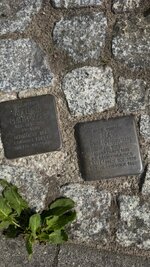
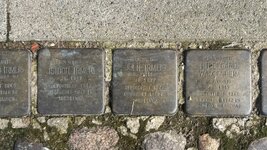
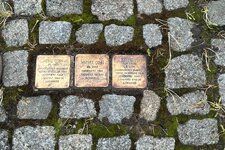
In 2011, Bryan Wood, great-grandson Max Philippsborn, with the other descendants of Willi, Joachim Reissner and Heinz Philippsborn, returned to Seelow to move Stolpersteine in front of the houses of the Reissner, Philippsborn and Irmlig families.
Sabine Franke, a former teacher from Rüdersdorf, was the driving force behind Max Philippsborn being honored with a stumbling block and thus became a catalyst for the renewal of the family bond with Seelow. She did a lot of research about Jewish citizens from the region and initiated the subsequent laying of Stolpersteineen, among others for Moritz Reissner in Herzfelde, who came from Seelow.
Since 2022, she has been working together with Bryan, the current rabbi, and his brother Benjamin to have Adelheid Philippsborn, born Reissner, also have a stumbling block installed for her husband Max Philippsborn. Because in 2011 he had not yet been recognized as a victim of National Socialism. During her research, Sabine Franke found the cause of Max's death and learned that after the pogrom night of the 10th. November 1938 was imprisoned for four weeks in the Sachsenhausen concentration camp. Under Block 40, the small warehouse, he had to perform the heaviest forced labor in the subcamp "Klinkerwerk". Max never fully recovered from this physically demanding work and the constant abuse and eventually died from its consequences. Further research was carried out as part of a student project at the Heinitz-Gymnasium in Rüdersdorf, which Sabine Frank also initiated.
Based on all this collected evidence, the municipal council of Seelow then approved the application for a stumbling block for Max Philippsborn in June 2023. On the 11th March 2024, his birthday, his descendants then placed this stumbling block next to his wife Adelheid in front of the common house in Berliner Straße 46 as part of an event of the VVN-BdA Märkisch-Oderland (Association of the Persecuted of the Nazi Regime - Federation of German Antifasciststs). After this important ritual, the relatives of Max and Adelheid Philippsborn visited the cemetery and put a banner on the entrance gate with the names of all the people buried there.
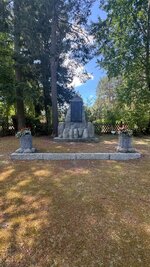
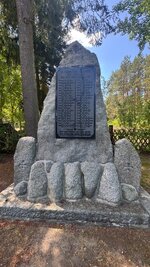
Even if there is no longer a Jewish community in Seelow today, we hope that future generations will actively participate in the maintenance of a restored Jewish cemetery and, as Joachim Reissner suggested, do good in their honor. We hope that with a future restored Jewish memorial park, with the new station museum and the Hugo Simon Foundation, these will not only be used as places to honor the memory of former Jewish Seelowers. They are also intended to be places of dialogue with the Jews living in Germany today, as well as with the younger generation who are engaged in Jewish life in Germany.
Benjamin Wood, Sabine Franke, Michael Schimmel



 www.stolpersteine.eu





 i'am in awe of;; you could almost do this stuff for a living;; have a good journey home.