LED technical question

(RIP) sherpa

Well-known member
UKGSer Subscriber
Joined
Dec 1, 2002
Messages
945
Reaction score
0
Location
Thurgoland
HELP please!

I want to connect some 3 volt 20 mA LEDs but don't want to put a resistor on every + leg of every LED 'cos of space constrictions.

Can I parralel up a number of LEDs and then put one larger resistor in the + feed to the lot?

I've thought about connecting 4 in series but they all differ in brightness that way (4 x 3 = 12)

I would experiment but the LEDs were expensive super bright ones and I'd rather not blow any!

Any help appreciated.

Sherpa ;)
 
The reason the brightness varies with four LEDs in series is probably because they aren't made to exact tolerances and so each LED performs slightly differently. Or it could be as previously suggested that you've overdriven them a bit. By the way, a good place to buy cheap LEDs is www.ultraleds.com - about £15 for 50 x 11,000mcd white when I got some.

As for wiring in parallel, all you need to know is: how much current flows through each LED, the voltage across it, and the supply voltage.

On the bike we can assume supply voltage is 14.5. Assuming the LEDs are similar to the ones I bought recently, they have a forward voltage of 3.2V at a current of 20mA.

So, if you were to wire 10 LEDs in parallel, and want to use a single resistor:

The total current would be 200mA.

The voltage across the LEDs is still 3.2V.

Therefore, your resistor needs to allow 200mA to flow with a voltage of (14.5 - 3.2) = 11.3V across it.

using V = IR or R = V / I this gives R = 11.3 / 0.2 = 56.5 ohms.

I can't remember the closest value of resistor available but I'd advise to get one slightly too high rather than too low, to avoid burning out the LEDs.

Also bear in mind the power the resistor has to dissipate. Power is given by IIR (I squared * R), which in this case is 0.2 * 0.2 * 56.5 = 2.26 watts.

The normal resistors used with LEDs are usually rated at about 0.5W I think, so make sure you buy one that can cope.
 
One thing I forgot to mention above. I didn't really have any problems with wiring four LEDs in series with a 100 ohm resistor, as I described in another thread. Any brightness differences didn't really seem noticeable. And this way is more efficient in that you draw less current from the supply and dissipate less power from the resistor.
 
Great!

Thanks very much Mouse !

That'll help me sort out what I'm planning - I'll keep you posted.

Just off to check that my T P F and T insurance is up to date!!

Particularly the FIRE bit!

Sherpa
 
Can`t remember

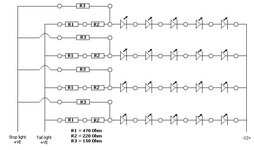
where I got this from but it is very handy.
During experimentation it worked great although I haven`t yet seen how it copes with voltage fluctuations when wired to the bike. I reckon it will be fine though! Fingers crossed.
I used 1.5V super bright red LED`s from the Maplin shop. It will give you bright running lights and super bright brake lights.
When constructing it`s worth noting that LED`s are only bright when viewed straight on so try to splay them a bit.
Cheers, L. :)
 

Attachments

  • led_s_t.jpg
    led_s_t.jpg
    37.5 KB · Views: 209
other usefully links

http://www.eleinmec.com/article.asp?6

http://www.robotroom.com/Infrared555.html

Formulas

These are the formulas we use for the 555 to control the length of the pulses.
t1 = charge time (how long the LED is on) = 0.693 * (RA + RB) * C
t2 = discharge time (how long the LED is off) = 0.693 * RB * C
T = period = t1 + t2 = 0.693 * (RA + 2*RB) * C
Frequency = 1 / T = 1.44 / ((RA + 2 * RB) * C)


t1 and t2 are the time in seconds. C is the capacitor value in Farads. 220uF = 0.000220 F. So for our circuit we have:

t1 = 0.693 * (10000 + 2200) * 0.000220 = 1.86 seconds

t2 = 0.693 * 2200 * 0.000220 = 0.335 seconds

T = 1.86 + 0.335 = 2.195 seconds

Frequency = 0.456 (cycles per second)
 
LEDs for 6v indicators

Ok, it's nothing to do with a GS, but it's still BMW, sort of. I've seen some really clever stuff in the forum about LEDs. My question is "Where/Can I get any LEDs which will run on a 6 volt system, be coloured amber, and equal the brightness of a 21w bulb? This is to fit indicators in the sidelights of a 1936 Frazer-Nash BMW. Any ideas please?
 
1936 Frazer-Nash BMW

Show us, Show us, Show us, Show us, Show us, Show us, Show us, Show us, Show us, Show us, Mr Williad :D Gooowan pulease! ;)


Back
Top Bottom