Motorcycle Cable for Garmin 276 and 296 - with pin-outs

PanEuropean

Registered user
Joined
Jan 16, 2004
Messages
1,591
Reaction score
2
Location
Toronto / Zürich
Hello all:

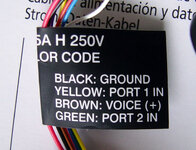
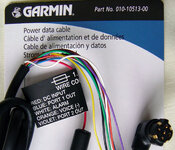
Here is a photo of the 'cable with bare ends' that suits the Garmin 276 and 296 GPSR's. Although this is not being sold specifically as a motorcycle cable, it has the same 'extra-durable' rubber on the outside of the cable assembly as the motorcycle specific cable for the SP 26xx series.

Garmin has thoughtfully included a sticker on the end of the cable that identifies what all the different coloured wires are for. There is a diagram in the back section of the 296 owner manual that identifies which wire goes to which pin on the other end of the connector.

The "Port 1" and "Port 2" cables are there for future use. One possibility that is being investigated right now is using them for a temperature input from the motorcycle itself - either outside air temperature, coolant temperature, or oil temperature. So, if you buy one of these cables, don't cut off the wires you don't use, just put shrink wrap over them and reserve them for future use.

PanEuropean
 

Attachments

  • 296 cable.jpg
    296 cable.jpg
    101.1 KB · Views: 204
PS: Just so as to not cause any confusion here - even though I am riding this summer with a 296, doing moto testing with it, I still believe that the SP 2610 is the most appropriate GPSR for a motorcycle rider to purchase.

The deciding factor for me is memory storage capacity. If the 276/296 could hold a big memory chip - for example, 512megs or one gig - I would vote for the 276. But, the 276 uses the little chips, which currently have a maximum size of 256 megs. I believe this is way too small for motorcycle use, especially if you plan to do touring to different countries.

The 276 might be an appropriate choice if you don't plan to stray too far from your home base, and you also need the marine navigation capabilities that it provides. But, unless you need those marine capabilities - or the aviation and marine capabilities that the 296 has - you will be far better off with a 2610, and it will cost you less to buy a 2610. The 276 might appear at first glance to cost less than the 2610, but you have to add the cost of the 'automotive kit' that includes the car cable, the 128 meg chip, and the CitySelect CD. Once you add that, the price is the same as a 2610. If you elect to buy a 256 meg chip for the 276/296, then you will spend more than you would for a 2610.

PanEuropean
 
PanEuropean said:
I still believe that the SP 2610 is the most appropriate GPSR for a motorcycle rider to purchase.

Interesting. How about using an SP 2610 off-road? The biggest disadvantage (from my perspective) of the 2610 is a lack of batteries, meaning you can't use it away from a powered vehicle easily. So I couldn't attach it to my pedal bike, and use it there very easily.

But I'm with you on the memory cards. The Garmin items are overpriced. Has anyone reverse engineered these things, or are they totally proprietary?

David
 
I still believe that the SP 2610 is the most appropriate GPSR for a motorcycle rider to purchase.

I'm totally happy with my old cheap B&W Garmin V with 2 main exceptions:
- memory (occasionally, but not often a problem)
- processor speed (re-route, draw etc)

how much faster are the new generation of Garmin (ie SP 2610)? I can't see any information on this on the garmin site.

Whilst I would obviously prefer an SP2610 over the V, I would miss the pocketablity of mine, oh yes and 800 quid of so it would cost me.
 
Jimbo:

Heck, if you're happy with what you have, keep your money in your pocket, don't go running out to buy a replacement just because there's a faster one available.

What I meant when I said "I still believe that the SP 2610 is the most appropriate GPSR for a motorcycle rider to purchase" was this: If you don't have a GPSR now, and you are in the market to purchase one for automotive or motorcycle use, then the one you should buy is the SP 2610. In my personal opinion, this is the best GPSR for moto use. I've used just about all the other GPSR's that Garmin makes, excepting the Quest.

The newer GPSRs - 276, 2610, Quest, et al - are many orders of magnitude faster than the older ones, such as the GPS V that you have. The best comparison would be to look at the difference between a computer that was released the same year as the GPS V (1999) and a computer that was released within the last year.

But, if the GPS V does the job for you, and you don't mind the occasional wait (£800 in your pocket can compensate for a lot of waiting), then stick with what you have. The only other thing that might give you good cause to upgrade would be if you find you can't stuff enough cartography into the 21 meg fixed internal memory of your GPS V. That might become an issue for you if you want to keep up with the latest cartography. But, until it does, stick with what you have, and with what you are happy with.

PanEuropean
 
David Emmett wrote:
The Garmin items are overpriced. Has anyone reverse engineered these things, or are they totally proprietary?

David, the only reason these things are expensive is because they are produced in very limited quantities. Garmin started making these chips in the mid 1990s to meet a need for GPS cartography storage, long before other SDRAM memory formats, such as CF, MemoryStick, SD, and so forth were developed.

Now that generic, or COTS (Commercial Off the Shelf) flash memory is widely available, Garmin has moved to using it in their new models of GPSRs, such as the SP 26xx series, both to reduce the cost to end users and to stop the whinging from the uninformed who don't know the history behind the small Garmin chips. You probably didn't notice that Garmin doesn't even sell CF cards themselves - they would much prefer that the owners buy a CF card from a local store, which will be far less expensive for the user than ordering one from Garmin. The original Garmin chip format is still used on the 276 and 296 because those units are primarily marine or primarily aviation/marine, and Garmin does not want to piss off upgrading marine users by preventing them from using their existing cartography, which was (for a long time) sold preloaded on those chips. Marine cartography is not updated as frequently as automotive cartography, so there is a longer life cycle to marine maps, hence a need to support the format a little while longer. Many marine maps sold on Garmin proprietary chips in the mid 1990s - before the use of CDs was widespread - are still current. But, Garmin is slowly weaning users off the proprietary chip format - any marine cartography purchased since 2001 has been delivered on CD, same as the automotive cartography.

The technology for the original Garmin chips is proprietary, but Garmin has shown no interest in going after any manufacturers who have knocked it off. So far, only one manufacturer has bothered to make a knock-off, probably because the market for these little chips is so limited - and it's shrinking, not growing. My personal guess is that the 276 and 296 will be the last 'new' Garmin products to ever use that proprietary chip format. From here on in, I expect that all the new products will either use COTS media, or have an internal hard drive, or have a massive SDRAM built into them. NB this is just my own personal guess, not any kind of inside information.

PanEuropean
 
It would have been nice if Garmin had equipped the 276 and 296 with both a CF slot and the proprietary connector, so that new purchasers didn't become locked into an obsolete memory product.

These may be the last GPSRs to use the old memory products, but someone who buys one today will be locked into a memory format which will only become more expensive as it becomes less widely used.
 
meyerweb said:
It would have been nice if Garmin had equipped the 276 and 296 with both a CF slot and the proprietary connector, so that new purchasers didn't become locked into an obsolete memory product.

These may be the last GPSRs to use the old memory products, but someone who buys one today will be locked into a memory format which will only become more expensive as it becomes less widely used.
It is an old argument and I totally agree with you.

Some of us do not see why the 276C came out with Garmin format data cards at all. (Yes, I have listened to the 'it is primarily a marine unit and the boaters have an investment in marine charts on these cards' and I do not buy it)

If this compatibility was the argument then a Garmin card slot and SD card (smaller size) could have been fitted into the 276C just as 2 Garmin data card slots are fitted into some of the dedicated marine units (don't get me started on why any unit should be 'dedicated' to any user group)

In spite of this, I still bought a GPSmap 276C because it is the best GPS option for my use, even if it is a little behind the other technology that I use every day.

Garmin always was a little slow listening to its customers (USB is an example).
Yes, I know about product development lifecycles. I also know about market analysis.
 
Keep in mind that the marine users don't need as much storage space for cartography as the automotive users. 128 megs is sufficient to store more marine charts than a boater would ever use - for example, the entire Med will fit on a 128 meg chip with room to spare.

PanEuropean
 
Interesting that Garmin makes units for marine use and units for auto use but does not differentiate between auto/moto onroad and offroad use.

These 2 usages are quite different with offroad users wanting; UTM grids, multiple datums, large tracklogs and large numbers of waypoints (like hikers but more!).
As well offroad users (auto and moto) also use the same units onroad and want auto-routing for this use.

I notice that the GPSmap 276C is the most popular GPSr on the Adventure Riders forum, whereas the SP2610 is more popular on road oriented BMW forums.

Map load size limitations are the problem on the GPSmap 276C; not good that we have to chose between adequate map coverage and navigation features when more than a few of us want both.


Back
Top Bottom