Nano ceramic coating


there's different type's of ceramic coatings

:)

right best I get on the booze now.... cos it's the weekend

 
Does it scratch easily?

it's pretty good, this is specifically the high temp they do 4 variations 2 of which are oven cure... and are harder finishes...

if you throw the bike on it's side and slide down the road it'll wear off...

:)

We've got a scooter exhaust we did 5 years ago it's still looking pretty good, the headlight covers on my 4x4 did 50,000 road miles before the looked worn...
 
it's pretty good, this is specifically the high temp they do 4 variations 2 of which are oven cure... and are harder finishes...

if you throw the bike on it's side and slide down the road it'll wear off...

:)

We've got a scooter exhaust we did 5 years ago it's still looking pretty good, the headlight covers on my 4x4 did 50,000 road miles before the looked worn...

Hard fit wethead in oven. :beerjug:
 
I had a quick google, but am none the wiser.
WHAT is guaranteed ? Under what circumstances could somebody claim and then what would they actually get if the claim was successful?

It is were as effective as a proper drenching in ACF-50 for each winter for 7 years, then I can see the appeal- but there's no mention of protection against corrosion that I can see?

This could be Bro Science - apologies in advance, my understanding is that ACF50 doesn’t bond to the surface the same way, meaning that after a period of time the ACF50 leaves the surface of whatever you’ve sprayed it onto and you’ve got to repeat the process again. How frequently you repeat it depends on what weather you’ve ridden through I guess.

The nano ceramic coating bonds to the actual metal and plastics / paint work creating a layer that doesn’t leave the surface it was applied to and whatever lands on it (mud, salt etc) can’t bond to the nano coat so washes off easily with minimal effort.

In my head (again it’s Bro Science) the bike is like a non stick pan and cleans easily, and when it’s cleaned it’s still protected.

The guarantee is in relation to the treatment and life span of the application, it shouldn’t start to deteriorate for 7 years, and travels with the bike,so if I sell it the warranty for the nano coat travels with it.

As I said my explanation is Bro Science in its simplicity.
 
I am a little surprised that someone will charge £330 to spend a couple of hours applying a substance that costs £50!
Hourly rate a little high !!
 
The Blood Bikes I use were supposedly coated with some sort of ceramic protection, I couldn't tell the difference when it came to cleaning them, so I decided not to bother with it on my own vehicles. Maybe this system is better.:nenau
 
Takes me back to a similar thread on here many years ago about ceramic coating and how it was like magic. I can't remember who was selling the amazing properties, but his argument of why it was better than other car polishes was that it was produced in some complicated process that made the space shuttle look like child's play, whereas Autoglym "just comes in a bottle."

I asked him whether he brought the ovens, furnaces, fractionating columns etc to the bike when he was applying the stuff. His answer was "no, obviously not, we just bring it in bottles."

The cynic in me sets off alarms when products get "over sold." The reality is that short of doing half a vehicle in this stuff and half in "normal" polish and seeing how it compares seven years down the line or just before the warranty expires, it all seems very subjective. No manufacturer seems to be doing this. I'll even pay half for someone to come and do half my car (or bike) and I'll happily publicise the results every month for seven years.

My neighbour runs a "detailing" service (which seems to be a new term for car cleaning) and will talk all day long about how he makes his own formulas, better than factories produce, better than the stuff offered by new car dealers etc. But his car never seems any cleaner than mine after they've both been washed, not does it seem any quicker or easier to clean.

The bottom line for me is this: if there was a £300 coating that performed as well as it's advertised, why aren't manufacturers - particularly premium brands - doing it as standard? It would probably only cost them £150, and would allow them to sell the vehicles with the advantage of being really easy to keep clean.
 
The Blood Bikes I use were supposedly coated with some sort of ceramic protection, I couldn't tell the difference when it came to cleaning them, so I decided not to bother with it on my own vehicles. Maybe this system is better.:nenau

They were probably only coated with ceramic protection. Things have moved on to nano-ceramic coating now.
 
I put Armour Sheild IX on my bike. Did the wash, wipe down with the alcohol and then applied 2-3 coats. Does make the water bead off better, and the wheels certainly stay cleaner.

Quick blast with the pressure washer and all the mud falls off easily
 
This could be Bro Science - apologies in advance, my understanding is that ACF50 doesn’t bond to the surface the same way, meaning that after a period of time the ACF50 leaves the surface of whatever you’ve sprayed it onto and you’ve got to repeat the process again. How frequently you repeat it depends on what weather you’ve ridden through I guess.

The nano ceramic coating bonds to the actual metal and plastics / paint work creating a layer that doesn’t leave the surface it was applied to and whatever lands on it (mud, salt etc) can’t bond to the nano coat so washes off easily with minimal effort.

In my head (again it’s Bro Science) the bike is like a non stick pan and cleans easily, and when it’s cleaned it’s still protected.

The guarantee is in relation to the treatment and life span of the application, it shouldn’t start to deteriorate for 7 years, and travels with the bike,so if I sell it the warranty for the nano coat travels with it.

As I said my explanation is Bro Science in its simplicity.

that's about how I see it...

obviously there's the other elements are you treating the substrait, is the materials isotropic or ansiotropic ... are you creating a hybrid onto which you can wet layer...? or are you rubbing something onto the paint and plastics like they use in to old days when the product was called scotchguard..?
 
Ok, I’ll bite, what’s the difference ?

Ceramic protection, despite the claims made at the time, wasn't as good as they said it would be. So now they use nano-ceramic coating to make it sound better. What's the difference? That, Joe, is a very good question...

It's like the difference between each new evolution of shampoo or skin cream. I mean, who can believe we used to think panthenol pro-vitamin B5 was the best protection you could get for your hair? Now we've moved on to micellar water and hyaluronic acid, and laugh in the face of people who believe glycosamine was ever any good.

I rather suspect it's all just snake oil. Give something a tech-sounding name and splash "lifetime guarantee" over the website in big letters (and 7 years, but doesn't cover "neglect" or define exactly what neglect might mean in this context, in tiny writing at the bottom). Explain the process you'll use in complicated terms that don't mean anything (can anyone tell me how "detail cleaning of accessible areas" differs from cleaning of accessible areas?) How would you go about challenging this if you thought it wasn't done properly. What exactly is done at the "fallout/decontamination" stage?

I asked a provider if they'd do half my car (for half the cost) so I could document how it fared over the next 4 years - the guarantee time at that stage, before ceramic became nano-ceramic, obviously. They declined because they "wouldn't want to put their name to a car that hadn't been done up to their exacting standards." They did however offer to do the whole car for half the price.

"Broscience" is another way of saying "not science at all."

Ultimately, if there was a coating that retails for £300 so could be put on at manufacture stage for £150 that offered all the benefits claimed, car and bike manufacturers would do it as a matter of course. It would be a HUGE selling point, particularly for high-end 'premier' makes. Can you imagien Bentley or Aston Martin not offering it as standard on a £100k car if it was genuinely effective?

By all means pay someone to give your car or bike a damn good wash and polish. If you spend five hours washing a car with the stuff you can buy in Halfords, it's going to look fantastic.
Spend £30 and a bit of elbow grease with Autoglym polish and protector yourself and it'll last for a while too. I just don't believe that the "nano-ceramic coating" claims are well founded and, by the time you find out, your guarantee will be long gone.
 
the coatings we put on, for one project are at the time of manufacture... the product (the car) we support is 2million in cash for an out of the box and 4 million in english readies if you want it your way with every optional extra.

they've currently sold 20 with everything and 59 out of the box

We've made 100 pieces for that client which included 10 test units each needed which also had sensors embedded for material evaluation testing...

is what we do the one product that rules all products... nope, it's part of a control protocol... and can prolong the life of stuff...

the autoglym stuff on a new car is really good, Aston Martin recommend that... As does bentley

nano super micro ceramic cold application out of a bottle can be very nice... and does work to a degree... but, some of these things are sold almost on a franchise basis like the fibre glass bed liners for pickup trucks... and whoever buys into it gets fed leads, and anything over a certain amount becomes their money....
 
the coatings we put on, for one project are at the time of manufacture... the product (the car) we support is 2million in cash for an out of the box and 4 million in english readies if you want it your way with every optional extra.

they've currently sold 20 with everything and 59 out of the box

We've made 100 pieces for that client which included 10 test units each needed which also had sensors embedded for material evaluation testing...

is what we do the one product that rules all products... nope, it's part of a control protocol... and can prolong the life of stuff...

the autoglym stuff on a new car is really good, Aston Martin recommend that... As does bentley

nano super micro ceramic cold application out of a bottle can be very nice... and does work to a degree... but, some of these things are sold almost on a franchise basis like the fibre glass bed liners for pickup trucks... and whoever buys into it gets fed leads, and anything over a certain amount becomes their money....

As clear as mud.....
 
I am a little surprised that someone will charge £330 to spend a couple of hours applying a substance that costs £50!
Hourly rate a little high !!

He was at mine from 0900 - 1845hrs. Didn’t stop and was meticulous. But you wouldn’t know because you didn’t ask.

Where did you get £50 from?

 
As clear as mud.....

yup I think so

the options are

pay your money and it'll work

or

pay less for a lesser product which also works but needs to be applied again....

or

apply ACF50 which is a sticky goop... and makes the bike look dirty

or

use material sciences to build a solution that does something nothing else in the market can do... which costs an arm and a leg of sorts but in comparison to the end product it's really pennies in the bigger picture

:)
 
He was at mine from 0900 - 1845hrs. Didn’t stop and was meticulous. But you wouldn’t know because you didn’t ask.

Where did you get £50 from?

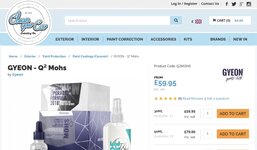
This is regarded as one of the best nano caramic coating....
£59
 

Attachments

  • 0E9D1201-D9B1-4B32-BD12-D6DC3264C402.jpg
    0E9D1201-D9B1-4B32-BD12-D6DC3264C402.jpg
    162.6 KB · Views: 456
how much can you cover with 30ml..?

with cerakote I can cover a 24x30inch panel at 20-30 micron


Back
Top Bottom