

You are using an out of date browser. It may not display this or other websites correctly.
You should upgrade or use an alternative browser.
You should upgrade or use an alternative browser.
Power Snorkle
- Thread starter big simp
- Start date

Deano
Guest
I want a snorkle that does not open behind the front tire. Last time I did an air filter change, I got a whole wad of sand pour out of the snorkle. Surely thats no good!!
Deleted account 211025001
Registered user
- Joined
- Feb 3, 2005
- Messages
- 8
- Reaction score
- 10
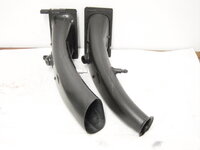
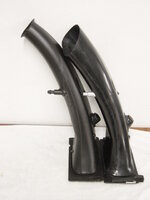
Anyone got any advice about power snorkles for the 1200 GS, pictures would be great.
Will be using a full system, K&N, plus a power controller, and wondered if these snorkles actually work.
cheers
Steve
This is the thread for you

Andres
Cheers, Otto very interesting this info.
steve

LiquidLAN
Registered user
I want a snorkle that does not open behind the front tire. Last time I did an air filter change, I got a whole wad of sand pour out of the snorkle. Surely thats no good!!
Great design isn't it, especially on a bike built for the conditions the GS and GSA are supposed to be built for. Interesting none of the other offrod bike builders went for a similar design, but hey what do KTM know??

Have a look around the sight, Mouse amoung others have made snorkle extentions that bring the air intake up near the top of the yoke, good for fording and probably better for avoiding sand ingress.
Also check out the TT catalog, they have an additional filter that fits on the end of the snorkel specifically for sandy conditions. Not sure what it does to the power, but I'm pretty sure it will be far less detrimental than a cylinder full of sand.
Ken H.
Guest
How's sand going to get in a cylinder where there is a full air filter in the airbox first?I'm pretty sure it will be far less detrimental than a cylinder full of sand.
Deano
Guest
How's sand going to get in a cylinder where there is a full air filter in the airbox first?
No sand got into the airbox or the cylinder, but I dont want heaps of sand being ingressed into the snorkle. Check out these pics to see what I mean...


LiquidLAN, have you got any pics of the hose that you installed?
LiquidLAN
Registered user
No sand got into the airbox or the cylinder, but I dont want heaps of sand being ingressed into the snorkle. Check out these pics to see what I mean...
LiquidLAN, have you got any pics of the hose that you installed?
Agreed with an airfilter correctly fitted you won't get sand in the airbox etc, with a front facing snorkel ramming air and more sand in surely you are more at risk than you would be if the airbox drew from the back of the bike or in from the side???
Deano, it wasn't me that fitted the snorkel, there's an HP2 here with one... its just a piece of hover hose by all accounts...
however the TT snorkel I was talking about is in the additional 2006 catalog part number 044-0870
http://www.touratech.com/shops/008/advanced_search_result.php?keywords=044-0870
I've never seen them, but as I understand it fits outside the snorkel and prevents sand ingress in the first place... seems like a much better idea.

If you're just after power then remove the snorkel, it is there primarily to dampen intake noise, just cut it back so that it still clips in place to hold the filter.Anyone got any advice about power snorkles for the 1200 GS, pictures would be great.
Will be using a full system, K&N, plus a power controller, and wondered if these snorkles actually work.
cheers
Steve
BiG DoM
Registered user
If you're just after power then remove the snorkel, it is there primarily to dampen intake noise, just cut it back so that it still clips in place to hold the filter.
Many would disagree and argue that it is a tuned length and profile ... much research has gone into this.

alimey4u2
Registered user
Many would disagree and argue that it is a tuned length and profile ... much research has gone into this.
An excellent point but alas incorrect. Induction length tuning is effected by the inlet tract lengths, normally from the center of the plug to the inlet of the injector/carb body/velocity stack. Changing the length or diameter of the "exterior" snorkle will not effect natural resonances, although it may well effect flow.....

Variable induction technology proves this.....

Wasn't there a mod that involved swapping a standard RT intake with a GS one for better top end - or vice-versa??
I was working on the priniciple that any engine will make the most horsepower by allowing it to intake as much air as possible, assuming that the fuel/air ratio is maintained by some sort of controller.Many would disagree and argue that it is a tuned length and profile ... much research has gone into this.
I didn't know that BM did any research on the GS snorkel with regards to performance, I expect that they did reasearch with regards to smoothing the air flow to allow for a leaner mixture at low throttle and meet emission regs, and also worked on the snorkel with a view to reducing intake noise, again to meet regulations.
I guess I considered that to increase power, raising the peak torque revs, you also have to raise the airbox frequency:
(Airbox Frequency), squared, is proportional to the inlet pipe area/(airbox volume x inlet length)
So if you raise the airbox frequency you must also increase the other side of the equation, so the options are:
Increase inlet pipe diameter
Decrease airbox volume
Decrease inlet pipe length
Easiest option would be to decrease the inlet pipe length, rather than mess around with pulse tuning, cam timing, port polishing, guess I'm just lazy, a smaller exhaust could smooth airflow but I always thought the first step was to sort volumetric efficiency of the intake and valve system, but I can use a hacksaw, sort of
 so that argument suits me and I always choose that option.
alimey4u2
Registered user
On the 2007 Yamaha R1, They change (vary) the length of the inlet ram tubes to the injectors. On several multicylinder performance engines I have viewed. Those with different induction tract lengths make up for it by having differing "internal" ram tube lengths but then all have a common length snorkel to the airbox.
It was explained to me by a notable American tuner who said:" If a man plays a trumpet in a room & a door opens, does the note of the trumpet change ?"
Am I wrong .... It doesn't matter either way to me but I really would like to know the truth...
It was explained to me by a notable American tuner who said:" If a man plays a trumpet in a room & a door opens, does the note of the trumpet change ?"
Am I wrong ....
It doesn't matter either way to me but I really would like to know the truth...is the key, the airbox is tuned, both in shape and the material it is made from, to have as close to perfect resonance as possible, to have as little frictional loss as possible not only from the incomming air but during the engine cycles.On several multicylinder performance engines I have viewed.
The design of the Yamaha, Honda, etc, airboxes is a big part of the bike design, it's not how big your air box is but Helmholtz resonance that's the important bit.
It was explained to me by a notable American tuner who said:" If a man plays a trumpet in a room & a door opens, does the note of the trumpet change ?"
Am I wrong ....

I do know you can ignore tuned airboxes and Helmholtz on BM's though.

ovenpaa
Registered user
however the TT snorkel I was talking about is in the additional 2006 catalog part number 044-0870
http://www.touratech.com/shops/008/advanced_search_result.php?keywords=044-0870
I've never seen them, but as I understand it fits outside the snorkel and prevents sand ingress in the first place... seems like a much better idea.
I get my filters direct from Oz:
http://www.uniflow.com.au/
I have a feeling the one for the HP2 is the same as the pre filter for the 990S but I could be wrong!
http://www.uniflow.com.au/index.html?lang=en-us&target=d73.html
Bottom of page


ECM
Registered user
Helmholtz Resonance is something used in loudspeaker designs as well. Mostly for acoustic reasons.
But I can not imagine that a small pipe sitting in front of a more or less dense filter (in effect stopping one end of the pipe acoustically) will do anything useful in terms of motorcycle performance.
Or it is the fact that this air intake itself has now a better "sound" to it. Is that it??
But I can not imagine that a small pipe sitting in front of a more or less dense filter (in effect stopping one end of the pipe acoustically) will do anything useful in terms of motorcycle performance.
Or it is the fact that this air intake itself has now a better "sound" to it. Is that it??

Similar threads
- Replies
- 13
- Views
- 732


- Replies
- 9
- Views
- 572

- Replies
- 28
- Views
- 2,189


