R1150GS Clutch Hydraulic Failure.

Ian J Hartley

Well-known member
UKGSer Subscriber
Joined
Jun 15, 2003
Messages
5,106
Reaction score
457
Location
Swindon, England
OK to cut a long story short my bike suffered a clutch hydraulic failure to other day and had to be recovered Home.

The following day the investigation began.
No obvious loss of fluid.
level still good in the reservoir sight glass.

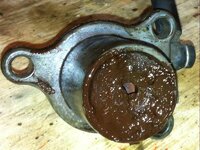
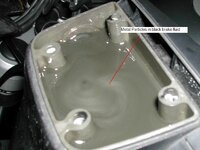
So off with the lid to have a look. Only to be greeted by this horrible sight.
Metal particles floating in a black fluid.
I changed all my fluids last year, and a check of the brake fluid (crystal clear) ruled the fluid out.
 

Attachments

  • Picture1.JPG
    Picture1.JPG
    50.7 KB · Views: 2,962
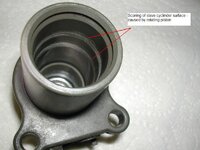
So further investigation and removal of the Clutch slave cylinder and I find the thing has failed.

No story there. at 12 years old and 50K miles I would expect the thing to fail sometime.
 

Attachments

  • IMG_0468.jpg
    IMG_0468.jpg
    104.9 KB · Views: 2,618
Think I'd be at least flushing the system with methylated spirit :beerjug:
 
Well I finally got to the bottom of it.

The clutch slave cylinder piston had been spinning inside the cyclinder and had worn away the bore causing the metal particles and for the seal to eventually fail.
 

Attachments

  • Picture3.JPG
    Picture3.JPG
    57.2 KB · Views: 2,736
The cause of the whole story:-

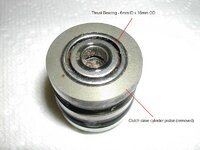
The thrust bearing that lives at the end of the Clutch slave cylinder piston had seized.
Because the clutch actuator rod spins all the time the engine is rotating the only way it could continue to spin is by spinning the clutch slave cylinder piston, thus wearing it out.
 

Attachments

  • Picture4.JPG
    Picture4.JPG
    56.1 KB · Views: 2,840
I know most people experience clutch slave cylinder failure at some point, and I'm thankfull mine has lasted this long, but I recon a large proportion of the failures are caused by the thrust bearing seizing, and that being the cause of the cylinder failure. Of course no one investigates further as there isn't much point. The thing has to be replaced anyway so 'get on with it'

After all the piston in the Master cylinder moves every time the slave cylinder does, yet they don't seem to fail anywhere near as often.

But it is a crap design that has a tiny bearing that size which is constantly rotating to last a long time. looking at it, I'm amazed it has lasted as long has it has.

That's all folks!
Ian
 
Thanks for the write up. An interesting reminder. And it's made me think I should look at mine. Clutch thickness is OK on mine but I've had thoughts to change the fluid. As I commute on mine I have many moments feeling for the poor clutch. Wondering what I'll find if I get the slave off and take a look.

Tim. Interested also in your comment about flushing with methylated spirits. Not heard of this before.


Sent from my SM-N910F using Tapatalk
 
Wondering what I'll find if I get the slave off and take a look.

Personally I wouldn't bother. I think you will know when the slave cylinder gives out. The only difference between a slight leak and a full blow failure is that with a slight leak you wouldn't notice on the reservoir sight glass, where as a full failure and all your fluid disappears. You loose the operation of your clutch under both occasions, however, with a slight leak you may be able to pump the lever to get the clutch to work.

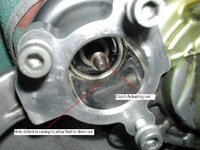
I know that a hole can be drilled in the casing to allow fluid to drain out, but the hole is a entry point for water. Besides which, your slave cylinder would have to be leaking for a while to get any fluid out and I think things would be obvious. The Clutch Actuating Rod has a felt washer fitted mid way along it's length to prevent fluid from travelling through to the clutch plate.
 

Attachments

  • Picture 5.JPG
    Picture 5.JPG
    65.6 KB · Views: 2,962
Hi I changed my Slavs last year for one that had done only a few thousand miles only for it to fail again a couple of thousand miles later, I had flushed clean fluid right through I have sludge around the pushrod in the box would this have an impact on the new slave or was it more likely fluid still contaminated cheers will
 
Hi I changed my Slavs last year for one that had done only a few thousand miles only for it to fail again a couple of thousand miles later, I had flushed clean fluid right through I have sludge around the pushrod in the box would this have an impact on the new slave or was it more likely fluid still contaminated cheers will

If you remove the slave then allow the clutch fluid to drain it should empty the whole system up to the bar mounted reseviour. ? So should be quite easy to replenish when refitting the slave and flushing any impurities out..
 
Hi I changed my Slavs last year for one that had done only a few thousand miles only for it to fail again a couple of thousand miles later, I had flushed clean fluid right through I have sludge around the pushrod in the box would this have an impact on the new slave or was it more likely fluid still contaminated cheers will

If you have 'sludge' around the clutch actuating rod, then it could be coming from the thrust bearing (grease), leaking slave cylinder (Brake Fluid) or leaking Gearbox input shaft rear seal (Gear oil) or a combination of all three.

Your into replacing the slave cylinder anyway, so that includes the thrust bearing as it's a integral part of the slave cylinder. Clean the gearbox housing of all the sludge. The actuating rod should be removeable once the slave cylinder is off, as it floats freely through the hollow gearbox input shaft to the clutch diaphragm Spring. Some models have a felt washer on the actuating rod to absorbe fluid. It could be that you can't remove the rod because of the felt washer, (mine was stuck) so don't try force removal of the rod. Once you have the area cleansed, before you fit the new slave cylinder. Make sure your gearbox input shaft rear seal is not leaking. If it is, you will need to replace that as well before you fit the slave cylinder.

I'm not entirely sure of your question, Have I explained it enough?

Ian
 
Update on mine.

I didn't bother looking at the slave cylinder (you were right Ian ). But the old fluid was well past it sell by date. Really really dark brown.

New fluid, speed bleeder to replace the BMW contraption and all is much better. Good, positive clutch action now.
 
If you have 'sludge' around the clutch actuating rod, then it could be coming from the thrust bearing (grease), leaking slave cylinder (Brake Fluid) or leaking Gearbox input shaft rear seal (Gear oil) or a combination of all three.

Your into replacing the slave cylinder anyway, so that includes the thrust bearing as it's a integral part of the slave cylinder. Clean the gearbox housing of all the sludge. The actuating rod should be removeable once the slave cylinder is off, as it floats freely through the hollow gearbox input shaft to the clutch diaphragm Spring. Some models have a felt washer on the actuating rod to absorbe fluid. It could be that you can't remove the rod because of the felt washer, (mine was stuck) so don't try force removal of the rod. Once you have the area cleansed, before you fit the new slave cylinder. Make sure your gearbox input shaft rear seal is not leaking. If it is, you will need to replace that as well before you fit the slave cylinder.

I'm not entirely sure of your question, Have I explained it enough?

Ian
How rude I am sorry ian I didn’t even see your reply, my apologies
Regards Will


Back
Top Bottom