

You are using an out of date browser. It may not display this or other websites correctly.
You should upgrade or use an alternative browser.
You should upgrade or use an alternative browser.
R1250GS calliper bolt length
- Thread starter Daggerit
- Start date


Taking the OP at face value - he is suffering fade through repeated hard braking on the road, and expects similar on track.
Forget about the inertia of larger discs - the difference will not be significant (we are not talking wheels and alloy to carbon-fibre here)
So - there should be less fade, with the increase in swept area/mech advantage/heat dissipation .............. BUT - for an odd-occasion track day on an R1250GS? Not worth considering further, I don't think.
Buy the bolts and the spacers - small cost.
1) Now try mounting the calipers within the rim diameter - YES/NO?
Buy the larger discs (if available) - large cost
2) Now try mounting the calipers within the rim diameter - YES/NO?
You could shell out a fuckload of cash - to find out it can't be done.
Better go get on some trackday forums and find out what pads are most recommended for trackdays - and see if you agree on the BMW discs after fitting.
Forget about the inertia of larger discs - the difference will not be significant (we are not talking wheels and alloy to carbon-fibre here)
So - there should be less fade, with the increase in swept area/mech advantage/heat dissipation .............. BUT - for an odd-occasion track day on an R1250GS? Not worth considering further, I don't think.
Buy the bolts and the spacers - small cost.
1) Now try mounting the calipers within the rim diameter - YES/NO?
Buy the larger discs (if available) - large cost
2) Now try mounting the calipers within the rim diameter - YES/NO?
You could shell out a fuckload of cash - to find out it can't be done.
Better go get on some trackday forums and find out what pads are most recommended for trackdays - and see if you agree on the BMW discs after fitting.
Buy a Yamaha R1 with Galfer discs/pads, Carbon fibre wheels, and full Ohlins suspension
Is the correct answer..............


Brake and spindle bolts etc are Steel as it bends first when under stress - Stainless can break as it’s more brittle and therefore not as suitable in high load areas...
Yeah, wonder why they’re M10 versus the M8 of older bikes... And surprised they’re carbon steel rather than stainless too.
Sent from my iPhone using Tapatalk

Your insurance Co may raise an eyebrow when you explain all this.

Thanks for all the replies gents.
To try to give people some more information, I had the brake fluid changed at the first service because I was worried that I'd degraded it when I first had the braking 'problem' (as the lever had been noticeably spongier after that) and I've also changed to SBS RS compound pads since then as well. While that did help the feel of the lever, I have noticed that on back roads the lever still starts to get closer and closer to the handle after repeated braking, albeit after a slightly longer time. I noticed this on my 899 on track but never had the issue on the road which is why I'm trying to get on top of it as much as I can before any track action happens.
Someone pointed out that the OEM braking system has enough power to activate the ABS so why would you want more? It's a fair point, but the issue for me is when the bike is being slowed repeatedly and then the system isn't able to perform as well. So yes, it can stop the bike with enough force to overcome the tyre grip and activate the ABS - once. Beyond that the system starts to degrade overall.
For the fitment of the calipers within the diameter of the wheel, I'd never even factored it in as being an issue. Stock discs are 305mm OD solid and I want to go to 330mm OD floating which is what is commonly fitted to sports bikes running smaller 17" wheels so in that regard I don't imagine that there will be any issue at all. Obviously that's something that I'll be checking once my spacers have arrived to make sure, before the discs are ordered.
For the carbon versus stainless question, I don't think that there's any issues with using the stainless as all the strength values are almost identical and while the stainless might be less ductile, that should only come into play if the bolt is being loaded close to it's ultimate shear strength. I imagine that BMW have a pretty massive safety factor on the bolts and that you'd never get anywhere near shearing them so stainless isn't a problem.
Back to the heat issue, I had a bit of a thought this morning. I'm wondering if the increased velocity of the disc being further out from the wheel centre is where the 'lost' energy in my thought process is? In that the disc will be moving through the pads faster so although there may be less force exerted by the pad for a given braking force versus a smaller disc, the actual heat generated is the same and just dissipated through a larger volume? It's the only thing I could come up with the explain it in my head...
I think that's most of the points covered but I enjoy seeing people's thoughts and some of the issues they raise.
To try to give people some more information, I had the brake fluid changed at the first service because I was worried that I'd degraded it when I first had the braking 'problem' (as the lever had been noticeably spongier after that) and I've also changed to SBS RS compound pads since then as well. While that did help the feel of the lever, I have noticed that on back roads the lever still starts to get closer and closer to the handle after repeated braking, albeit after a slightly longer time. I noticed this on my 899 on track but never had the issue on the road which is why I'm trying to get on top of it as much as I can before any track action happens.
Someone pointed out that the OEM braking system has enough power to activate the ABS so why would you want more? It's a fair point, but the issue for me is when the bike is being slowed repeatedly and then the system isn't able to perform as well. So yes, it can stop the bike with enough force to overcome the tyre grip and activate the ABS - once. Beyond that the system starts to degrade overall.
For the fitment of the calipers within the diameter of the wheel, I'd never even factored it in as being an issue. Stock discs are 305mm OD solid and I want to go to 330mm OD floating which is what is commonly fitted to sports bikes running smaller 17" wheels so in that regard I don't imagine that there will be any issue at all. Obviously that's something that I'll be checking once my spacers have arrived to make sure, before the discs are ordered.
For the carbon versus stainless question, I don't think that there's any issues with using the stainless as all the strength values are almost identical and while the stainless might be less ductile, that should only come into play if the bolt is being loaded close to it's ultimate shear strength. I imagine that BMW have a pretty massive safety factor on the bolts and that you'd never get anywhere near shearing them so stainless isn't a problem.
Back to the heat issue, I had a bit of a thought this morning. I'm wondering if the increased velocity of the disc being further out from the wheel centre is where the 'lost' energy in my thought process is? In that the disc will be moving through the pads faster so although there may be less force exerted by the pad for a given braking force versus a smaller disc, the actual heat generated is the same and just dissipated through a larger volume? It's the only thing I could come up with the explain it in my head...
I think that's most of the points covered but I enjoy seeing people's thoughts and some of the issues they raise.

Back to the heat issue, I had a bit of a thought this morning. I'm wondering if the increased velocity of the disc being further out from the wheel centre is where the 'lost' energy in my thought process is? In that the disc will be moving through the pads faster so although there may be less force exerted by the pad for a given braking force versus a smaller disc, the actual heat generated is the same and just dissipated through a larger volume? It's the only thing I could come up with the explain it in my head...
Rubbing speed doesn't make much difference to heat generation but the swept area does.

We are not biased at all are weIs the correct answer..............
It is sent from my phone. So fucking what?
We are not biased at all are we
It is sent from my phone. So fucking what?
If I could manage to run two bikes then I would definitely have something more suited to the track, but unfortunately I can't afford it at the moment. So I have to make the big girl try to do something she's not really made for... It's fun though!
If you are getting sponginess and increased travel - then that is likely to be the fluid changing phase. I've never looked at the evaporation point of brake fluid - as I always assumed it was above the temperature that the pistons could transmit to the fluid. (bearing in mind that the temperature gradient across the pistons also tends to limit that fluid temp) I've assumed that it was water agglomeration at the lowest point in the system (at the calipers) - although again, I do wonder how much (if any) of the moisture which enters via the reservoir or whatever other susceptible points - actually transfers to the caliper areas?
Must go and see what the boiling point of brake fluid is [EDIT - see below]
Must go and see what the boiling point of brake fluid is [EDIT - see below]
Attachments
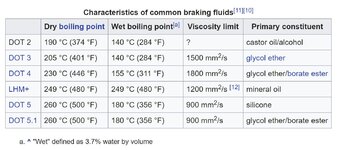
If you are getting sponginess and increased travel - then that is likely to be the fluid changing phase. I've never looked at the evaporation point of brake fluid - as I always assumed it was above the temperature that the pistons could transmit to the fluid. (bearing in mind that the temperature gradient across the pistons also tends to limit that fluid temp) I've assumed that it was water agglomeration at the lowest point in the system (at the calipers) - although again, I do wonder how much (if any) of the moisture which enters via the reservoir or whatever other susceptible points - actually transfers to the caliper areas?
Must go and see what the boiling point of brake fluid is
DOT 4 is 155°C to 230°C I believe, depending on whether it's 'wet' or 'dry' (absorbed some atmospheric moisture or not). I'd assume mine would have been in the upper range because it was a new bike so doubt that it actually boiled, but would've gotten pretty hot which I'm assuming is part of the issue. I did the same in my car and found the brakes were spongy until the fluid was changed out. Maybe I just need to slow down a bit... Haha.
Perhaps a cheap start would be to begin every track-day with fresh brake fluid?
As for M10 threads: Usually, if no thread dimension is mentioned, it is assumed to be 'standard'. For M10, the 'standard' is 1.5.
As for M10 threads: Usually, if no thread dimension is mentioned, it is assumed to be 'standard'. For M10, the 'standard' is 1.5.
Deleted account 191119001
Registered user
- Joined
- Aug 13, 2017
- Messages
- 12,798
- Reaction score
- 9
Not sure if it has been mentioned yet, but given that the brakes are linked in the GS, would this possibly cause a problem on the rear, if different energy is applied to the front, totally different from what had been tested and deemed acceptable by BMW.........
Perhaps a cheap start would be to begin every track-day with fresh brake fluid?
Potentially... I'll maybe do one and see how good/bad it is on the stock setup with the uprated pads, but I imagine that if it's getting spongy on the road it'll just be worse on the track. Not out to break any records or anything, but also don't want to have to worry about the brakes if I'm pushing on.

Not sure if it has been mentioned yet, but given that the brakes are linked in the GS, would this possibly cause a problem on the rear, if different energy is applied to the front, totally different from what had been tested and deemed acceptable by BMW.........
In theory - yes, but when there are so many other variables in play (chief of which - I think is the mass balance of the fat rider and his fat pillion....... and the transfer of weight forward under braking)

fred_jb
Registered user
Brakes fade due to heat-induced impairment of the pad/disc friction. Brake fluid will heat up locally, and may change phase (or included water will) and cause an increase in the volume of the now 2-phase fluid. This can push fluid out of the reservoir.
But - when brake pressure is re-applied, it returns to liquid phase due to the elevated boiling temperature of the increase in pressure.
Two-phase brake fluid only causes sponginess (and loss of fluid from the reservoir) - not brake fade. IMO
I always thought that as soon as you have anything, be it water or brake fluid, turn to gaseous form in the brake line you inevitably lose braking effectiveness which is what most people would describe as brake fade. As I understand it, unlike brake fluid and most other liquids, gas is readily compressible and therefore absorbs the brake lever movement without transmitting the full force to the pads. I think it unlikely that the gas will almost instantaneously return to the liquid phase as pressure is applied, and therefore will not do so in time to avoid losing braking force. It is only by being heavily compressed that it will be encouraged to return to liquid, and by then loss of braking has already happened.
Not sure if it has been mentioned yet, but given that the brakes are linked in the GS, would this possibly cause a problem on the rear, if different energy is applied to the front, totally different from what had been tested and deemed acceptable by BMW.........
It's a good point, and one that I was curious about. As Blackal has said, there's a lot of factors that could affect in even more in normal operation so I'd like to think that there's either some computer intelligence involved or the system doesn't apply the rear as much as you think. I'm just thinking if you were fully loaded with luggage and a pillion the rear brake could be applied significantly more, so don't know if the system takes that into account or if it would just apply the standard amount.
Deleted account 191119001
Registered user
- Joined
- Aug 13, 2017
- Messages
- 12,798
- Reaction score
- 9
In theory - yes, but when there are so many other variables in play (chief of which - I think is the mass balance of the fat rider and his fat pillion....... and the transfer of weight forward under braking)
do the fatties do track days...........I always thought that as soon as you have anything, be it water or brake fluid, turn to gaseous form in the brake line you inevitably lose braking effectiveness which is what most people would describe as brake fade. As I understand it, unlike brake fluid and most other liquids, gas is compressible and therefore absorbs the brake lever movement without transmitting the full force to the pads. I think it unlikely that the gas will almost instantaneously return to the liquid phase as pressure is applied, and therefore will not do so in time to avoid losing braking force. It is only by being heavily compressed that it will be encouraged to return to liquid, and by then loss of braking has already happened.
It is, to all intents and purposes (intensive purposes for Tarka
) a 'static system' and as such - pressure is pressure. By that I mean - that as the fluid hardly moves between just-touching the disc and full-on braking - there is no dynamic factor to consider.As for the change (back) in phase to liquid -the time it takes follows exactly the time to apply the force. If there is any hysteresis - then it is minimal.
fred_jb
Registered user
It is, to all intents and purposes (intensive purposes for Tarka
As for the change (back) in phase to liquid -the time it takes follows exactly the time to apply the force. If there is any hysteresis - then it is minimal.
I remain unconvinced. To my mind regardless of how minimal the movement that needs to be imparted to the pistons, there is a difference between simply putting them in contact with the pads and actually exerting useful amounts of force to get the level of friction required. In this sense pushing on the piston with liquid is like using a metal rod to apply pressure, while doing so with any gas in the system is akin to trying to apply pressure to the piston with a rod made out of foam rubber! After all, is that not the reason why we have to bleed brakes to ensure there is no air in the system?

Similar threads


- Replies
- 3
- Views
- 1,334