Radio interference from DRLs on 1200RT

Then the interference is not radiated, it is conducted.

It is noise current generated by the DRLs 'pulling' pulses of current from the bikes battery at a relatively high frequency, maybe 10's of kHz. The battery is normally a low enough impedance (at low frequencies at least) to remove this noise, however at higher frequencies the battery will not be a good capacitor. Try adding a small polyester type capacitor - say 1uF/50V for starters across the DRL power wires, try at the battery end first, but you may need to add it the DRL end, but I guess you might have to break into the wires, which is awkward.

I would guess that the Cyclops kit would be some sort of power filter that goes in series with the DRL power leads.

Also....would it be necessary to fit a capacitor to the trigger wire that comes from the relay to one of the bikes wires, that becomes live when ignition is turned on?
 
Also....would it be necessary to fit a capacitor to the trigger wire that comes from the relay to one of the bikes wires, that becomes live when ignition is turned on?
I have been away for the weekend so my apologies for not getting back to you.

I haven't see the wiring for these lights so I am making some assumptions. I assume that there is a pair of wires from these lamps that need to connect back to the battery via a relay and fuse of some sort. The capacitor should be a cross the +ve and -ve of these wires, these will be the wires that carry the current to the lamps. My first experiment would be to add the capacitor on these wires somewhere near the relay, and see what happens. You shouldn't need a capacitor on the trigger wire for the relay.

A photo of the set up would be helpful and or a wiring diagram if you have one.

As long as the capacitor has a sufficient voltage rating it will be fine - try something of at least 50V or higher - maybe something like this to start.
 
Try some different LED bulbs. I fitted LEDs to my VW T5 DLRs and got radio interference, changed the bulbs to a different make of LED and problem gone. Why?, I have no idea.
 
I have been away for the weekend so my apologies for not getting back to you.

I haven't see the wiring for these lights so I am making some assumptions. I assume that there is a pair of wires from these lamps that need to connect back to the battery via a relay and fuse of some sort. The capacitor should be a cross the +ve and -ve of these wires, these will be the wires that carry the current to the lamps. My first experiment would be to add the capacitor on these wires somewhere near the relay, and see what happens. You shouldn't need a capacitor on the trigger wire for the relay.

A photo of the set up would be helpful and or a wiring diagram if you have one.

As long as the capacitor has a sufficient voltage rating it will be fine - try something of at least 50V or higher - maybe something like this to start.
Unable to provide a wiring diagrame, not sure how to insert.
The DRLs came with a wiring harness. Your assumption is correct.
When you say "The capacitor should be a cross the +ve and -ve of these wires" I'm not understanding fully. Would I cut both the +positive and the -negative wires and fit one capacitor to each of the wires, assuming to keep the +positive and -negative separate?
 
Unable to provide a wiring diagrame, not sure how to insert.
The DRLs came with a wiring harness. Your assumption is correct.
When you say "The capacitor should be a cross the +ve and -ve of these wires" I'm not understanding fully. Would I cut both the +positive and the -negative wires and fit one capacitor to each of the wires, assuming to keep the +positive and -negative separate?
It is always difficult without a diagram or picture :)

How many wires are there on the lamps, is it just two wires to take the feed to the battery to both lamps or 4?

Any chance of a photo?

A link to the parts on amazon?
 
It is always difficult without a diagram or picture :)

How many wires are there on the lamps, is it just two wires to take the feed to the battery to both lamps or 4?

Any chance of a photo?

A link to the parts on amazon?
Hopefully the link below works.
Not sure how to insert a photo, I'm not a tech person, a retired builder. :cautious:
A +positive and a -negative wire connect battery to relay. Then two cables (each containg one +positive & one -negative wires) come from the relay to each of the DRLs via a waterproof connection block.


https://www.amazon.co.uk/Additionne...4&sprefix=motorcycle+auxi,aps,92&sr=8-33&th=1
 
OK I have taken a look at this now and to be honest unless you are competent with soldering, joining and re-insulating the wires (with heatshrink) then I wouldn't try installing a capacitor or capacitors.

Having said that - the best place to place capacitors is as close to those plug-in waterproof connectors as you can - there should be two wires under the insulation, you would need to cut the wires and solder a capacitor between the two inner wires, then rejoin the wires and re-insulate the capacitor, solder joints and then cover the whole 'capacitor and solder joint section' with another layer of waterproof insulation - a tricky job!

A less good place is close to the fuse - again cutting the wires stripping them back and soldering a capacitor between the red and black wires, but again you need to be proficient in soldering and wiring.

If someone sells a filter box to reduce the interference with all the correct connectors on it then get one of those.

However the very best solution is to sell or junk those Amazon DRLs and but the properly designed BMW ones.
 
OK I have taken a look at this now and to be honest unless you are competent with soldering, joining and re-insulating the wires (with heatshrink) then I wouldn't try installing a capacitor or capacitors.

Having said that - the best place to place capacitors is as close to those plug-in waterproof connectors as you can - there should be two wires under the insulation, you would need to cut the wires and solder a capacitor between the two inner wires, then rejoin the wires and re-insulate the capacitor, solder joints and then cover the whole 'capacitor and solder joint section' with another layer of waterproof insulation - a tricky job!

A less good place is close to the fuse - again cutting the wires stripping them back and soldering a capacitor between the red and black wires, but again you need to be proficient in soldering and wiring.

If someone sells a filter box to reduce the interference with all the correct connectors on it then get one of those.

However the very best solution is to sell or junk those Amazon DRLs and but the properly designed BMW ones.
I purchased some capacitors, the lowest ones I could get were 62v. But before cutting into the harness I set up a separate battery wired directly to the DRLs. The capacitors connected to the positive and negative wires near to the DRLs. Connect wires to the battery.......DRLs did not come on, so I assume the capacitors stopped all power.
I appreciate everyones help in this matter but I've now decided to not to go any further with this. So its radio OR DRLs, not both at the same time.
 
I purchased some capacitors, the lowest ones I could get were 62v. But before cutting into the harness I set up a separate battery wired directly to the DRLs. The capacitors connected to the positive and negative wires near to the DRLs. Connect wires to the battery.......DRLs did not come on, so I assume the capacitors stopped all power.
I appreciate everyones help in this matter but I've now decided to not to go any further with this. So its radio OR DRLs, not both at the same time.
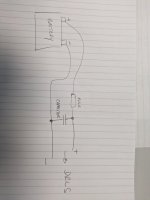
A correctly connected capacitor 'across' the +ve and -ve power supply wires will not 'stop the power' - a capacitor is effectively an open circuit to d.c. Did you connected the capacitor in series with the wires? this would stop the power. You only need one capacitor across the + and -.
 
A quick sketch of where the capacitor should go

PXL_20240319_123249896.jpgo.
 
Capacitor now fitted as your sketch and now the radio gets NO interference from the DRLs.
I must thank you again for helping me to overcome this problem. Hopefully this may be helpful to anyone else with the same problem.
That is great news - I'm pleased that you got it sorted :)

Out of curiosity what was the value of the capacitor - have you got a link to where you bought it?
 
Capacitor from a local supplier.......1uF 100v Metallised Polyester Film Capacitor.
OK that sounds like a good choice, I was slightly concerned that you may have got an polarised electrolytic type which would have needed to have been connected the right way round (otherwise they go pop!) - but polyester film should be fine.
 
wouldnt this drain his battery quickly?
Why do you say that? - a capacitor is an infinite impedance to DC.

modulus of Z= 1/(2 x pi x f x C), where f = frequency, C = Capacitance. So when f = 0, Z = infinity.

Any capacitor will have a small leakage current, a 100V metalized polyester capacitor operated at 12V will be in the nA region, so not an issue.

How long have you been doing electronics?
 
I
Why do you say that? - a capacitor is an infinite impedance to DC.

modulus of Z= 1/(2 x pi x f x C), where f = frequency, C = Capacitance. So when f = 0, Z = infinity.

Any capacitor will have a small leakage current, a 100V metalized polyester capacitor operated at 12V will be in the nA region, so not an issue.

How long have you been doing electronics?
I would have added a switch to turn them off 🤣🤣


Back
Top Bottom