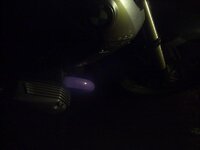
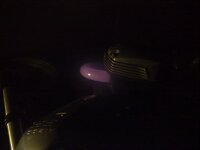
red hot downpipes (LITERALLY)

mark2jag

Registered user
Joined
Nov 25, 2008
Messages
1,550
Reaction score
0
Location
Camberley, Surrey
Was running the bike from cold in the dark tonight and after no more than a few minutes running Just happened to notice that the down pipes were so hot they were actually glowing cherry red. Its the same intensity on both pipes, and I would like to know if this is what you would normally expect or not.... Maybe of relevance but it has been run out of fuel yesterday (dodgy fuel gauge)but refilled and ran absolutely fine. In short ............... HELP!!!!!! (ah yes by the way its a 58 plate 1200GS, er nearly forgot to mention it, even though this is the 1200GS forum,lol
 
Last edited:
I can't be arsed to type it out again :blast

You see that book that came with the bike ?

well, see where it says that you shouldn't sit with a boxer engine running without moving?

now you know why , don't you ;)
 
Totally normal. Useful as an indicator of why you shouldn't use them to hold onto if you fall over / need to kneel down next to them.

For a really good effect, try running the engine at around 4000 revs for a couple of minutes and then see them glow :cool: Not recommended to do too often, and don't leave the engine running for more than a few minutes when stationary.
 
I can remember dealer telling me this when I got my first boxer...dont run it stationary ..

Just for the crack, any pictures??
 
Just for the crack, any pictures??

:postpics

Whenever I saw this along with the comment "I have always wanted to do that" I was struck by the thought "poor sod". Now I am that Poor Sod.
 
Hot exhaust pipes

Takes me back to the days when you could buy beautiful ex RAF leather gloves for next to nothing; At a traffic light in the winter i would lean forward on my BSA twin and grip the pipes until I could smell and feel the warmth ! The gloves did have wiring for heating but I think it was 24 volts (?) and dynamos were not too powerful.
 
Was running the bike from cold in the dark tonight and after no more than a few minutes running Just happened to notice that the down pipes were so hot they were actually glowing cherry red. Its the same intensity on both pipes, and I would like to know if this is what you would normally expect or not.... Maybe of relevance but it has been run out of fuel yesterday (dodgy fuel gauge)but refilled and ran absolutely fine. In short ............... HELP!!!!!! (ah yes by the way its a 58 plate 1200GS, er nearly forgot to mention it, even though this is the 1200GS forum,lol

Normal - but don't run it for too long when stationary - might overheat - says so in the Manual - DOH!
 
A couple of months ago at my dealers' I watched a mechanic strip a boxer engine (not 1200, BTW) that had overheated. The insides were looking nasty.
'Customer let his bike 'warm up' while he was inside having a coffee', the mechanic says with a grin. 'Some people just won't accept that the best thing to do after start is ride off immediately.'
 
'Customer let his bike 'warm up' while he was inside having a coffee', the mechanic says with a grin. 'Some people just won't accept that the best thing to do after start is ride off immediately.'
I let mine 'warm up' from cold, not long enough to have a coffee though!....how long does it take to have a coffee?
 
Glowing pipes isn't a new thing - BMW's did the same back in the 70's and 80's .
 
Slightly off thread!

What about glowing brake discs? Who else was at a Goodwood nine hour race and watched an Aston Martin coming in to the pits with red hot discs and then going up in flames when refuelling?
 
"...I let mine 'warm up' from cold,..." Why?

There are 2 good reasons to let the bike warm up a bit.

1) It allows the oil to get fully around then engine before you put any real strain on it. (although this takes just seconds).
2) Many components in any engine do not actually fit when the engine is cold.

For example, when cold, the valves are not the correct length (hence the clearance for cold valves - the exhaust clearance being bigger than the inlet as it gets hotter and expands more).
Pistons do not have straight sides, when cold they are tapered in at the crown slightly and they are too small for the bores, when used, the crown gets hotter than the rest of the piston and straigtens it out. Acceleration too early can send the pistons rattling up and down the barrel and cause excessive wear. When they warm up they fit correctly but when allowed to overheat by not allowing cool air to run through the radiator and fins they become overlarge - guess what happens then.

This is generally why liquid cooled engines have more power than air cooled ones as they can control the overall temperature of the engine (and hence tolerances) to within a few degrees. The BMW boxer is somewhere between liquid and air cooled having a measure of both.

Just my 2 cents worth.
 
As one engineer to another

There are 2 good reasons to let the bike warm up a bit.

1) It allows the oil to get fully around then engine before you put any real strain on it. (although this takes just seconds).
2) Many components in any engine do not actually fit when the engine is cold.

For example, when cold, the valves are not the correct length (hence the clearance for cold valves - the exhaust clearance being bigger than the inlet as it gets hotter and expands more).
Pistons do not have straight sides, when cold they are tapered in at the crown slightly and they are too small for the bores, when used, the crown gets hotter than the rest of the piston and straigtens it out. Acceleration too early can send the pistons rattling up and down the barrel and cause excessive wear. When they warm up they fit correctly but when allowed to overheat by not allowing cool air to run through the radiator and fins they become overlarge - guess what happens then.

This is generally why liquid cooled engines have more power than air cooled ones as they can control the overall temperature of the engine (and hence tolerances) to within a few degrees. The BMW boxer is somewhere between liquid and air cooled having a measure of both.

Just my 2 cents worth.
Thanks for that information, it all makes sense and is in line with what we have been taught... but probaly materials and lubricants have improved incredibly since I learnt anyway.. However in my (French) handbook it says under the heading Fire risk - "Ne pas faire tourner le moteur inutilement à l'arrêt.; Partir immédiatement après le demarrage." Some may appreciate a translation - it means... don't run the motor unneccesarily when the bike is at rest; leave immediately after starting up.
 
There are 2 good reasons to let the bike warm up a bit.

1) It allows the oil to get fully around then engine before you put any real strain on it. (although this takes just seconds).
2) Many components in any engine do not actually fit when the engine is cold.

For example, when cold, the valves are not the correct length (hence the clearance for cold valves - the exhaust clearance being bigger than the inlet as it gets hotter and expands more).
Pistons do not have straight sides, when cold they are tapered in at the crown slightly and they are too small for the bores, when used, the crown gets hotter than the rest of the piston and straigtens it out. Acceleration too early can send the pistons rattling up and down the barrel and cause excessive wear. When they warm up they fit correctly but when allowed to overheat by not allowing cool air to run through the radiator and fins they become overlarge - guess what happens then.

This is generally why liquid cooled engines have more power than air cooled ones as they can control the overall temperature of the engine (and hence tolerances) to within a few degrees. The BMW boxer is somewhere between liquid and air cooled having a measure of both.

Just my 2 cents worth.
.


generally I´m at one with Old Git Ray, because the aspect of red pipes is prior an effective result of thermal capacity built by the surrounding material, which is really thin at the pipes in conjunction with simultaneously high exaust gas temperatures at this location, but on the other hand having a relatively huge surface for e. g. at the cooling fins of the cylinders.
This should indead allow to heat up the engine for an appropriate period of time to improve and maintain proper working clearances of parts.
In this context the realisation of a specially designed separate oil circuit provides sufficient cooling of the the critical hot spots.
In comparison this deserves the remark of a big effort in development regarding reducing complexity to avoid for example additional expense for a water cooling system.
At the same time extended stop and go in the city traffic should not go beyond the scope of healthy operating conditions.


Best


.


Back
Top Bottom