Running rough, won't idle, loud thumping

Sorry to hear that you have no compression With a bit of luck it'll be a valve and you can slap a couple in and get back on the road quickly

Do the head strip at TDC on the cylinder that you are taking off i.e. Inlet valve just closed and piston crown at the top of that bore

Examine the bore for gouges or scrapes in case something fell off and went thru
 
South London checked it out and said there was zero compression on the right.... was very suprised at zero - me and a mate will be stripping it down tomorrow to have a look, I hope for the best :eek:

Simple checks first Rupert, whip off the RH rocker cover and check the valve clearances. If one is zero, chances are the dreaded valve head failure has happened. Also check BOTH spark plugs are tight.

Best of luck Rupert, let us know how it goes and take plenty of pics. Expecting the worst but hoping for the best.

Fingers are crossed for you.
 
If valve clearances are Ok it could be a burnt valve - usually exhaust. Enough compression when it's revving to fire that cylinder but not at tick-over. Happened to me on an 1150 and hence it turned into a single below 1500 rpm.

Easy enough to fix and shouldn't have done much damage as long as it's not eaten the valve seat in the head.

Can be caused by valve clearances being set too tight hence valve doesn't sit on the seat and can't lose heat to the head.
 
South London checked it out and said there was zero compression on the right.... was very suprised at zero - me and a mate will be stripping it down tomorrow to have a look, I hope for the best :eek:

Any news yet Rupert??
 
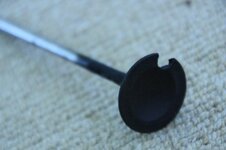
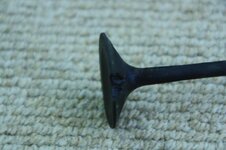
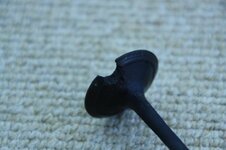
I got the bike back today - was a burnt out valve. I think he said it was the intake - it is the smaller diameter. Thanks for all for the help :beerjug: Photos:
 

Attachments

  • IMG_3032.jpg
    IMG_3032.jpg
    30.3 KB · Views: 191
  • IMG_3033.jpg
    IMG_3033.jpg
    44.3 KB · Views: 190
  • IMG_3034.jpg
    IMG_3034.jpg
    37.9 KB · Views: 189
It's a 2005 with 62.5k on the clock. What would cause the valve to burn? Is it just chance? The bike was due a service but not over due...
 
Rupert, I believe that is the exhaust valve.

That appears to be some serious localised burning of the one area of that valve through flame impingement or continuous hot gas flow.

I suspect that the valve must have become stuck open somehow as valves usually rotate in use on their seats with use and dissipate the heat into the valve seat each time the valve fully closes, preventing localised overheating such as this. If they can't close and transfer the heat, they burn out. We are talking tiny amounts, perhaps a thousandth of an inch (in old money) lifted off the valve seat which is why having your valve clearances checked at every service is so important (I check mine every 4000 miles when I change the oil).

Was the valve found to be a very tight fit in the guide by any chance, or held tight through a build-up of carbon deposits on the valve stem ????

It is also looks like there is a fair amount of carbon build up which I would not have expected to see at a valve running in high enough combustion chamber temperatures to burn away the metal. Carbon deposits usually form below 350 Centigrade, hence I suspect a jammed valve or tight valve guide .

I would be tempted now it is rebuilt to:

1) Use an upper cylinder fuel treatment additive occasionally (Redex etc).
2) Take the bike on an occasional good fast run to clear out deposits (Italian tune-up).
3) Use a good grade of fuel eg super unleaded and not cheapo supermarket fuel.
4) Get the valve clearances checked by a trusted person regularly until the new valve is bedded in fully.

I'd say you got lucky Rupert, well done for erring on the cautious side and investigating properly rather than trying to keep riding it. Any longer and the valve head would fail and smash up the head, piston crown and barrel resulting in a very expensive rebuild.
 
Incidentally, does your bike spend a lot of time sitting in traffic queues due to living/working up in the smoke?

A long period at idle every day could well lead to lower overall combustion chamber temperatures, resulting in poor/incomplete combustion with increased carbon build up leading to the valve failure you experienced.

Just a hunch, assuming your valve clearances weren't set too tight at the previous service..:nenau
 
I'd say you got lucky Rupert, well done for erring on the cautious side and investigating properly rather than trying to keep riding it. Any longer and the valve head would fail and smash up the head, piston crown and barrel resulting in a very expensive rebuild.


yes. i'd say you were possibly on course for the infamous 1200 RH cylinder destruction event.
 
Spot on Cookie.

Maybe worth a letter to BMW with a photo of your valve problem Rupert?

After so many reported failures on 1200 variants this could be the rare (and precious)evidence seen just before one of these engines really does go bang as it is usually too late or expensive to analyse the debris afterwards.
 
I don't necessarily see a link between this failure and the more serious engine destruction events.

A burnt valve is, as has been pointed out, often due to the valve not closing properly. Years ago (like 40+) engines could suffer from carbon build up and poor materials so that proper seating in the head deteriorated. But that was then and we've moved on a very long way. What we're talking about here is a situation where only a tiny gap needs to develop to allow very high pressure gasses to escape between the seat and valve when the mixture goes bang, the most likely cause is insufficient valve clearance which prevents the valve seating, raises the valve temperature and probably over the long term promotes pitting of the seat. Once sufficient gas begins to escape through the largest gap everything goes very rapidly downhill as it will cut a groove in the valve edge like an oxyacetalyne torch. It'll fail in minutes, but not catastrophically

I've no proof, but from the pictures people have posted of wrecked heads, it's due to the heads coming off the valve, which is something different. This is either it's due to the piston to walloping the valve (overevving/stuck valve) or the valve head has snapped off due to some sort of metal fatigue, possibly at the point where the head is welded to the stem.

I'm sure there are some proper metallurgist tossers out there who could shed light on this, even if it's to tell me I'l talking b***cks.
 
A fair comment Rick.

Without either destructive testing methods, examination of the fracture surfaces or the use of a scanning electron microscope it is difficult to come up with a definitive answer for the failure mode should a valve head snap off. It is most likely due to brittle fracture of the heat affected zone with welded valve heads. This produces the formation of dislocations at the grain boundaries in the metal structure, leading to cracking and eventual failure.

No argument that the valve in Ruperts bike was most likely permanently unseated, resulting in the burning. Why it happened is the real question: Incorrect valve clearances or a stuck valve/guide?

And if a stuck valve guide, again why? Is it due to carbon build up on the stem of the valve, causing jamming in its guide and a failure to fully close?
 
I'm with Rick on this.
My first suspicion would be overtight valve clearances - easy mistake to make - use the intake feeler on the exhaust? Hence my earlier question about who services the bike.

Once a valve starts to burn and starts a tiny leak in one area, it slowly eats away until you get Ruperts valve.
 
And if a stuck valve guide, again why? Is it due to carbon build up on the stem of the valve, causing jamming in its guide and a failure to fully close?


I guess I have trouble seeing this happening on a modern engine. Sure head carbonisation was an issue many years ago but I've stripped a few engines in the last 30-odd years and they are normally pretty clean, especially as guide oil seals are used. Ok, maybe an old diesel may be a mess but usually not a modern bike engine.

I was prompted to dig out the burnt valve that let go on my 1150 (at about 70k miles I think). There's little evidence of carbon other than a thin brown crust on the rear, the valve seating face, however, is far from smooth and shows a lot of light pitting.
 
The valve clearances were done at City Bike Service, the guy seemed to know what he was doing...the service was about 10 months ago. Would dropping a bike have any affect on valves?

 
Would dropping a bike have any affect on valves?

Rupert, that depends if the locknut was correctly tightened on the follower but generally no, dropping a bike shouldn't change the valve clearance settings.

I suspect that an honest error could have been made during servicing with the exhaust valve clearance adjusted to the setting for the inlet valves, resulting in insufficient running clearance when hot. Thats purely speculation of course, though but it would explain how an exhaust valve could burn out in an otherwise sound engine.


Back
Top Bottom