Starting Issues - 2005 GS

Have you tried jumping directly from your spare car battery or the SUV but without the bike battery fitted?

Also, when you are hooking up all these spare batteries/cables etc are the connections really good? Crocodile clips (on jump leads for example) make notoriously poor connections due to only having point-contact and are thus unable to flow the large amounts of current through them a starter motor requires.
 
Have you tried jumping directly from your spare car battery or the SUV but without the bike battery fitted?

Also, when you are hooking up all these spare batteries/cables etc are the connections really good? Crocodile clips (on jump leads for example) make notoriously poor connections due to only having point-contact and are thus unable to flow the large amounts of current through them a starter motor requires.
That's a good point... several good points.

No, I have not tried a car battery hooked straight up to the +ve and -ve leads of the bike, I'll give that a go tomorrow. And yes, I have been using jump leads with croc clips, so I'll see about much more solid connections.
 
With the jump battery disconnected, the voltage on the bike battery is about 12.5 volts, the voltage drops to about 2.2v when I use my get around to try and turn the engine over and then returns to 12v as soon as the load is removed.
Where did you see that 2.2V, across the battery terminals whilst attempting cranking?
That is an unusually low voltage, a 12V battery is considered knackered when it drops to under 9V whilst loaded so your 2.2V suggests something very odd going on (if it isn’t the battery itself which is faulty).
Removing the bike battery as suggested above will eliminate that possibility.
More testing for you tomorrow!!
 
Where did you see that 2.2V, across the battery terminals whilst attempting cranking?
That is an unusually low voltage, a 12V battery is considered knackered when it drops to under 9V whilst loaded so your 2.2V suggests something very odd going on (if it isn’t the battery itself which is faulty).
Removing the bike battery as suggested above will eliminate that possibility.
More testing for you tomorrow!!
I put a meter across the battery terminals while I turned the bike over. That's where I got the readings.

I am still convinced there is some corrosion somewhere I have yet to find it, because a volt drop like that is pretty close to a short circuit, especially as the voltage jumped straight back up the 12 volts afterwards. Unfortunately there are no sparks or smells of burning to help pinpoint the culprit!

I have tested the continuity of all the major +ve and -ve leads, on the lowest Ohm range on my garage meter and I am not seeing any resistance at all. Even testing from the battery -ve to the body of the alternator showed nothing.

The thing is, the bike was going fine until it was parked up and then put under a cover. I believe it was last ridden around a year ago when it was taken for an MOT, which doesn't mean it was perfect, but at least it was running.

As you say.... more testing, testing 123!
 
Have you swapped out the solenoid?
No, it's a brand spanking new starter... which shows exactly the same fault as the unit I took out.

I have by passed the relay of the starter button circuit. That improved things in that at least the motor turned over, but only of a few lumpy revs.
 
No, it's a brand spanking new starter... which shows exactly the same fault as the unit I took out.

I have by passed the relay of the starter button circuit. That improved things in that at least the motor turned over, but only of a few lumpy revs.
Sorry, it was the relay I was referring to, I guess you’ll have to check continuity / resistance on each and every cable. After that look for voltage leakage to earth on any and all +12v connections and wires
 
Sorry, it was the relay I was referring to, I guess you’ll have to check continuity / resistance on each and every cable. After that look for voltage leakage to earth on any and all +12v connections and wires
Hmmmm, deep joy!
 
Is the starter button shorting out.?
Not according to my multimeter, but I bypassed it completely with a link wire direct from the starter solenoid to the battery and the bike still won't turn over for more than a few slow revs.
 
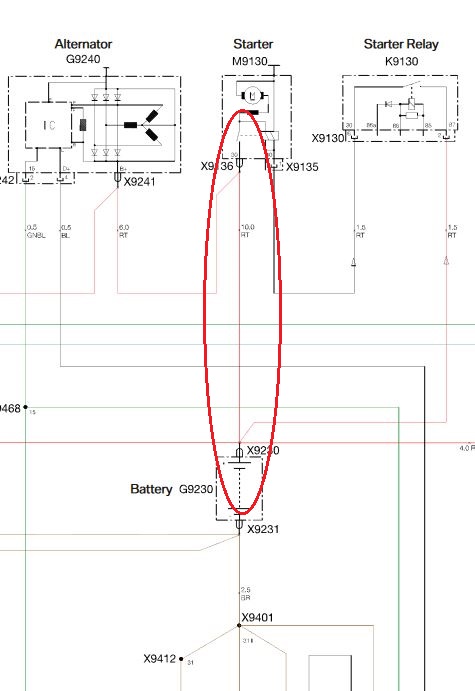
Is there a separate, dedicated heavy duty cable from the battery to the starter motor on those models or do the battery cables just dissapear into the main wiring harness?
What does the relay under the seat do, is that a relay which then operates the starter solenoid? I suppose that makes sense as even the solenoid will pull a fair few amps which you wouldn`t want to go through the start circuit/handlebar switches etc. Canbus, innit.
If you are doing more testing today and getting nowhere it might be worth hooking up a temporary cable direct from the battery +ve terminal to the starter motor solenoid (where the original cable connects) to eliminate any potential issues the original cable may be hiding along the way.
I assume the earth return path on those models is via the starter motor body/engine/frame? Any other earth straps on the engine/bike that may have corroded and giving high resistance?
I bet when you do find the fault it is related to the long-term lay up, bikes can deteriorate just sat there being unused - especially if stored outside, and problems can appear anywhere.
If it`s not electrical you could be looking at something more sinister such as moisture having reached the cylinders and caused a bit of corrosion and related resistance to piston movement. I know you`ve rotated the engine over via the crank and it`ll turn with the rear wheel while in gear but have you taken the plugs out and rotated the engine, what did it feel like. Smooth and with the normal resistance you would expect from turning an engine over?
 
if you bump start the bike and it all runs well and the alternator is pushing 14+V then the important stuff is OK... then its a duff battery, dodgy wiring, or the new starter is broken

if you have a second big battery in circuit (with good connections) and it still drops to 2V on cranking, I'd say the engine is seized or the new starter is broken
 
Is there a separate, dedicated heavy duty cable from the battery to the starter motor on those models or do the battery cables just dissapear into the main wiring harness?
What does the relay under the seat do, is that a relay which then operates the starter solenoid? I suppose that makes sense as even the solenoid will pull a fair few amps which you wouldn`t want to go through the start circuit/handlebar switches etc. Canbus, innit.
If you are doing more testing today and getting nowhere it might be worth hooking up a temporary cable direct from the battery +ve terminal to the starter motor solenoid (where the original cable connects) to eliminate any potential issues the original cable may be hiding along the way.
I assume the earth return path on those models is via the starter motor body/engine/frame? Any other earth straps on the engine/bike that may have corroded and giving high resistance?
I bet when you do find the fault it is related to the long-term lay up, bikes can deteriorate just sat there being unused - especially if stored outside, and problems can appear anywhere.
If it`s not electrical you could be looking at something more sinister such as moisture having reached the cylinders and caused a bit of corrosion and related resistance to piston movement. I know you`ve rotated the engine over via the crank and it`ll turn with the rear wheel while in gear but have you taken the plugs out and rotated the engine, what did it feel like. Smooth and with the normal resistance you would expect from turning an engine over?
Lots to reply to.

The +ve just disappears and linking a wire from the battery direct to the solenoid seems to upset the system as the LCD screen goes blank.

Spot on with the relay under the seat. It operates when the starter button on the grip is pressed, so I assume it means all the heavy current runs through a short length of cable from battery to solenoid rather than all the way up to the handlebars... and back.

The Earth strap seems to go direct from the -ve terminal to a T25 screw on top of the engine. This was extremely corroded... but isn't any more!... that cable is now on my suspects list, as -ve cables tend to suffer long term with black corrosion.

I've turned the engine over on the nut at the front of the crank with all four plugs out. It feels smooth and there are no rough spots where it feels like it's binding.

My feeling regarding storage is the same as yours. I once sorted the electrics on a long term 'dry' stored K100. That was a long process, front to back, circuit by circuit, connector by connector. We got there in the end... and so will I.

I am not ruling out rodent damage!
 
Smiffy. I'll take your advice, but I am not sure how putting 12 to 14v into a 12v battery can fry electronics.
The alternator on the car has a regulator which controls the current to the rotor, which controls the strength of it's magnetic field, which in turn controls the output. When you are cranking the bike, the car alternator will be giving maximum output. When you let go of the starter button, the car alternator is still giving its all, so the voltage will start to rise. The regulator will cut the field current to correct the voltage, but a magnetic field takes a finite time to collapse, so for a moment you can get a much higher voltage than desired.
 
With the jump battery disconnected, the voltage on the bike battery is about 12.5 volts, the voltage drops to about 2.2v when I use my get around to try and turn the engine over and then returns to 12v as soon as the load is removed.
That strongly suggests that the battery has gone high internal resistance. Best bet is to get it tested with a battery tester that places selling batteries will have, try Halfords. And a warning about Tayna. My pal bought a battery that their website recommended for a GS1200, he then had problems like yours, and took it back (he lives near enough to do that). They said that that battery should not have been used on a big twin, and would only give him a partial refund. You need to get a battery with a really high CCA rating, like the Yuasa 240CCA. With one of those, your battery terminal should stay above 9.0 volts while cranking.
 
That strongly suggests that the battery has gone high internal resistance. Best bet is to get it tested with a battery tester that places selling batteries will have, try Halfords. And a warning about Tayna. My pal bought a battery that their website recommended for a GS1200, he then had problems like yours, and took it back (he lives near enough to do that). They said that that battery should not have been used on a big twin, and would only give him a partial refund. You need to get a battery with a really high CCA rating, like the Yuasa 240CCA. With one of those, your battery terminal should stay above 9.0 volts while cranking.
The motobatt is 240cca if i recall
Not near the bikebbut cant call the number of my head
 
I put a meter across the battery terminals while I turned the bike over. That's where I got the readings.

I am still convinced there is some corrosion somewhere I have yet to find it, because a volt drop like that is pretty close to a short circuit, especially as the voltage jumped straight back up the 12 volts afterwards. Unfortunately there are no sparks or smells of burning to help pinpoint the culprit!

I have tested the continuity of all the major +ve and -ve leads, on the lowest Ohm range on my garage meter and I am not seeing any resistance at all. Even testing from the battery -ve to the body of the alternator showed nothing.

The thing is, the bike was going fine until it was parked up and then put under a cover. I believe it was last ridden around a year ago when it was taken for an MOT, which doesn't mean it was perfect, but at least it was running.

As you say.... more testing, testing 123!
I think that you're electrical theory is confused. Corrosion in an electrical circuit normally causes high resistance not a short circuit. Shorts are the result of no or very little resistance and therefore result in high current flow. I =V over R. Voltage 12v divided by 0 ohms equals 12 amps, a short circuit. Have you compared the resistance through the 2 different starter motors? Do you have access to an amp meter, it would be interesting to see what current is being drawn by the starter supply cables.
 
Hows the testing going!?
Bypassing the cable from battery +ve to the solenoid should have no effects as it`s only replicating what`s already there. It`s effectively open circuit until the solenoid pulls the contacts closed to the motor. Unless there is something amiss with that cable....;


I still think you`ve got a duff battery (2.2V under load) plus maybe an additional wiring fault somewhere just to complicate things...
 
I had the same issue, turns out a 12v wire to the solenoid was not getting full power, here's a copy and paste from my thread when I solved the issue:

Key in, ignition comes on, no warning messages on the dashboard, but the starter motor is not turning the engine over;

1. Check battery, if the lights go dim and you can hear a loud clicking sound as the solenoid tries to kick in, chances are the battery has low charge. Recharge or replace.
2. If the battery is good, can you hear the relay faintly clicking as you push the starter button? (Its under the front seat on up-to 2007 bikes, under the tank on later model hexheads, not sure about twin-cams and toilets).
3. The relay is clicking? Good. To save a lot of time and hassle, do this next: Remove the cover over the starter motor (one screw and pull it back and off).
4. You can now see the thin black wire that goes to the solenoid. Pull it off. Now connect (i.e. just touch) a wire from your battery +ve terminal direct to the spade connector the black wire went to. The starter should now kick into life, and if the ignition is switched on, the bike will start.
5. If you have access to a multimeter, put the +ve probe to the black wire, the -ve to earth. You will probably find that you have much less than 12 volts coming through, which is the cause of your problems.
6. The "official" fix: Go back to the relay, trace where the thick red wire goes to in the loom, find the dodgy connector or broken bit and re-wire/re-attach/re-solder accordingly.
7. The quick fix: Cut the thick red wire that goes to the solenoid. Cover and seal the end that goes back to the loom. Attach a new wire to the end that goes into the relay, fix the other end to the battery +ve. The bike will now start off the button as normal. Sorted! :thumb
And don't worry about that red wire being permanently live, the bike won't start without the key in and starter button being pushed. I think its permanently live anyway.

This appears to be a fairly common problem and hopefully you'll now be able to sort it a bit quicker and easier than I did!



Back
Top Bottom