stepper motors

birdseye

Registered user
Joined
Oct 18, 2004
Messages
1,224
Reaction score
0
Location
usk
reputedly these make throttle body balancing difficult - presumably because this is usually done without engine load and therefore whn the air flow isnt much above idle.

so does anybody know if you can simply disconnect the stepper motors and if so - how?
 
I don't imagine it will do any good, because you don't know what position the stepper motors will be in when you disconnect them.

Apparently the BMW diagnotic computer can "park" the steppers.

And balancing the throttles with the steppers disconnected would not do any good, if it is the steppers themselves that are causing the imbalance. As soon as they are reactivated, the imbalance will come back.

Looks like this is a problem we are stuck with, for now :(
 
The TB's can be balanced nicely at 3.5-4.5 rpms. I have done 4 differenct 12GS's and they all ran with less vibs after.

Hi Peter!
Cheers,
Marty
 
Marty Hill said:
The TB's can be balanced nicely at 3.5-4.5 rpms. I have done 4 differenct 12GS's and they all ran with less vibs after.

Hi Peter!
Cheers,
Marty

Marty,

Would you be so kind as to elaborate for the ignorant or point to the appropriate procedural description.

Thanks.

Terry
 
Hi Marty

Terry

BWM say that the stepper motors will interfere with the balancing of the throttle bodies above idle, and that said, the stepper motors should be parked using BWM computer GT1 before commencing balancing above idle.

But, even if you don't park em it seems worthwhile results can be obtained.

The procedure is straightforward and basically consists of:

Warming up the engine. (But don't let it idle for too long - see handbook)

Connect Carbtune or whatever measuring device you are using across both throttle bodies by removing the rubber caps and attaching hoses.

Run the engine at a steady revs above idle. Personally I do it at about 4,000 rpm but some do it as low as 2,000rpm and others go up to 5,000 rpm. Read the pressure differential on your device.

Stop the motor.

If there is a significant difference in readings ( more than 5mm is what I'd go for) raise the throttle cable outer on the lower pressure side and couple of flats on the adjuster. The aim being to reduce the difference in pressure to less than 5mm, or as equal as you can get it when the motor is running.

Restart motor and see your result, repeat the above 3 steps until you're happy.

Don't overheat the motor and if you're going to adjust your valve clearances do it before the balancing act.

Check everything is tight and remove device and refit rubber caps.

Hey presto! Smooth as a babies butt!


It's really easier to do than explain. Hope above helps.

Peter
 
Wraith,
Thanks, I'm a terrible writer. A slight difference in how I/we do it. Many of us have throttle locks(the best comes from europe)we lock the throttle at say 4k and make the adjustment with the motor running then lock the cable down. We use a fan pushing air over the cly's to keep the temps down...it works. By leaving the engine running, we can get the adjustment spot on. This way might save a bit of time.
In any event, you are right/much easier to do than to describe. As you said, always do the valves first.
 
Marty Hill said:
Wraith,
Thanks, I'm a terrible writer. A slight difference in how I/we do it. Many of us have throttle locks(the best comes from europe)we lock the throttle at say 4k and make the adjustment with the motor running then lock the cable down. We use a fan pushing air over the cly's to keep the temps down...it works. By leaving the engine running, we can get the adjustment spot on. This way might save a bit of time.
In any event, you are right/much easier to do than to describe. As you said, always do the valves first.

Where do you get the throttle locks?
 
Mouse said:
I don't imagine it will do any good, because you don't know what position the stepper motors will be in when you disconnect them.

Apparently the BMW diagnotic computer can "park" the steppers.

And balancing the throttles with the steppers disconnected would not do any good, if it is the steppers themselves that are causing the imbalance. As soon as they are reactivated, the imbalance will come back.

Looks like this is a problem we are stuck with, for now :(

Got to do some good if you think about it, Mouse. If you try to adjust the throttle bodies with the steppers in action, the steppers will be trying to do the some adjustment at the same time - thats why BM want them immobilised.

But if you balance the throttle bodies with the steppers parked up, then when you re-connect them they will be trying to balance something that is already more in balance.

Anyway, BM want them immobilised before balancing the TBs, so who am I to argue? I was simply wondering what would happen if you pulled their plugs.
 
We use a fan pushing air over the cly's to keep the temps down

Great idea, but unfortunately in the Victorian town in which I live garages are at a premium. So I have the loan of a rented Local Authority garage with no lighting or electricity.

And as for a throttle lock, a couple of girls hair bands (or elastic bands) twisted and placed between the grip and the switch block will supposedly do the trick.

Peter
 
Good morning Birdseye,

adventurersworkshop.com sells them in the US. They are called Kaoko throttle locks. The chaps name is Andrew and I am sure he would let you know where they originate. Also, perhaps Dutch knows where they come from in europe.

Wraith's solution might do as well for this project.

Cheers,

Marty
 
I was curious...

The stepper motors unbolt easily from the throttle bodies - there are no gaskets.

The "valves" can then be gently pushed back into the electrical gubbins - my assumption is then one could try balancing with the motors wired up but hanging loose and the holes blanked off with duct tape ?
 
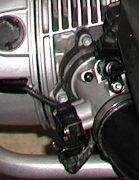
Great. So which are the stepper motors? Where are they and what do they look like.
 
Can't locate my camera so a poor crop from an existing photo. It is the bit located at the top right of the photo - with a large electrical connector and is held onto the body with two small torx bolts.
 

Attachments

  • p8250001a.jpg
    p8250001a.jpg
    6.9 KB · Views: 404
my assumption is then one could try balancing with the motors wired up but hanging l

Brilliant Clive !!!!

I wonder, after all of the discussions re stepper motors, why nobody has thought of this before?

You cannot simply disconnect the electrics to the steppers because a) you do not know where they are parked and b) may throw some sort of error with diagnostics/engine management ?

The stepper motors have no gasket, but do have an O ring
Disconnect electrics before removal and then reconnect electrics, leaving stepper motors hanging. This way diagnostics should not detect anything 'missing' when ignition is on.

What I Did Was- Plugged hole with slightly trimmed plastic wine stopper ( did not use cork in casebits of cork get sucked in ) and created good seal by wrapping cork with ptfe tape.

Then balanced engine and it does seem to run smoother but I cannot really be sure that doing this really makes a huge difference, but at least I know that the steppers have not interfered!

You can see the steppers move in and out and beware mine ejected the plungers while hanging with engine running, which were simple to screw back in.

Gently push plungers back home before relocating steppers.

Far toooo simple so I wonder what is wrong. I await the technical wisdom of any following replies, but hopefully all credit to Clive ?:D

and... p.s.

why why why have stepper motors anyway, what is wrong with an idle screw ?
 
I can see that there is maybe a small issue with playing with the stepper motors in any way.

These linear motors automatically do the adjustment at idle in response to inputs from the bikes sensors.

The BWM GT1 workshop computer parks the motors so they don't interfere with balancing above idle under no load conditions.

I've experienced the bike coming out of a service with idle balance worse than when it went in. Others have also commented on this.

I believe that this is due to the inevitable stiction in the stepper motors i.e. if you move them at all they won't necessarily return to exactly the same place.

Just something to be aware of really. Mine sorted themselves out over a few hundred miles.

Peter
 
Wraithwrider said:

I believe that this is due to the inevitable stiction in the stepper motors i.e. if you move them at all they won't necessarily return to exactly the same place.

Peter, I believe they move around more than you suspect. When I had mine off (at around 18,000 miles) the angled end valve(s) which slide in and out of the seating, was visibly scored. This implied there was substantial continual movement of the valve back and forth.
I can't really experiment further as I don't have a balancer.
 
I can see that there is maybe a small issue with playing with the stepper motors in a

That is not really what is being done, Peter.

For anyone who has not had the pleasure of looking at these motors, they are simply a reversible motor, which pushes a spiralled rod up and down, (and even out if you wait long enough !). On the end of the rod is a brass end, which blocks, or unblocks the throttle balancing orifice, which is wide, say 3-4mm, so hardly a needle valve orifice. It is really quite crude and simple.

When you switch the ignition on, the rod is withdrawn, opening the orifice. This happens before the engine is started. You can feel this vibration happening with your finger. When the engine is running, they continually move up and down.

Yes, there may be issues if they are disconnected, I do not know, but leaving these simple motors hanging, still connected, while balancing cannot, in any way that I can see, have issues.

If anyone can tell me which sensors control these steppers, I would be interested. I am also interested to know why even have stepper motors to control idle? Making things difficult, just for the sake of it, is what I think;)
:D


Back
Top Bottom