The Taming of an R90S?

Gelandestrasse

Well-known member
UKGSer Subscriber
Joined
Feb 27, 2010
Messages
1,090
Reaction score
391
Location
Salisbury, England
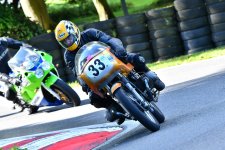
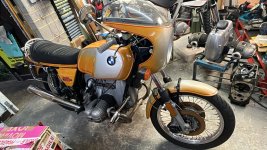
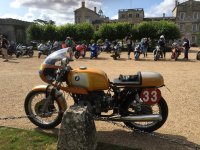
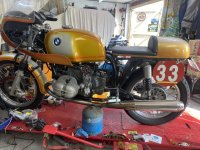
Ten years ago I took possession of this converted R90S. She had been recently imported from South Africa, having undergone a part restoration and conversion in 2011. With the engine sorted and the bodywork looking decidedly 'track bike' she held an appeal that I could just about stretch to financially. This is a picture of her in July 2019 at Wilton House. She's the sort of bike you tremble a bit at first to ride, but when you get off she made you feel like a hero! There are probably some other experiences in life like that....
IMG_6612.JPG

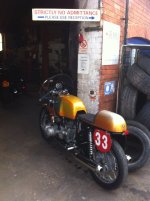
The bike I took possession of in 2015 looked more like this (taken at her first MOT for the registration process - note no numberplate even!):
IMG_1559.jpeg

The big rev counter (from an R1100) was all the information she was to give the rider and the only creature comfort was a starter motor. I had to lean her against the wall wherever I went as the stand was paddock-style back in the garage at home.

This thread will be about the conversion back to standard-looking after retiring from track-riding a couple of years ago. It is turning into a bit of a journey!!!

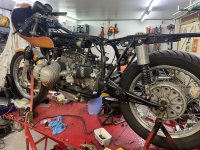
Here she is on the lift ready for the strip down:
bike on lift for first strip 2.JPG
 
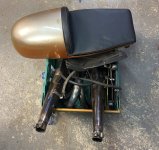
And the first batch of redundant components:


pile of redundant parts cropped.jpg


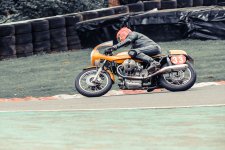
Back in 2017, this was the best I could do round the hairpin at Cadwell Park:

TFP_8305.jpg

By 2022 I think I got a little better - you can see the top of the right hand rocker cover beneath the sump.....

Favourite angle.jpg

Partially stripped:
bike on lift for first strip 3.JPG
 
Was this the bike where the engine was slightly higher in the frame to improve ground clearance and straighten the driveline run ?

Stuck in my memory.
 
I find that very interesting as the position of the engine seems very similar to the position I ended up with, on 3 special frames that I did for Mike to get the best driveshaft angle.
Only downside is it limits access to the oil filter.20180203_131245.jpg
 
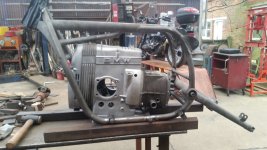
The engine, as pointed out in the last few posts, was indeed raised in the frame. Here's a shot of the latter stages of the strip down, just before engine removal from the frame. The mounting points can be clearly seen:

bike on lift for first strip 4.JPG

To overcome the 'access to the oil filter' issue the conversion included a Motoren Israel sump extension with remote spin-on oil filter and an oil cooler (you can see the cooler and hoses). This picture above also hints at a revised timing cover, needing to be shortened because of the lack of headroom. A bit of a close up:

front of engine before.JPG

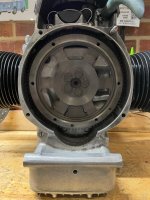
An alternator rotor had been turned down on a lathe to leave just the oil seal face for the crank. The Bean Can ignition meant that the engine has a later camshaft, which, if the aim was to put the bike back to standard, was going to involve some head scratching - I wasn't going to remove the camshaft and replace because the engine was running too sweetly for that! Now with the sump, extension, alternator rotor and bean can removed and the engine on a stand:

front of engine stripped 4.JPG

If anyone is interested in purchasing this front cover and/or the Motoren Israel sump extension, please get in touch!

The main frame, along with a 'waif and stray' donor frame from a 1976 60/6, went to a frame builder for alteration - John Hand Racing https://www.facebook.com/profile.php?id=100050486261659. The story behind John. When I retired first time in 2018 I worked for a few weeks in the machine shop at Wasp Sidecars, which is local to me. I had known the founder (Robin Rhind-Tutt) for about 20 years and although at that time he was confined to a wheel chair fighting dementia, the Wasp 'factory' was still in the sprawling outbuildings of his house in Berwick St James. Mark, John and Albert ran the business. Fast-forward to 2024 and Wasp (after Robin died) left Berwick to set up in Dinton. Dinton is just over 1 mile from my house! But that's another story. John had left Wasp and set himself up as JHR. When I worked at Wasp I could see John's talent at frame building (he was the sole builder of the Rickman-Metisse-type frames that Wasp built). So the conversion-back-to-standard work was left to John - I am sure you can tell from his Facebook page he is more than capable of this task.

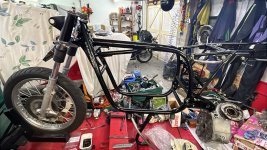
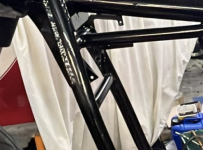
The frame conversion involved not only mounting the engine mounts in the right place, but fixing the steering lock tube in (properly), various brackets (rear brake light switch, starter relay, horn, brake line guide, etc) and sealing up a hole or two. Frame bracing around the headstock was left in place, as was the rear subframe (which was welded to the main frame in the first conversion) - these are to improve rigidity and therefore handling, over standard. I gave John an old engine block with spacers and studs as a jig. He welded up the rear frame gussets (very common for these to split).

I took the frame and various other parts to get powder-coated - the result was fantastic! Here's a shot of the frame a month or so ago:

frame front wheel on lift.JPG
 
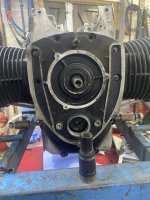
I wanted the engine to have a smooth-sided timing cover and there was no point in fitting one with the rev counter cable outlet. I sourced a /7 1978-80 timing cover which looks fine - but left me with the issue of how to create a spark signal. There was no chance I could fit a set of points or use the bean can due to the incompatibility of camshaft/timing cover. No issue there; I bought a crank-mounted ignition system from Motorworks. However, I still had the issue of sealing up the camshaft hole.

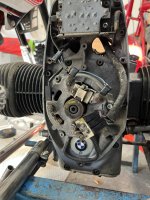
I put new seals in the timing cover. I had a mate turn up a top-hat bung for the camshaft hole. I retained it with a 2" penny washer held in by M4 screws (like the original points backplate). The hole in the middle of the penny washer is smaller than the top-hat bung, so it won't fall out! I stuck a BMW badge over the hole....
camshaft cover.JPG

I've yet to fit the ignition system but I've a way to go before getting there. I have to choose whether to use a /6 or /7 wiring loom and sort out compatibility issues each one would create, all mainly around the ignition system (and instrument bulb layout). The engine is ready to go back in the frame - here it is being looked after by my 'what's going on here then' renovation https://www.ukgser.com/community/threads/whats-going-on-here-then.337475/ :

My bike looking after the project engine.JPG
 
Last edited:
PRIDE COMES BEFORE A FALL

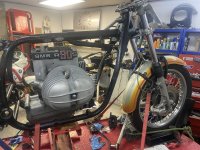
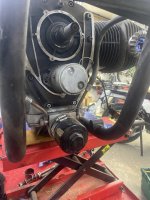
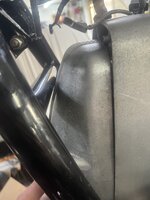
I managed to get the engine back in the frame over the weekend and was pretty pleased with myself having a) done it by myself and b) not scratched the frame at all. I went to put the front cover back on (thank heavens I took it off before installation) and found that I couldn't. That is when I discovered that an extra cross-member (for frame stiffening purposes) had been added, I hadn't removed it and hadn't appreciated it was in the f++cking way. :blast.

Screenshot 2025-01-20 at 12.29.28.png

These things are sent to try us! I've come up with 2 possible ways out - cut the tube out or modify the front cover (make it 2 pieces). I think I am going the latter route. Anyway, The rest of the rebuild should be more straightforward so I will keep going!
 
My heart goes out to you. I bet the air turned blue in the garage when you made that discovery
 
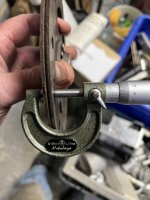
I turned my attention to getting the gearbox fitted. First of all, check the thickness of the clutch and health of the engine's back end:

IMG_1348.JPG


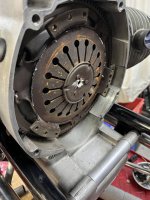
At 6.05mm the clutch plate was healthy and bore some fresh-looking Optimal grease from last time although the picture below shows fresh Optimal. Also not even a hint of oil leaking:

IMG_1349.JPG

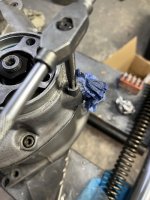
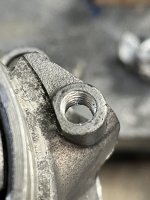
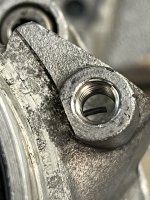
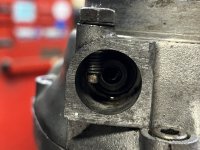
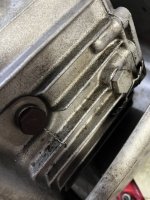
Before I could fasten up the gearbox I had to do a job on the end plate M6 hole for the breather bolt. It had stripped in the past (battery earth had been fastened on top of the gearbox previously) so that bolt hole was not used and now needed helicoiling:

IMG_1351.JPG
IMG_1352.JPGIMG_1353.JPGIMG_1356.JPG

That felt better. I needed to fit a new neutral switch as for the track a neutral light wasn't needed:

IMG_1350.JPG

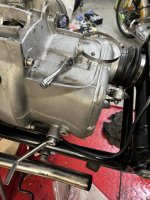
Once all that done I was ok to fit the gearbox, a /6 gear change lever, clutch actuating arm and also the first bit of wiring - the neutral/oil switch sub-loom with an earth on a gearbox bolt:

IMG_1360.JPG


Next job is to fit a standard rear brake lever (rear sets used previously) and fit a brake light switch, while I have the room. Then the swingarm can be bolted up and rear wheel fitted.
 
Is that a later (lighter) flywheel in there ?

I had a lightened flywheel in an R75/5.

Just over 1KG lighter than standard and made a very noticeable difference when accelerating.

IMG_2503.jpeg
 
It is a later spec lighter flywheel, yes. The eagle-eyed amongst us will see the smooth-sided gearbox with a later end cover. This is to keep the classic look of a /6 with not only a lighter flywheel, but a significantly reduced effort at the clutch lever. It is said that the later clutch set up will handle more power than the earlier (if you are considering an upgrade in that area).
 
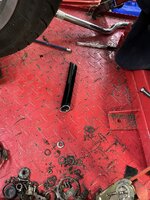
A few weeks have passed and I'm a little further on. The front frame member debacle is solved, but it took me stripping off the alternator and diode board to finally figure that there was only one way out....
IMG_1530 2.JPG

Dreams on the cutting room floor.......

IMG_1547.JPG

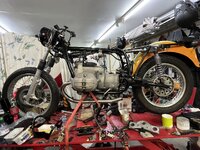
Now I am back on the straight and narrow with a few more components added on, namely the headlamp, wiring loom (with handlebar switches, front indicator wiring and a loom for the cockpit instruments), charging loom, engine oil, gearbox oil, final drive oil, rear mudguard, rear light/indicators and a numberplate....

IMG_1641.JPG

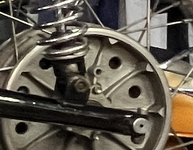
Quick quiz - does anyone know what this hole is for (the one on the cast spoke of the rear hub)?


Screenshot 2025-02-16 at 17.35.21.png
 
Thanks for the suggestion - that hubcap (I have one) is fitted using the 5 bolts for the bearing cap.

I still don't know what the other hole is used for.

While I am here, a quick project update:

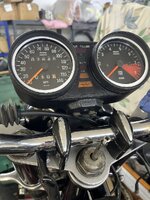
Been spending time getting all the electrics right, and making sure all the bulbs in the instruments work ok. The indicators are fitted and working. I've got the handlebars on and am moving forward to sorting out the front brakes. The number of boxes of spares to fit to it has gone down from 5 to 2. Always nice to have a picture:
IMG_1718.JPG
 
Looking closer at the picture of the rear wheel, the hub looks different from the wheel on my -75.
Could this by any chance be a different hub, intended for racing?

54384249279_e30be29d88_c.jpg
 
Quite possibly. Why they made special racing ones beats me!

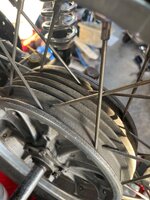
I’ve just noticed it is 4-ribbed; all others in have only have 3.image.jpg


Back
Top Bottom