this one is for Greggers

curiousexplorer

Registered user
Joined
Oct 2, 2009
Messages
99
Reaction score
0
Location
rotterdam, holland
Had new tyres put on, and at same time exchanged czech wheelbearings for SKF sealed ones, costs next to nothing, 10 min. work. On the one bike everything went fine, on the other one (we have 2 F650GS's) the front brake disk grinded against the left brake pad. Went back to dealer, they took the bearings out again, and found that the distance between the bearing seatings was about 1.5mm smaller then the lenght of the distancer tube. On the one front wheel they assembled right bearing first, then distancer, then left bearing. On the other front wheel they assembled left bearing first, then distancer, then right bearing, and so creating a misaligned wheel. The left seating is to deep. Is there anyone with a workshop DVD that can check if BMW actually says that the bearings should be assembled from the right side first?? Also wondering about the rear wheels now. greetings, hans
 
I assume you meant the other gregger but anyway could not resist checking my Haynes manual.

Section 7 says install left bearing first all the way to the seat and to heat housing if necessary.
Then install spacer and right hand bearing until it seats - there should be at most only the smallest amount of axial play in the bearing spacer.

Will check the workshop manual if I can find it.
Cheers
 

Ok - here are The words of BMW ...


Clean the bearing seats.

Heat the left bearing seat.

Technical data
Mating temperature, wheel bearing 100 °C

Press in the left wheel bearing until seated, using thrust piece (No. 36 6 600) and handle (No. 00 5 500).

Install the circlip.

Install tubular spacer (1).

Adopt the same procedure to install the right bearing.

Technical data
Mating temperature, wheel bearing 100 °C

Allow the wheel to cool.


As you can see, the manual says to start with the left bearing...

I do wonder about these wheels, IMHO I'd expect the bearing spacer tube to be a similar dimension (or slightly larger) to the distance between the inner machined seating faces of the wheels -I can't see how it can work otherwise. The tube needs to bear the load applied by tightening the axle bolt, otherwise it is simply transferred to the balls in the bearing which will f*ck it up in double-quick time

However, if the AD has followed the manual by starting with the left bearing, then they are simply highlighting the fact that there is a problem. I guess there's a chance that BMW have aligned the disc and caliper to the LH bearing seat - although logic would say to just make it foolproof by just making everything match up ..

What I'd do - but only because I have the tools and ability :augie to do it properly - is to re-manufacture a new bearing spacer tube to match the distance between the seat faces. But ... I'd check that there wasn't an alignment issue in the first place. The problem here is that you can't really remove bearings without f*cking them up.

Doing this you're sure that the bearing aren't laterally overloaded (as was discussed in the previous thread). What this doesn't do though is explain how things managed to stay as they were - the spacer tube being effectively redundant - without compromising the wheel or bearings...
 
My repair manual DVD says remove left front before right front, replace right before left. Heat the bearing seats to 100C before both removal and replacement.

For the rear, remove left, then right, replace left then right, after heating the bearing seats to 100C as for front. So replacement for the rear is opposite to the front.

The order of installation is emphasized in bold for the front, but not for the rear.

Note that F800GS specifies different order from F650 GS.
 
Sturge ... Unless you have your DVD in upside down, mine says different...


f650wheelbearing.png


f800wheelbearing.png


Can you take a snapshot of yours to identify the differences - maybe this is where the problem has been addressed by BMW...
 
Sturge ... Unless you have your DVD in upside down,
...

Can you take a snapshot of yours to identify the differences - maybe this is where the problem has been addressed by BMW...

Sure. Mine says "4th edition, 05/2009" ...

650front.JPG


800front.JPG
 
Sturge ...

Ah, now, mine's one of the first DVDs - 1st edn, 03/2008 - which explains the difference in procedure, (36-31-851)
but not if there are different components involved.

I guess that the 'North American' way is slightly different, doubtless due to the public liability issues involved.
You'll notice that we get to use the extra special BMW RayGun to make it all fit properly... :toungincheek

f650wheelbearingRAYGUN.png


G
 
wow, threw a stone in a still pond.....

Many thanks, Greg and Sturge, for your answers, even the DVD's don't match up, what can you trust??? Greg, aren't you busy compiling data for a manual? this should be in it I think. Made note of procedures now, the mechanic didn't heat the wheels BTW, he just pulled them out and tapped the new ones in.... twice, with the one wheel!! greetz, Hans
 
Sturge ...

Ah, now, mine's one of the first DVDs - 1st edn, 03/2008 - which explains the difference in procedure, (36-31-851)
but not if there are different components involved.

I guess that the 'North American' way is slightly different, doubtless due to the public liability issues involved.
You'll notice that we get to use the extra special BMW RayGun to make it all fit properly... :toungincheek
G

Oh, we've got the ray-gun as well. I just didn't show enough of the DVD. And we have the special "long spindle with pull-in nut". God only knows what that one costs :eek: at BMW. About $1.95 at the hardware store would do for me. We pull, you push :blast
 
Hi Hans,

Well, I guess that's all part of the development programme!
And, yes, something like this will be finding its way into the book,
but from the perspective of doing it with minimal tooling and out
in the middle of nowhere:eek:

Re the BMW Manual, well, it's easy to make a simple job really
complicated if you try hard enough..lol..

Ok - back to the problem. I think there's a component mis-match
somewhere, and I'm thinking it's the bearing spacer tube.
This tube needs to be the right length to within 10ths of mm for it to be effective,
otherwise the bearings will be placed under huge (and I mean HUGE) additional loads
which will lead to the bearing's inevitable failure.

Common ball race bearings are fantastic at tolerating radial load, in other
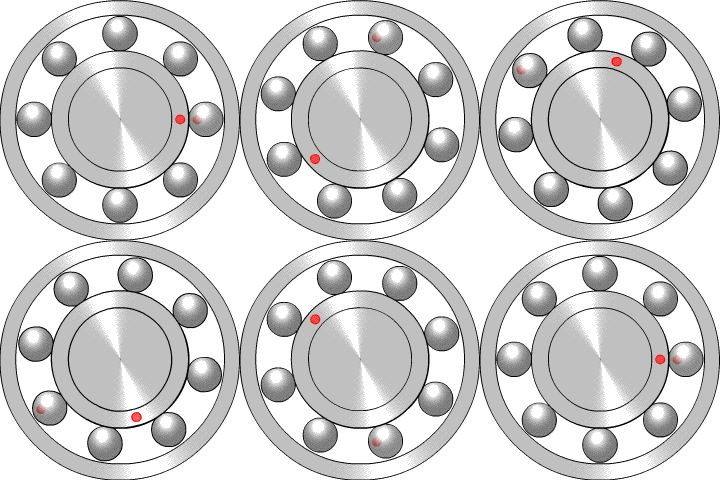
words forces placed upon it in it's plane of rotation - looking at the animation,
they're the forces from left/right/up/down etc. The balls in the bearing
also rotate in the same plane so wear rates are very low. These bearings
are not so tolerant of axial loading, in other words forces perpendicular
to the radial forces - the ones applied if you were to imagine pushing the
inner race through the outer race.

BallBearing.gif


bearing-ball.gif


This second drawing shows the tracks on the inner and outer races - it's quite
easy to see what happens if axial loads are placed on these bearings, the balls are
squeezed horizontally as well as vertically which will make them 'skate' in the races and
will wear the balls and races quickly, which will enlarge the tolerances and eventually
lead to the collapse of the bearing...

So - you can see that the bearing spacer tube is there to alleviate this axial loading
by allowing the tightening forces of the axle nut to be transferred from the inner race
through the tube then the next inner race to the outer flange of the axle... If that tube
is too short, then it's pulling the inner races together and applying those high levels of
axial load which the bearing isn't designed to tolerate... they wear out then collapse - simples!
If the tube's the right length, there's no significant axial load and the bearings
last a long time - lovely!

Hope this explains something lol...

Greg


The workings of a taper roller bearing are a whole different matter lol... next time, next time...

 
Hi, Greg, all crystal clear, nice GIF !! Looking forward to THE BOOK, one thing I noticed in the DVD images is that the 21" wheel has a circlip that holds the left bearing in place, the one you put in first, hence the whole wheel is aligned via the tubular spacer, but the 19" wheel does not have one, so theoretically the wheel can move as much as the difference between seatings and distancer. I would have put a circlip in there to lock things up. strange. greetz, hans
 
Arrrr ... those drawings took me fookin ages ... :toungincheek

Bearings ... well, I've got a set of 4 NSKs ready to go into my wheels, but SKF also are well known.
I'd just get down to your local bearing supplier, they'll have a range on the shelf and they'll all be better
than the cream-cheese bearings used as OE!


Back
Top Bottom