Hi Hans,
Well, I guess that's all part of the development programme!
And, yes, something like this will be finding its way into the book,
but from the perspective of doing it with minimal tooling and out
in the middle of nowhere

Re the BMW Manual, well, it's easy to make a simple job really
complicated if you try hard enough..lol..
Ok - back to the problem. I think there's a component mis-match
somewhere, and I'm thinking it's the bearing spacer tube.
This tube needs to be the right length to within 10ths of mm for it to be effective,
otherwise the bearings will be placed under huge (and I mean
HUGE) additional loads
which will lead to the bearing's inevitable failure.
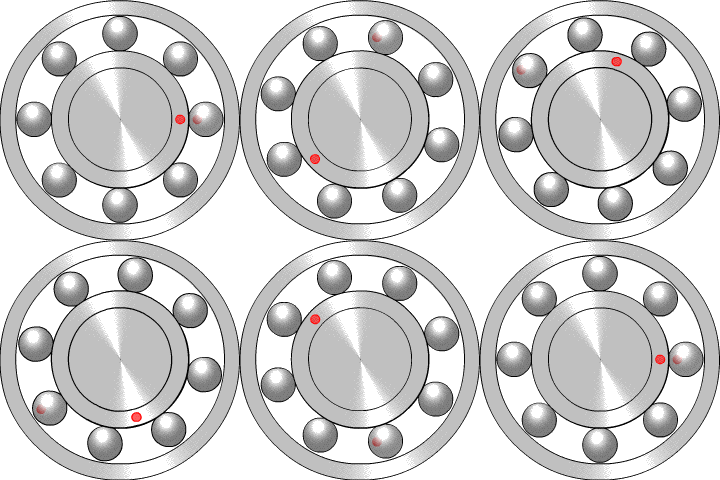
Common ball race bearings are fantastic at tolerating radial load, in other
words forces placed upon it in it's plane of rotation - looking at the animation,
they're the forces from left/right/up/down etc. The balls in the bearing
also rotate in the same plane so wear rates are very low. These bearings
are not so tolerant of
axial loading, in other words forces perpendicular
to the radial forces - the ones applied if you were to imagine pushing the
inner race through the outer race.
This second drawing shows the tracks on the inner and outer races - it's quite
easy to see what happens if axial loads are placed on these bearings, the balls are
squeezed horizontally as well as vertically which will make them 'skate' in the races and
will wear the balls and races quickly, which will enlarge the tolerances and eventually
lead to the collapse of the bearing...
So - you can see that the bearing spacer tube is there to alleviate this axial loading
by allowing the tightening forces of the axle nut to be transferred from the inner race
through the tube then the next inner race to the outer flange of the axle... If that tube
is too short, then it's pulling the inner races together and applying those high levels of
axial load which the bearing isn't designed to tolerate... they wear out then collapse - simples!
If the tube's the right length, there's no significant axial load and the bearings
last a long time - lovely!
Hope this explains something lol...
Greg
The workings of a taper roller bearing are a whole different matter lol... next time, next time...



 to do it properly - is to re-manufacture a new bearing spacer tube to match the distance between the seat faces. But ... I'd check that there wasn't an alignment issue in the first place. The problem here is that you can't really remove bearings without f*cking them up.