The important thing to keep in mind when balancing the throttle valves is to understand what you really want to obtain.
The adjustment as such is merely adjusting the length of one throttle cable vs the other one.
The idle actuators are used for upping the idle when the engine is cold, and it does this by pushing the butterfly valve partly open. Hence, the importance of ensuring no interference from the idle actuator. This may be done by using the GS911 or similar device.
When at idle, the butterfly valves are resting on the stops. These stops are adjusted at the factory, and should NEVER be touched.
The throttle cables should allow the butterfly valve to stay at idle without any tension from the cables (resting on the stops), thus the cables should be adjusted in such a way that when opening up the throttle you first pick up the play.
The BMW procedure then focus on an even pickup. I.e when slowly you open the throttle, you tension up the play of the cable, and then the butterfly starts to open. And the focus in on this opening happens at the exact same time to both cylinders. Therefor the procedure calls for setting up both cables with a bit of play, then setting the left cable to start opening up with the minimum of play. and the right throttle a little bit more.
With the instrument connected (electronic one or home made) the aim is to adjust the right cylinder in a such a way that both butterflies opens simultaneously. I.e they focus more on the synchronization on the opening point rather than exact equal vacuum.
Keep in mind that while the throttle cables and the butterfly is purely mechanical, the vacuum reflects the amount of air flowing through to the engine. This is ofcourse affected by the opening of the butterfly valve, but it is also influenced by the engine valves adjustment, obstructions in the intake channel and possible minor leak in the induction system.
So.. rather than readjusting the throttle cables at a higher RPM, the BMW focus is on accepting a potential difference. They do however specify a maximum difference, meaning that if the difference is too large (remember that at this point, both butterflies are at the exact same angle), there must be a leak , an obstruction or the valves out of adjustment.
With this in mind, the importance of a reading system is not as much exact accuracy as is the response time. Unless you have an electronic system that is dead on calibrated with a mBar reading, even the simplest and cheapest system is as good as any.
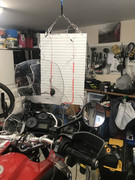
Personally I'm all for the simplest system (as linked). It is VERY sensitive, (I use it on my vintage boxer, and you can hardly even touch the cable adjustment before it shows a difference. I also use two-stroke oil. It's red, easily visible, it's thin, and it's made to be run through the engine, handy in case i screw up, like one hose popping off and the oil is sucked into the engine).
Then you may think: Exact equal vacuum to both sylinders is important for the equal proper fueling of the engine, hence a more smooth running engine.
I is true that if one cylinder puts out more power than the other one, this will cause the engine to run less smooth. Hence the requirement for the maximum allowable difference.
But as for the fueling, remember that the R1200 (different from the 1100/1150) engine has an O2 sensor for each cylinder, and whatever the amount of air that enters the cylinder, the amount of fuel added is optimized based on feedback from the O2 sensor.



 , didn't make me jealous at all, no, not one little bit

 , adjust the right and you'll have a better response and more a controllable throttle.


