Tyre Valves - easy to take apart?

Taff

Well-known member
UKGSer Subscriber
Joined
Feb 21, 2004
Messages
7,351
Reaction score
6
Location
South West Wales
I've done a search, but can't find anything.

I have tubeless tyres on both my car and bike and over the last few days have noticed a slow puncture in one of the car tyres. I have checked for nails / cracks etc but can't see anything, although I think I can hear a slight "hiss" when I put my ear next to the valve.

When I had Ultraseal put in my old bike tyres years ago, the tyre fitter reckoned it took just seconds to take the guts out of the valve, but is it easy to take the valve components out and put them back in properly again? :nenau
 
Spit on it...if it bubbles, its leaking, if it doesn't, look elsewhere.

And yes, easy as unscrewing a nut to take out.....core comes out in one bit....lefty loosey, righty tighty, piece of pish.

Halfords sell the cores....it's called a Schrader valve, not to be confused with the ever so skinny and stupidly designed Presta valve that BTBR and his ilk are probably very familiar with ;)

Seriously though, tighten it up with a pair of long fine nosed pliers (look down its throat and you'll see a flat bit that's threaded on the ends) or use a valve tightener (Halfords again)

But gob on it first to establish where the leak actually is.....

More likely to be the valve seat if it's an older rim.....gob on that too.


Happy new year ;)
 
I've done a search, but can't find anything.

I have tubeless tyres on both my car and bike and over the last few days have noticed a slow puncture in one of the car tyres. I have checked for nails / cracks etc but can't see anything, although I think I can hear a slight "hiss" when I put my ear next to the valve.

When I had Ultraseal put in my old bike tyres years ago, the tyre fitter reckoned it took just seconds to take the guts out of the valve, but is it easy to take the valve components out and put them back in properly again? :nenau

The 'hiss' is most likely your imagination. If it was leaking enough for there to be an audible hiss you would be looking at a flat tyre every day.
Spit on the end of the valve or make up a mixture of water and washing up liquid and spray it all over and around the valve. You should get some bubbling if there's a leak.
Otherwise, remove the wheel and submerge it to establish where the leak is.
Valve tools are easily obtained, probably around £3 to £5 and valve cores are available from any tyre fitters for next to **** all.
 
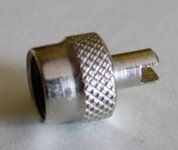
Lots of bicycle innertubes used to come with metal caps with little forked protrusions on them... I make sure to have one of said caps somewhere in each vehicle I own (and we own lots) so that I can always remove a valve core. They go in and out easily. One thing that people often forget is that the schraeder valve is intended to hold the air in either the tire or tyre while filling... you are supposed to put the little dust cap back on to KEEP the air in. If your valve cap is a proper one with a little rubber gasket in it, and if you are keeping it tight, then it is very unlikely that the valve core is the problem.
Spit or soapy water, as otherwise described is the best way to find a leaky valve. submerging the tire in water is the best way to find leaks elsewhere. Removing the wheel from the vehicle and submerging it portion by portion is much easier than driving into a lake, and MUCH easier than getting it out again.
When looking for a slow leak, I usually overinflate the tire up to 60 psi or so to increase the chance of seeing the stream of bubbles.

Mark
 
, I usually overinflate the tire up to 60 psi or so to increase the chance of seeing the stream of bubbles.

Mark

Overinflation is not always a good test... My car tyre has a very slow puncture on one of the tyres, if I inflate it to what the manual says then in 2 days time it is nearly flat; however if I overinflate it then it stays up for weeks on end, how weird is that? :nenau
 
Overinflation is not always a good test... My car tyre has a very slow puncture on one of the tyres, if I inflate it to what the manual says then in 2 days time it is nearly flat; however if I overinflate it then it stays up for weeks on end, how weird is that? :nenau

Hmmm, this might be an indication that the leak is between the bead and the rim... the higher pressure might be forcing more rubber to contact the rim and seal where some bit of dirt or rubber imperfection or rim flaw is letting air out at your normal operating pressure...
...or not:-)
 
Also check that the tubeless tyre valve assembly is sealing in the wheel rim (nothing to do with the Schrader valve).

I used to get a leak around the valve in the alloy front wheel on my R80RT - fixed it by removing the tyre and using some non-setting jointing compound between the rubber assembly and the alloy rim.

Dunk it in water and look for a stream of bubbles as suggested - that will at least pinpoint the source of the problem.

Happy New Year.

Bob.
 
And yes, easy as unscrewing a nut to take out.....core comes out in one bit....lefty loosey, righty tighty, piece of pish. Halfords sell the cores....it's called a Schrader valve.. tighten it up with a pair of long fine nosed pliers (look down its throat and you'll see a flat bit that's threaded on the ends) or use a valve tightener (Halfords again). More likely to be the valve seat if it's an older rim.....gob on that too.
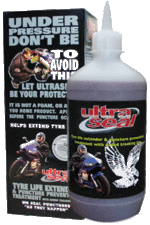
Thanks Bill. Got a pack of these shiny "Metal dust caps with Valve Key" from Halfords - costs £2.50 for a pack of 5, so one will stay on the bike permanently. I have gone round all the tyres (car and bikes) and tightened every core. For some reason on the car 2 cores could be tightened without any air escaping, while the other 2 didn't. Don't know if the air should be escaping, but my guess is that it shouldn't. If I was to remove the core, I guess that I should be able to just funnel Ultraseal in through the valve. Correct? :nenau I've had Ultraseal put in a set of bike tyres before, and I don't think they lost any pressure in the year or so that I had them - I've never experienced that before.

The 'hiss' is most likely your imagination. If it was leaking enough for there to be an audible hiss you would be looking at a flat tyre every day.
You may be right, but the pressure has dropped from 36psi to 32psi in 2 days, so it is a very slow "puncture" and its definately going somewhere. The problem is that I live in town, and trying to listen for a very slight hiss above the traffic noise and kids is a right bugger. :D

Overinflation is not always a good test... My car tyre has a very slow puncture on one of the tyres, if I inflate it to what the manual says then in 2 days time it is nearly flat; however if I overinflate it then it stays up for weeks on end, how weird is that? :nenau

Hmmm, this might be an indication that the leak is between the bead and the rim... the higher pressure might be forcing more rubber to contact the rim and seal where some bit of dirt or rubber imperfection or rim flaw is letting air out at your normal operating pressure....or not:-)
You two may be on to something here, because I've noticed exactly the same. If I deliberatley over-inflate the car tyres (say to 42psi instead of 36psi) they hold the pressure for longer - and the "higher pressure might be forcing more rubber to contact the rim" theory would make perfect sense. The car rims are about 10 yrs old and I remember now that when a different tyre was replaced a year or so ago, Rocky did mention that there was some rust on the rim (which wasn't giving a perfect air-tight seal) which he sanded smooth to make it air-tight. I reckon Ultraseal should do the trick though, until the rust on the rim can be treated when tyre needs replacing. :thumb2
 

Attachments

  • 180px-Kaperka.jpg
    180px-Kaperka.jpg
    10.7 KB · Views: 160
  • bottle.gif
    bottle.gif
    44.2 KB · Views: 160
.... For some reason on the car 2 cores could be tightened without any air escaping, while the other 2 didn't. Don't know if the air should be escaping, but my guess is that it shouldn't. If I was to remove the core, I guess that I should be able to just funnel Ultraseal in through the valve. Correct? :nenau ...

Not to worry about the air escaping as you tighten or loosen a valve core... If you look at the end of the little shaft thingie that stands proud of the main valve, you will see that some of them have widere ends peened onto them, and some shafts have little hash marks on them... when you stuff the little valve wrench down the hole, sometimes it depresses said shaft, causing air to escape...and sometimes not, depending on the clearance between the hole in the center of the wrench and the little shaft thingie... If you were to remove the cores from all your vehicle tires, you might find several "different but equal"designs - they all meet the same spec... you can use any core in any scraeder valve body, but they are all made a bit differently.

The instructions for the goo should tell you how to get it in the hole once the core is out, and whether you are supposed to spin the tire immediately or whatever.

Good luck!

Mark
 
slow leaks in car tyres often respond well to taking the tyre off, cleaning the rim & refitting tyre.

in one case i had to have the inside of the rim painted, as it was slightly porous.


Back
Top Bottom