
What can cause a broken gearbox case - output bearing?

@Magwych Hopefully to Illustrate my thoughts in a clearer fashion

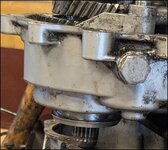
I would have expected to see the lines of the top of the gear rather than the back end of a gear

View attachment 546212

I still have a 1200ADV box with a snapped input shaft Which I always meant to fix

My 2004 1200 GS has an awfully high first gear Which was always a pain when Trying to pull away from steep junctions 2 up etc etc
1792087821280.jpg


Does that illustrate things better??
 
@Magwych Hopefully to Illustrate my thoughts in a clearer fashion

I would have expected to see the lines of the top of the gear rather than the back end of a gear

View attachment 546212

I still have a 1200ADV box with a snapped input shaft Which I always meant to fix

My 2004 1200 GS has an awfully high first gear Which was always a pain when Trying to pull away from steep junctions 2 up etc etc
I can see what you mean, but I'm not entirely convinced it is out of place. That last gear had to mesh with its matching gear on the intermediate shaft. You can see the picket for the shaft end and there needs to be a full size roller bearing between that and the rear gear of the intermediate shaft.
I do wonder if it was not just rear end collision damage. It can take quite a knock (DAMHIK 😉) but with enough force something will gave to give. Or, perhaps it was a bearing failure.

As it is, there have been plenty of dustractions to deplete my savings again. I will have to live with the clunky 'box for a while longer.
I specced my GSA with the enduro box, to avoid the high 1st gear. My first GS could be a pain, constantly fanning the clutch in the worst of the Blackwall tunnel approach traffic. Fortunately, the differences between standard and enduro are only the gear sets on the intermediate and output shafts.
 
Last edited:
My 2008 input shaft was way worse than that when I opened up my gearbox, the damper casing was almost fully torn apart. A new input shaft was about £480 IIRC and was a straight swap out.

The damper outer casings split under torsion/shock as the damper internally is a stack of conical washers mounted back to back inside a thin pressed metal casing and not a proper coil spring.

I suspect it was a cost-saving exercise to use them.

The original coil spring dampers didn't need an outer metal casing they were just an open coil spring pushing on a claw.
Belleville washers they are called, I believe. Their use is not such a bad idea; the cheap, pressed metal casing is not. The casing seems to serve no function other than to hold the assembly together, maybe some ore-tension on the belleville washer stack. I am.musing whether the case can be removed, and the stack retained by a receessed washer and simple circlip?
IIRC, I may have a spare input shaft. I bought one second hand some time ago but it was in a worse state than mine.


Back
Top Bottom