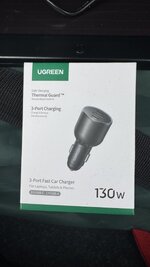
Which 12v usb type c cigarette adapter

dommiek

Active member
UKGSer Subscriber
Joined
Mar 7, 2009
Messages
222
Reaction score
82
Location
the MK riviera
I have a standard 12v cigarette type accessory fitted to my Honda.
I'd like to buy a USB type C adapter to charge a phone, any recommendations?
 
I have a standard 12v cigarette type accessory fitted to my Honda.
I'd like to buy a USB type C adapter to charge a phone, any recommendations?
Definitely 12v standard type?
I thought bikes usually took a DIN 12v type, which is slightly different.
Tried them all, they last about 12 months 😁
 
Definitely 12v standard type?
I thought bikes usually took a DIN 12v type, which is slightly different.
Tried them all, they last about 12 months 😁
Yes, definitely a standard one. I know BMW's have a 12v din, I think Honda are still in the 1980s.
Reading the reviews, the don't seem very reliable.
 
So long that it supports PD (Power Delivery) you’ll be charging your phone not only quickly, but also efficiently.

One thing to note. The 12v ciggy type charger is highly unlikely to be waterproof, so I’d suggest a hardwired wireless charger instead. However, choice is yours and nobody can influence your decision making, but you.

Don’t know what PD is? Google has the answer.

“
USB-C PD (Power Delivery) is a universal, intelligent fast-charging protocol that allows devices and chargers to negotiate and deliver higher levels of power over a USB-C connection.

How It Works
  • Dynamic Negotiation: When you plug a device into a PD charger, they perform a digital "handshake" via the connector's communication pins. They exchange data on their power capabilities and agree in real time on the exact voltage and current required.
    Scalable Wattage: While standard USB connections max out around 2.5W to 15W, USB-C PD scales up to 240W under the PD 3.1 specification (Extended Power Range, using up to 48V at 5A).
    Smart & Safe: It automatically adjusts power output to match the connected device, safely protecting smaller gadgets (like earbuds or phones) from receiving too much voltage, while pumping high wattage into power-hungry laptops. [1, 2]
    Two-Way (Role Swapping) Power: PD supports bi-directional power flow, meaning a device like a laptop can either receive power or act as a power source to charge a phone or monitor.

What You Need to Use USB-C PD
To use USB-C PD, you must have three matching components:
  1. A PD-enabled device (such as a modern smartphone, tablet, Nintendo Switch, or laptop).
    A compatible USB-C PD charger (wall brick, car charger, or GaN adapter).
    A certified USB-C cable (rated for the required amperage/wattage, such as an E-marked cable for higher tiers).
Note: USB-C is the physical shape of the connector, whereas Power Delivery (PD) is the smart charging standard that runs through it. You can have a USB-C port that does not support PD. [1]

If you'd like, let me know what device you are trying to charge, and I can tell you what wattage and PD charger you need!

 
So long that it supports PD (Power Delivery) you’ll be charging your phone not only quickly, but also efficiently.

One thing to note. The 12v ciggy type charger is highly unlikely to be waterproof, so I’d suggest a hardwired wireless charger instead. However, choice is yours and nobody can influence your decision making, but you.

Don’t know what PD is? Google has the answer.

“
USB-C PD (Power Delivery) is a universal, intelligent fast-charging protocol that allows devices and chargers to negotiate and deliver higher levels of power over a USB-C connection.

How It Works
  • Dynamic Negotiation: When you plug a device into a PD charger, they perform a digital "handshake" via the connector's communication pins. They exchange data on their power capabilities and agree in real time on the exact voltage and current required.
    Scalable Wattage: While standard USB connections max out around 2.5W to 15W, USB-C PD scales up to 240W under the PD 3.1 specification (Extended Power Range, using up to 48V at 5A).
    Smart & Safe: It automatically adjusts power output to match the connected device, safely protecting smaller gadgets (like earbuds or phones) from receiving too much voltage, while pumping high wattage into power-hungry laptops. [1, 2]
    Two-Way (Role Swapping) Power: PD supports bi-directional power flow, meaning a device like a laptop can either receive power or act as a power source to charge a phone or monitor.

What You Need to Use USB-C PD
To use USB-C PD, you must have three matching components:
  1. A PD-enabled device (such as a modern smartphone, tablet, Nintendo Switch, or laptop).
    A compatible USB-C PD charger (wall brick, car charger, or GaN adapter).
    A certified USB-C cable (rated for the required amperage/wattage, such as an E-marked cable for higher tiers).
Note: USB-C is the physical shape of the connector, whereas Power Delivery (PD) is the smart charging standard that runs through it. You can have a USB-C port that does not support PD. [1]

If you'd like, let me know what device you are trying to charge, and I can tell you what wattage and PD charger you need!
It the standard Honda accessory 12v cigarette lighter fitted to the bike from new. I'm wanting to charge a Motorola G14 smartphone to use as a nav. Already have a Garmin XT I use but I think a phone is now a better option.


Back
Top Bottom