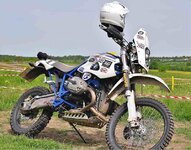
Why has nobody...

The standard GS could do with a smoother engine without the Swiss cheese torque curve. But the remap (ideally with a better zorst) does that.

A different lump with more top end power at the expense of the mid range and bottom end, though probably fine in a more road biased sporty chassis, would spoil the GS.

The new WC is supposedly better but has become little more than a Triumph, Aprilia, Yamaha. Its over sanitised so much its not a GS any more. Sticky-out pots are not enough on their own.
 
Quote:
<table border="0" cellpadding="6" cellspacing="0" width="100%"> <tbody><tr> <td class="alt2" style="border:1px inset"> Originally Posted by Bendy toy

For a special GS, why not fit a totally different engine? Enough money to fund a sport or HP2 engine would get close to Skidoo stroker engine - mad top end AND great mid range lugging power. Who knows if the gearbox could cope.

</td> </tr> </tbody></table>
Nope, that’s not the same at all.

Shoehorning a fundamentally different engine into the 1200GS frame does nothing more than create a Triumph, Ducatti or Aprilia clone, though several BMW owners might like that.

What we are looking at here is a different / better Boxer engine inside a traditional GS frame, preserving the all important heritage of the marque.

You pays your money and you takes your choice.
Personally, going for a fundamentally different engine is not my thing, mainly because it would require more development time than riding time - but I always root for people trying out bold experiments.

For me, the 'heritage' argument doesn't wash.
I remember people getting well and truly knotted up over the launch of the F800GS because, in their own words: "It's sacrilege!" Uhh... come again? Have puppies been hanged in the making of this bike? Have vestal virgins been ravished and disemboweled on the altar of the Great Dog Taken-A-Wanka? :P
 
I've been reading this topic with interest.

I haven't had access to an HP2 Sport engine (the bikes themselves are hen's teeth here),

....but my '09 GSA DOES run an R1200S engine.

Aha, that's a start. Held up only by the (understandable) availability of a suitable HP2S engine on the dark continent.
 
Aha, that's a start. Held up only by the (understandable) availability of a suitable HP2S engine on the dark continent.

Not just availability... but cost! :eek:

The days are long gone where you could pick up a crashed bike for literally pocket change. There are a couple of breakers here who charge almost new retail prices for ex-crash parts in good nick.

I had a (brief) opportunity to pick up an HP2 Enduro with minor cosmetic damage and a buckled front rim a while ago. I walked away; I would have had to pay almost the cost of a low-mileage, ex-dealer 2011 twin-cam GSA!
 
Probably because the type of folks that undertake these projects aren't motivated to making a derivative special of the most common bike around these days.

Spot on, IMO.

The desired effect that you describe Richard, that of a better engine in the GS package, can be achieved (more or less) through other means far less expensively than doing a complete transplant.

As there is little 'wow' factor to be achieved by going down your suggested route, no potential financial gain and very little kudos, it is extremely unlikely to happen.
 
IMO the big issue with ALL modern bikes is the designs are all stuck. Yes they've added electronics and changed the styles but apart from BMW using Hossack derived suspension (1990) and Piaggio with the MP3 scooter (2006) nothing ground breaking is happening. TBH the scoots seem to be getting the interesting ideas (Peugeot with a hybrid idea). The latest Skidoo is is more ground-breaking than the new BMW boxer

Bikes are all part of the motor industry but compared to cars, bikes have not really changed.

What about 2 strokes today's are clean, powerful and economical. They are hugely less complicated than 4 strokes so why not?
What about DSG gearboxes?
What about epicyclic gearboxes based on the Sturmey Archer design? Straight cut gears running in threes don't whine and are very efficient. They dont have to be wheel mounted.
What about hydraulic transmission? Off the shelf pumps and motors would lose about 20% in system losses but bike designers have always been good at improving imperfect starting points (think tele forks).
What about 5 stroke engines such as the Ilmor?
Boxer 2 stroke? Losing at least 4" off each side would seriously change the bike's balance and it still would be firing at the same rate as the 4 strokes.
 
Boxer 2 stroke? Losing at least 4" off each side would seriously change the bike's balance and it still would be firing at the same rate as the 4 strokes.

At the same RPM it would be firing twice as often, 2 x 2 = 4:P
 
IMO the big issue with ALL modern bikes is the designs are all stuck. Yes they've added electronics and changed the styles but apart from BMW using Hossack derived suspension (1990) .

BMW suspension is an almost direct copy of john saxons set up, early eighties.
I think he maybe on a small royalty fee for everyone produced ;)
 
Of course the other option to sticking a better engine from a road/track bike in an adventure bike is to wrap a road track/bike with an adventure bike....

ImageUploadedByTapatalk1377083808.607903.jpg
 
IMO the big issue with ALL modern bikes is the designs are all stuck. Yes they've added electronics and changed the styles but apart from BMW using Hossack derived suspension (1990) and Piaggio with the MP3 scooter (2006) nothing ground breaking is happening. TBH the scoots seem to be getting the interesting ideas (Peugeot with a hybrid idea). The latest Skidoo is is more ground-breaking than the new BMW boxer

Bikes are all part of the motor industry but compared to cars, bikes have not really changed.

We may think otherwise, but the market is actually pretty averse to innovation. Why else do you think the boxer twins (of which I proudly own two) have survived for so long? Ditto the Porsche 911 rear-mounted flat six which, on paper, is far from an ideal engineering solution?

IMHO, aside from making the things less expensive to run (especially in terms of fuel, which for us is now approaching European levels), if it ain't broke, why fix it?
What does a motorcycle really need? Two wheels and a propulsive system of some kind.

Hybrid engines are an expensive, complicated, fussy, ultra-high tech solution to a problem far more easily and cheaply solved using small turbodiesels. Now THAT, I wouldn't mind owning.

What about 2 strokes today's are clean, powerful and economical. They are hugely less complicated than 4 strokes so why not?
What about DSG gearboxes?

The death of the two-stroke engine was politically motivated by the American and EU anti-emissions eco-mentalist lobby.
As such, it's extremely unlikely to come back.
Also, deux-temps use more fuel per distance travelled. Not so much of an issue in the days when petrol was cheap.

DSG gearboxes - again, a high-tech solution to a problem that doesn't exist. Modern sequential gearboxes are well-engineered, easy to use and, thanks to high-volume production, relatively inexpensive.
IIRC, Honda first tried this in the eighties. Market reponse was lukewarm, so they dropped it. But I've seen it coming back on things like the NC700 and VFR1300, in switchable full-automatic / semi-automatic-by-pushbutton guise.

 
.... At least nobody I have ever read of, slapped an HP2 Sport twin cam engine into a 1200 GS?

It produces way more power out of the box than the WC version, without the extra weight of the water jacket. It shoud go like feck, without all the fiddling about at Hilltop or wherever.

7/11 and 9/11 chops used to be popular in the sport's bike world and were quite fun. A friend used to run a bog standard 600 Hornet with a full-on 900cc FireBlade engine shoehorned into it, way before Honda brought out their watered down version.

The car world does it. A chum has just shoved an Audi TT engine into an early Mark 2 VW Golf with great results.

Too difficult? Can't be done? Too expensive?

Maybe because if they wanted a sports bike, they wouldnt start with a GS
 
Maybe because if they wanted a sports bike, they wouldnt start with a GS

There have already been threads about tuning and putting command boxes onto WC bikes.

The sort of people who buy WCs are not after a 'GS' already, it seems to me.
 
At the same RPM it would be firing twice as often, 2 x 2 = 4:P

True for a parallel twin with one up and one down. But in a boxer both pistons reach TDC at the same time. :P :P

A 2 stroke boxer both will fire both cylinders at the same time so it will sound like a single banger 2 stroke or a twin 4 stroke.
 
Maybe because if they wanted a sports bike, they wouldnt start with a GS

I think that is where you are maybe wrong.

Punters are drawn to the GS because it has now morphed into what it never was before: An easy to ride, reasonably powerful, suitably quirky motorcycle.... but more importantly one that can be 'tuned' (for want of a better word) to deliver more power without losing its inherently easy going and forgiving nature. In short, it has become a sports bike that doesn't bite the hand that feeds it. A suggestion that it might bite back is treated with dread, as witnessed by the pages on whether the 2014 model might be fitted with a steering damper, coupled to demands that it should it be then the fitment should be backdated to embrace 2013 edition bikes too, at no cost (naturally).

That it is apparently uncomfortable on rides of anything greater than 100 miles, buffets its riders from pillar-to-post, has a finish that would shame a rusty Angolan trawler and (until recently) had a headlight that would not illuminate better than a snuffed candle, does though bring into question why anyone really buys one.
 
BMW suspension is an almost direct copy of john saxons set up, early eighties.
I think he maybe on a small royalty fee for everyone produced ;)

I got confused (plus ca change).

Hossack didnt like the Saxon hybrid swing arm/tele fork. He couldn't see any point in having the precision parts of a telescopic fork AND the cost of a swing arm and coil-over shock. But, Saxons also kept the bike looking traditional - always good with bike design. Hossack was never so good with marketing.

The Telelever, might give more wheel travel. Hossack generally use short swing arms, but his background was road racing. Longer Hossack arms would probably give similar wheel travel to the Telever.

The Hossack suspension uses no specially made precision parts. The coil-over shock is an off the shelf unit that's easy to tune to suit the bike. Ball joints and rose joints are all off the shelf and easy to adjust for correct geometry. Everything else is jig built tubular steel just like the main frame. BMW use some cast parts on the current K models but they are premium bikes.

Norman Hossack made front end conversion kits for the 1980s BMW K bikes which sold well in Germany. He also had a prototype that considerably improved the handling and front end weight of the early Hinckley Triumph Tridents. They turned it down, but that factory never has done anything revolutionary.
 
Why not simply increase the capacity of the engine. On pelican there was a thread of a big bore R1200S and more recently a HP2S, worth reading the thread if such things takes your fancy. The hp is crazy what you can get from spending some money on tuning and setting up a race HP2S. See last page and yes that is actual hp but the torque will slap you stupid. For the road you are looking at about 140 bhp.

Maybe you can combine the Wossner big bore kit for the R1200 with a longer throw crank below.
http://forums.pelicanparts.com/bmw-...-mm-crankshaft-1350-1370-ccm-boxerengine.html

Or if you are too lazy to develop the thing your self then try MAX BMW
 
Well, that's another interesting take on the whole, 'Let's see what could be done to up the ooooomph'. :thumb2

I guess bods head off to Hilltop because it's easy, whilst fitting an end can is easier still.... And it's noisy. :nenau
 
I think that is where you are maybe wrong.

Punters are drawn to the GS because it has now morphed into what it never was before: An easy to ride, reasonably powerful, suitably quirky motorcycle.... but more importantly one that can be 'tuned' (for want of a better word) to deliver more power without losing its inherently easy going and forgiving nature. In short, it has become a sports bike that doesn't bite the hand that feeds it. A suggestion that it might bite back is treated with dread, as witnessed by the pages on whether the 2014 model might be fitted with a steering damper, coupled to demands that it should it be then the fitment should be backdated to embrace 2013 edition bikes too, at no cost (naturally).

That it is apparently uncomfortable on rides of anything greater than 100 miles, buffets its riders from pillar-to-post, has a finish that would shame a rusty Angolan trawler and (until recently) had a headlight that would not illuminate better than a snuffed candle, does though bring into question why anyone really buys one.

I suspect its a bit more basic than that. The GS became a fashion item and the same guys who bought the latest R1 or Blade or whatever and willy waved about the power output started instead buying GSs. But not with the intention of doing the road of bones so much as box hill and similar.

So you get some fashionista on his GS ( adventure model has more street cred) , lots of touratech and of course ally boxes wanting ever higher power from a peaky engine when what you need for off road is lower weight and a more chuggy engine with low down power.

No different really from the sort of customising that HD riders like to do, or indeed sports bike riders. But the daft thing about ever increasing power in the GS is that it makes it less use for what it was originally designed and sold for whilst at the same time its far too heavy and big to make any sort of sports bike.
 
I think that is where you are maybe wrong.

Punters are drawn to the GS because it has now morphed into what it never was before: An easy to ride, reasonably powerful, suitably quirky motorcycle.... but more importantly one that can be 'tuned' (for want of a better word) to deliver more power without losing its inherently easy going and forgiving nature. In short, it has become a sports bike that doesn't bite the hand that feeds it. A suggestion that it might bite back is treated with dread, as witnessed by the pages on whether the 2014 model might be fitted with a steering damper, coupled to demands that it should it be then the fitment should be backdated to embrace 2013 edition bikes too, at no cost (naturally).

That it is apparently uncomfortable on rides of anything greater than 100 miles, buffets its riders from pillar-to-post, has a finish that would shame a rusty Angolan trawler and (until recently) had a headlight that would not illuminate better than a snuffed candle, does though bring into question why anyone really buys one.

Ooh I know...

...and some eejits keep them 9 years....as their only bike....

:yikes
 
Ooh I know...

...and some eejits keep them 9 years....as their only bike....

:yikes

I put the last paragraph in to spark some sort of reaction.

There is a lot to commend that approach.

The bike goes well still, owes you nothing and could well do another nine. It also puts the lie to the oft repeated old twaddle that the first generation bikes were / are all crap, fall apart and self destruct.

Largely unblinged (except for stickers) with a repainted alternator belt housing and (if I recall) a cracked rear carrier... Not a bad advertisement for the brand and model.... Oh and now your front disks have gone.

I had my Blackbird for a similar length of time, clocking up some serious miles and left it just as Honda rolled it off the production line. If it ain't broke, don't fix it.


Back
Top Bottom