Word of warning for twin cam owners

The problem is stupid owners walking away from the bike idling for long periods, not a sidestand issue. You would get the same on the centerstand. Until someone shows more than incidental speculation, it is a BS assertion!

Jim :cool:

+1. This is the real issue. Odd that folks are ignoring this and focusses on side stand conspiracy theories.
 
So here's a few questions:
What is the oil pathway for the high volume/low(ish) pressure cooling feed to the exhaust valves?

Is there single gallery that passes oil to the left and right hand side, each of which then returns to the main sump;
or, does the feed go first the left, ciruclate around h exhaus alve, then pass to the right and finally drain back to the sump ( or vice versa);

Is it the exhaust valve feed or the main pressure feed that branches off the oil cooler, and at what point? Before or after the feed take-off for the RHS exhaust valve? When the oil thermostat opens, is it possible that the RHS valve suffers from a loss of that cooling oil feed ?

I used to have a diagram of the oil pathways on a twin cam motor but can't find it now after a change of computer but I believe that as Bendy says, the cooling oil feed branches after the cooler to feed each head in parallel.

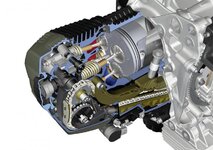
Its interesting that the designers saw fit to add a little centrifugal scavenging pump to the lower cam sprocket to squirt oil back down the cam chain tunnels which may imply that the rocker covers don't completely self drain down the cam chain tunnels as pre twin cam motors did?...
 

Attachments

  • r1200gs_dohc_head_cutaway_large.jpg
    r1200gs_dohc_head_cutaway_large.jpg
    68.9 KB · Views: 291
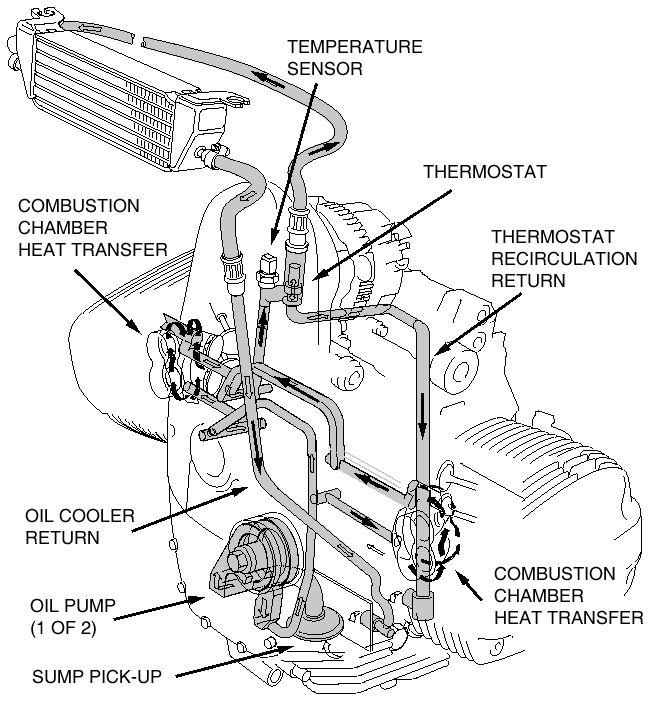
The cooling pump circuit branches to the left and then to the right heads then up to the thermostat and then the cooler then back to the sump.
cooling_oil_circuit.gif

The small impeler in the left head is where the breather to the airbox is, I think it will just be there to prevent oil droplets going up the breather pipe??
 
The pump delivers to both heads/valve gear in parallel from their respective rails. Also - the "centrifugal impeller" does not appear to be a scavenge "pump" - but a fan (not centrifugal) which circulates the air/oil droplets/oil vapour - back to the crankcase.

That is what I see in the two diagrams above.

Al
 
The pump delivers to both heads/valve gear in parallel from their respective rails. Also - the "centrifugal impeller" does not appear to be a scavenge "pump" - but a fan (not centrifugal) which circulates the air/oil droplets/oil vapour - back to the crankcase.

That is what I see in the two diagrams above.

Al

Well, whether its a fan or a pump (probably a mixture of the two as it'll be moving everything from pure oil to an air oil mixture), its definitely centrifugal (or a centrifugal axial vane impeller if you want to be picky). I was just wondering why it became necessary on the TC.

Anyway, I'll dip out of this thread now - the 1200 section definitely has a confrontational feel about it compared to the easy going 11xx section I've spent the last few years in ;)
 
Anyway, I'll dip out of this thread now - the 1200 section definitely has a confrontational feel about it compared to the easy going 11xx section I've spent the last few years in ;)

Matt, leaving this thread is not an option...

<iframe width="420" height="315" src="https://www.youtube.com/embed/mmLRTVYgEq4" frameborder="0" allowfullscreen></iframe>
 
The airbox on my MkII 1200 always smells oily, though the bike uses very little oil. Maybe that little vane pump is just to reduce that minor level of airbox oiling.
Although left and right are fed in parallel could it be the left side is somehow less restricted so gets a better oil flow rate.
 
MattW

I'll say thanks for your contribution and don't stop. I'd say to all lets make the forum a positive pool of information from which we can all benefit. As a newbie I'd like to say thanks to all who contribute.


Back
Top Bottom