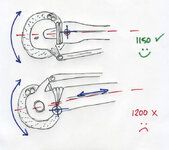
1200 drive shaft ... a shite idea

Micky

Never knowingly understood
UKGSer Subscriber
Joined
Nov 13, 2005
Messages
25,355
Reaction score
6,299
Location
South Yorkshire
Now I'm no engineer although I do have my City and Guilds in Motor Vehicle Engineering and Technology Parts 1 & 2

But when I first saw the new 1200 drive shaft layout I just said to myself "That aint gonna work!"

The 1100/1150 bevel box pivots on the drive shaft on the centre line of the drive shaft and in line with a universal joint, so that any movement up and down of the bevel box has hardly any effect on the drive shaft length :thumb

The 1200 bevel box pivots some two or three inches below the drive shaft so that any up and down movement of the bevel box must require the drive shaft to lengthen and shorten.

Yes I know that the shaft is splined but it is hard to believe that there could be any sliding of those splines under hard acceleration or on engine braking ... to all intents and purposes they'll be locked. Even if there is a degree of sliding on the splines allowed there HAS to be thrust backwards and forward on that drive shaft! Any thrust has to be transmitted into the rear of the gearbox/gearbox bearings, rear bevel box and bearings and relevant seals ... also to the engagement of those bevel drive teeth/gears.

Something has to go, has to give, but them I'm no engineer .... or artist :eek:

Nice to see that the new Triumph has the bevel box/swing arm pivot on the centre line of the drive shaft ... bet they don't have any failures :thumb

Me? I'll stick to my chain and sprockets thank you :JB

:beerjug:
 

Attachments

  • 1150:1200drive.jpg
    1150:1200drive.jpg
    95.9 KB · Views: 587
By heck, chief........................you sir, have stumbled on the Holy Grail and your logic exhibits a degree of rationality:clap
 
Take care with those crayons now Micky. :beerjug:
 
The 1200 bevel box pivots some two or three inches below the drive shaft so that any up and down movement of the bevel box must require the drive shaft to lengthen and shorten.

That does assume that the torque arm does not compensate for the apparent lengthening/shortening as the swingarm moves in its arc of movement. Not sure if your diagram covers that :aidan
 
Prop shafts lengthen and shorten on cars (RWD & 4WD) all the time as the suspension works. It works fine on them.

The 1200 swingarm has moved the torque arm up out of harms way.
 
That does assume that the torque arm does not compensate for the apparent lengthening/shortening as the swingarm moves in its arc of movement. Not sure if your diagram covers that :aidan

Prop shafts lengthen and shorten on cars (RWD & 4WD) all the time as the suspension works. It works fine on them.

The 1200 swingarm has moved the torque arm up out of harms way.

Both correct, If you measure the lower pivot to shaft line and brace to shaft line (I haven't done this) they will be similar if not the same. As the arm rises and lowers shortening the distance for the shaft the top brace pushes and pulls and the FD moves on the pivot to keep it the same that's why it is parallel. There will of course be some movement but it wont be much and as said it has worked on cars for years where there definitely is a lot of movement. FWD cars are different because they use CV joints although they still slide but any RWD car with a live axle has a sliding spline on the prop shaft.
 
You have a long and feckin' inconvenient memory Sir Wapping....

But it was quickly sorted and at little expense :P

:beerjug:


You forget me thinks :rob

Your chain also does not pivot in line with your rear wheel. The pivot point of the swingarm is several inches behind the out put Sprocket. This I believe is similar on 'all' shaft drive bike too.

You've also overlooked the fact that the paralever moves in paralel to the verticle raising the actual pivot point to a point more in line with the spline. Therefore not as much of the strain on the spline as you are probably thinking.


Val.
 
How many torque arms have you ever seen being reported as damaged on the superior 11xx generation?

I neither read the 11xx section, nor do I converse with those of an inferior model of bike. All they want to do is talk about real ale, and which beard comb is best.
 
They are a shite design and made of cheese. After nearly 70,000miles I'm still waiting for mine to explode and throw me under an oncoming truck:eek:

Of course, chains and 11** bearings never fail do they:augie
 
I neither read the 11xx section, nor do I converse with those of an inferior model of bike. All they want to do is talk about real ale, and which beard comb is best.

Your gonna get slated for that, but I can see where your coming from!!!!:beerjug:
 
The 1100/1150 bevel box pivots on the drive shaft on the centre line of the drive shaft and in line with a universal joint, so that any movement up and down of the bevel box has hardly any effect on the drive shaft length :thumb

The 1200 bevel box pivots some two or three inches below the drive shaft so that any up and down movement of the bevel box must require the drive shaft to lengthen and shorten.

Yes I know that the shaft is splined but it is hard to believe that there could be any sliding of those splines under hard acceleration or on engine braking ... to all intents and purposes they'll be locked. Even if there is a degree of sliding on the splines allowed there HAS to be thrust backwards and forward on that drive shaft! Any thrust has to be transmitted into the rear of the gearbox/gearbox bearings, rear bevel box and bearings and relevant seals ... also to the engagement of those bevel drive teeth/gears.

:beerjug:

spraken de deuch ??:flag
 
Now I'm no engineer ....

No, and your complete lack of understanding of how the rear suspension works and your subsequent slagging-off is testament to this.

Consider two things:
1. In your diagrams, how does either bevel-box rotate (pivot) when the torque-arm restrains it?
2. If it pivots as you say, what is the purpose of the bearings at the gearbox-end of the swinging-arm (or indeed, what is the purpose of the swinging-arm itself...)

Go and look again at how it really works. Hint: Think of double-wishbone setups on cars. Then tell me why you think that is inferior to a chain and sprockets set-up with its variable wheelbase and indeterminate chain tension.


Back
Top Bottom