2002 R1150GS - diary of an accidental full restoration

Today I’ve removed the right hand footrest and spent the best part of two hours trying to work out how to support the engine and gearbox so I can remove the side and centre stands, shock and subframe.

It was nice to find evidence of copper slip, clearly someone actually thought about future spannering at some point!

View attachment 455156

Unfortunately, unlike Japanese bikes, with nice, flat sumps, it seems I can’t just put a piece of wood under the engine and use a car jack to support everything. For some reason this beast has a V-shaped profile. Go figure. I’ve been trying to find a workaround with no success yet.

View attachment 455153

The only solution I can think of is wood under the gearbox on two axel stands, and somehow using two jacks at the front, one either side, to give lateral support.

Can anyone advise on how I move forward from here?

I’m off to make a brew.

Cheers
Mike
I think the way is as I showed i a picture earlier, a plate with 4 studs picking up on the sump threaded holes.
Though i agree, you do have a certain risk removeing those rubber bushes.
All my bikes where I have supported the engine and gear box like that have been in dry (relativly) climates and so the threaded section came out easily.
Alternative, maybe make up a plinth with blocks of wood and some wedges so that the the wedge can be driven in to set the angle you desire of the engine.
Make sure its secure and wont fall off your bench!
 
Thanks Ewe - two really good, neat mods there. I e got something similar to those Deutch connectors, but to be honest yours looks more ‘factory’ so I think I’ll hunt some out when I come to put it all together again.
 
I’d honestly love to remove those sump guard studs, but it isn’t worth the risk in my opinion. I’ll come up with a plan B!
On my first 1150 my hand was forced when one of them tore, good news was that once the rubber was gone it was clear that there is a for want of a better word large diameter thick washer left which is attached to the stud that goes into the motor , bit of heat and a set of Mole grips and it came straight out .

All four were replaced in the same manner (I used heavier duty car exhaust mounts that cost buttons and they had hex head washers)
 
Last edited:
I dont know how your facility is, but this is another way I have 'handled' the engine and gearbox assembly.
This allowed me to remove all other parts, and then the centerstand and side stand, and lower it on to a dolly to move around and pack in to storage.

20240804_121209-L.jpg
 
And with the Deutsch connectors, the rubber o ring can be tight, a very littlr smeer of silicone or vaseline grease helps a lot.
 
On my first 1150 my hand was forced when one of them tore, good news was that once the rubber was gone it was clear that there is a for want of a better word large diameter thick washer left which is attached to the stud that goes into the motor , bit of heat and a set of Mole grips and it came straight out .

All four were replaced in the same manner (I used heavier duty car exhaust mounts that cost buttons and they had hex head washers)
I figured the same Neil! But, given my luck, I’d hate one to let go.

The exhaust studs are ropey, but at least if the worst happened and one snaps I can take a head off and get it fettled. The crank cases are a different thing all together….
 
I dont know how your facility is, but this is another way I have 'handled' the engine and gearbox assembly.
This allowed me to remove all other parts, and then the centerstand and side stand, and lower it on to a dolly to move around and pack in to storage.

20240804_121209-L.jpg

That’s quick thinking!

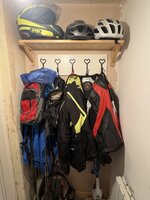
The irony is I’ve got a pair of identical folding ladders which only this afternoon I’ve been debating where I can move them to ( I’ve put a shelf and bike jacket storage up this afternoon where they’ve been leaning for years). I wonder if you’ve found a solution!
 

Attachments

  • IMG_3799.jpeg
    IMG_3799.jpeg
    159.4 KB · Views: 42
I figured the same Neil! But, given my luck, I’d hate one to let go.

The exhaust studs are ropey, but at least if the worst happened and one snaps I can take a head off and get it fettled. The crank cases are a different thing all together….
I have done the same fix as @Neil W and whilst it sounds dodgy it shouldn't give you much bother @Bikermike1411 The rubbers usually perish and fail rather than the studs seizing and as Neil says, a bit of gentle heat and a pair of grips sees them out.
 
Cheers Aidan! I’m still chewing that one over.

The rubbers aren’t rotten, so I don’t know if they’ve already been replaced, meaning they could come out easily….

It’s a big ‘if’!
 
Having spent two days staring at the bike, wondering how to progress, I had a plan in mind. Sort of. It involved axel stands and straps in a way to replace the missing front end, allowing me to take the subframe, and eventually centre stand, off.

Then my dad came over. For context, he taught me everything I know about spannering bikes, having watched and then helped him rebuild a dozen or so concourse
bikes in the 80s and 90s.

‘You’re overthinking this. And it has to come off one way or another’ he said, before moving the axel stands and trolly jack around.

‘Right’ release the top shock bolt.

We set to it. The bolt came out easily - no weight through it whatsoever.

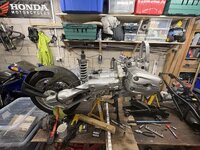
Then I pulled out the two forward subframe bolts, fiddled with the wiring loom routing a bit and lifted the subframe, complete with airbox and fuse box, straight off.

Nothing collapsed (I still can’t work out why) and there’s no weight on the trolly jack at the front or the axel stand under the gearbox.

Success…I hope!
IMG_3872.jpeg

I still need to work out how to get the engine supported so I can take the centre stand off (I think I have a plan for that) and take off the rear shock, but, besides stripping the ancillaries from the subframe it’s about as far down as I wanted to go.

The only concerning job at this stage is removing the torque arm from the swing arm, but there haven’t been any surprises yet so I think that will be ok.

The clutch hose is a mess and will be replaced. Can anyone let me know whether the slave cylinder can be rebuilt? I’m inclined to do it if necessary while I’m in here.
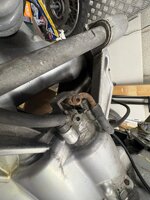
IMG_3874.jpeg

Cheers
Mike
 
Last edited:
Dont know about the clutch slave xylibder but ya gonna need a new hose.
Be very worth while to replace it now at this level of dissassembly.

Good work on the strip down too.
Am sure it will be most excellent when completed.

Am still following along
<thumbs up>
 
Oh yeah, that hose is toast. I’ll put a braided one on during the rebuild, along with braided brake lines when I perform the servoectomy.

It’s all gone quite well so far! Quite a bit of engine cleaning and paint prep/surface keying to do, but nothing particularly difficult. The biggest issue is getting ahead of myself now! I need to take the black parts and silver rear rack for powder coating, which will take some time.

In the meantime I can clean sub-units and put them away ready for reassembly and maybe start looking at re-wrapping the wiring loom

Also, there’s a looming road bump - I’m going for a shoulder operation in about 3 weeks, which will put me largely out of bike-related action for a couple of months
 
It’s a pain to be sure, but much needed!

Now the subframe is off I’m going to focus on doing what I can in preparation. I’ll do what I can now to prepare for the bigger tasks early in the new year. I can use the down time to carefully plan out the rebuild sequence too!
 
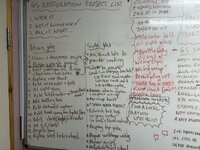
Had a busy week at work so not really spent any time in the garage. I did rewrite my plan on my whiteboard though (best thing I ever bought). I’m a teacher….don’t judge!

IMG_3937.jpeg

I’ve been asking on another thread about jobs I should do now, or things I should look at carefully during the rebuild. One which came out on top is the clutch and gearbox seals. Fair enough! I might have to ask for Steptoe’s advice regarding the method of doing the clutch pushrod seal, and the gearbox seals will have to wait until I take the rear end out in phase 2.

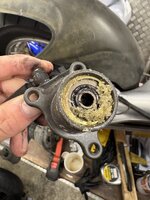
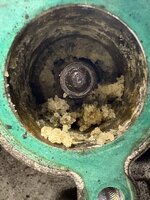
However, I did take the clutch slave cylinder off…

IMG_3960.jpeg

IMG_3965.jpeg

I was shocked at first until I realised it’s just ancient crystallised grease. The tunnel isn’t corroded and the bearing in the slave cylinder seems ok, but I’m going to see about replacing it anyway to be certain.

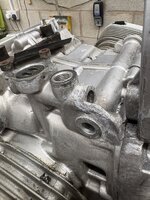
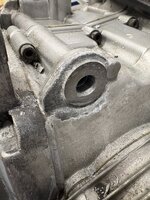
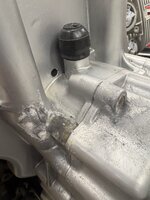
I then decided staring at the bike wasn’t going to get anything done. I started by cleaning/degreasing under the engine, then tentatively picked at one of the scabby bits of paint exposed since I’ve stripped the bike down. That was two hours ago….I’ve just come out of the garage having managed to remove most of the ‘blown’ paint from the engine and gearbox cases. It just chips off in big lumps, revealing the white corrosion underneath.

IMG_3987.jpeg

IMG_3990.jpeg

IMG_3993.jpeg

There’s more than that, believe me! I’m going to remove what I can, sand it as smooth as possible and key in the rest of the paint with sandpaper ready for priming.

Does anyone have any advice regarding efficient paint prep? I’ve not had much success with a dremmel so far - it’s either too aggressive or chews through cleaning medium in seconds. A brass brush on a drill is also way too aggressive - that’s how I ended up having to re finish the front cover! The alloy is softer than a burger cheese slice on a warm day….
 
On aircraft we use scotch pads, like the green nylon washing up scrubbing pads.
Usually red ones as less harsh.
You can get circular one to go on the end of a drill.

I just put roloc pads in to google and got heaps of results.
If you are near an airfield that does any kind of maintenance you should be able to get some from there.

You will need an arbour to mount them to, the arbour then goes in the drill / windy chuck.
 
Not heard of those, but I’ve just done a quick google and they seem exactly what I need. I’ll do a bit more research this week, thanks for the info!


Back
Top Bottom