
Charging Issue; Stator or RR

DJ123

Well-known member
UKGSer Subscriber
Joined
Feb 17, 2022
Messages
2,807
Reaction score
1,902
Location
Berkshire
Seems like one issue after another currently after a fuss free 18 months.

Whilst sorting my slight oil leak the Bike threw up the red warning for low charging/low battery voltage. It did this once a few weeks ago and it went within a few minutes. On the rides this week (short, local ones) its pretty much been on continuously.
The dashboard voltmeter was sitting around low to mid 12v, and occasionally creeping above 13v. But then it came back down soon enough - this was regardless of revs/speed.

I've done some checking with the voltmeter and the below are my findings; (battery has been checked, and charged - is a fine, working battery. Also tested with a new battery and the same issues maintained)

Battery voltage at idle; 12.6
Battery voltage when being rev'd; 12.6v - no change

Output from RR at idle; 6v
output from all 3 stator phases at idle; 26V (across the phases & to ground)

stator resistance;
between phases 0.5 ohm's across all, no which pairing (off a 200 ohm multimeter scale)
The same between the phases and a ground point

The RR also passes the test of resistance and diodes test;
Didoes test; 490 ohms across all 3
resistance test; 70 ohms across all 3

Now, electrics are not my strong point and i do not know what the answer is from this as to where the bad charge is coming from. If the stator was bad i would expect to see low voltage output & no resistance on 1 phase - which there isn't. Previous RR failures i've had have been either the shunt regulator failed or the regulator failed and lead to over charging. My only take away is perhaps this is a Diodes failure and is restricting the output voltage/not passing it forward which is causing the output voltage to drop.

Any thoughts on other things to check prior to splashing out on a new RR?
 
Last edited:
If you have continuity between any of the three phase wires and earth your stator is fubar.
That`s a helluva job to fix.

Carefully read through this excellent and comprehensive diagnostic guide so that you can identify exactly where the fault lies before embarking on potentially expensive and extensive remedial work;

https://www.ukgser.com/technical/ni...f charging system (R-series, '13 on) V1.0.pdf

I'm going to double check it tomorrow (phase to ground) and make sure i've tested it right/got the right result. I'm not convinced i have......

I used that document to go through all the test and to figure out what's good or bad.
 
Battery voltage when being rev'd; 12.6v - no change


output from all 3 stator phases at idle; 26V (across the phases & to ground)
Your battery voltage with engine running is low, should be about 14.2 - 14.5V.

I`m not entirely sure because i`ve never tested a stator in that way (you don`t normally expect to see any voltage from between the phase wires and earth) but the fact you have voltage there suggests an insulation breakdown to ground (most likely the stator windings) causing a circuit where there should not be one.

I`ve rewound a number of stators myself over the years (when it was expensive to buy one, but cheap Chinese ones do not make it worth the hassle these days) and the usual failure mode of Japanese bikes` charging problems were shorts to earth on the stator windings.

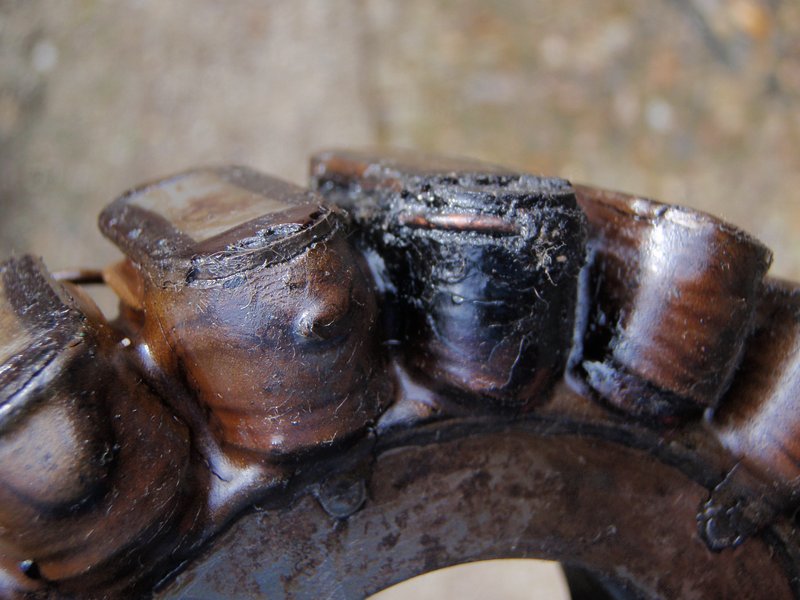
You can see where the windings have overheated and blackened here at the short;


One i rewound;
a13.jpg


Good luck in your fault finding, i hope it`s a simple fix!
 
The early LC's had an issue with failing stators. hence the change in the number of coils in the stator

The bad news is its 14hrs labour alone to change

The engine needs to be removed from the frame, and then the gearbox removed to access the stator (7hrs)

then its a matter of rebuilding (7hrs)

Ouch
 
Given the longstanding issues with stators on various bikes over many years and the debacle with the BMW F800 bikes one would have thought that BMW would have made a stator buried deep inside an engine much more robust.

Sent from my SM-T813 using Tapatalk
 
The early LC's had an issue with failing stators. hence the change in the number of coils in the stator

The bad news is its 14hrs labour alone to change

The engine needs to be removed from the frame, and then the gearbox removed to access the stator (7hrs)

then its a matter of rebuilding (7hrs)

Ouch
Yeah, i know the issues with it. Costs at the moment from BMW are circa £1600 to get it done.....
 
Given the longstanding issues with stators on various bikes over many years and the debacle with the BMW F800 bikes one would have thought that BMW would have made a stator buried deep inside an engine much more robust.

Sent from my SM-T813 using Tapatalk

it would have been nice! But to be honest it has lasted 10 years, which you could argue is an ok lifetime for it.
 
Seems like one issue after another currently after a fuss free 18 months.

Whilst sorting my slight oil leak the Bike threw up the red warning for low charging/low battery voltage. It did this once a few weeks ago and it went within a few minutes. On the rides this week (short, local ones) its pretty much been on continuously.
The dashboard voltmeter was sitting around low to mid 12v, and occasionally creeping above 13v. But then it came back down soon enough - this was regardless of revs/speed.

I've done some checking with the voltmeter and the below are my findings; (battery has been checked, and charged - is a fine, working battery. Also tested with a new battery and the same issues maintained)

Battery voltage at idle; 12.6
Battery voltage when being rev'd; 12.6v - no change

Output from RR at idle; 6v
Output from all 3 stator phases at idle; 26V - to


stator resistance;
between phases 0.5 ohm's across all, from any pairing (off a 200 ohm multimeter scale)
No resistance between stator and ground

The RR also passes the test of resistance and diodes test;
Didoes test; 490 ohms across all 3
resistance test; 70 ohms across all 3

Now, electrics are not my strong point and i do not know what the answer is from this as to where the bad charge is coming from. If the stator was bad i would expect to see low voltage output & no resistance on 1 phase - which there isn't. Previous RR failures i've had have been either the shunt regulator failed or the regulator failed and lead to over charging. My only take away is perhaps this is a Diodes failure and is restricting the output voltage/not passing it forward which is causing the output voltage to drop.

Any thoughts on other things to check prior to splashing out on a new RR?
updated some numbers which were wrong.

What Voltage should the RR kick out on the DC side, as at idle i get 6v and revs i get 15v which sounds right to me.

Which then begs the question why is the battery not charging if at revs the RR is kicking out 15V? My Bike is an early 2013 Bike and does not have the 50A fuse which i would suspect otherwise. Clearly somewhere between the RR output & the battery connection there's an issue. I've traced as many wires as i can and i am yet to find the issue. Seeing as everything else works ok I am ruling out a common earth/common circuits as i'd have other issues on other circuits.
Is there a module which regulates the battery charging which could have a fault or lose/broken wires?
 
When you say no resistance from stator wires to ground are you saying zero Ohms or??

No way should the voltage be only 6V at idle. You would have to see at least the battery's own voltage!

Sent from my SM-T813 using Tapatalk
 
What Voltage should the RR kick out on the DC side, as at idle i get 6v and revs i get 15v which sounds right to me
14.4V at both idle and increased engine speed.
Is this with the r/r output plug disconnected or fitted, electrical system loaded or not?
I think you need to re-do the stator output checks - preferably when the engine is both cold and hot. *Faults with stator insulation can appear only when the engine is hot.*
DC Voltage across battery terminals when at idle and when revved.
Stator resistance checks when both hot and cold
Stator ACV output, you say 26V at idle but what is the ACV figure when revved? (i do not connect a lamp as described in the PDF just measure at 3-way multiplug at idle and with engine speed increased) Typically 20 - 30VAC at idle and increases rapidly to 60 -70VAC at 3/4000rpm.

"When you say no resistance from stator wires to ground are you saying zero Ohms or??"

Good point RF, i`m not suggesting DJ123 does not know his way around a multimeter but due to the way some MM work it might be confusing to see a reading of `000` ohms on some multimeters is not in fact no reading (infinite resistance/no continuity) but in fact a dead short.
DJ, is the reading on your MM you see when checking phase to earth the same as when you touch the MM probes together?
 
When you say no resistance from stator wires to ground are you saying zero Ohms or??

No way should the voltage be only 6V at idle. You would have to see at least the battery's own voltage!

Sent from my SM-T813 using Tapatalk

yes - zero ohms / no resistance. Multimeter is not reading any resistance/ohms. the display shows '1' as it does when the probes are not connected to anything. When connected between the 3 phases it shows 0.3-0.5 as mentioned above.

At idle the stator is turning slower than when riding at revs. IIRC thats why there is guidance from the MFR to not idle for long periods nor have high draw electronics on at idle (heated grips, heated gear etc). If you want to check what your outputs and report back, that would help provide context to the number i have - no where on Google can i find any other reading. the fact it is producting 14.5v-15v at revs indicates the stator is outputting the juice needed to charge.

14.4V at both idle and increased engine speed.
Is this with the r/r output plug disconnected or fitted, electrical system loaded or not?
I think you need to re-do the stator output checks - preferably when the engine is both cold and hot. *Faults with stator insulation can appear only when the engine is hot.*
DC Voltage across battery terminals when at idle and when revved.
Stator resistance checks when both hot and cold
Stator ACV output, you say 26V at idle but what is the ACV figure when revved? (i do not connect a lamp as described in the PDF just measure at 3-way multiplug at idle and with engine speed increased) Typically 20 - 30VAC at idle and increases rapidly to 60 -70VAC at 3/4000rpm.

"When you say no resistance from stator wires to ground are you saying zero Ohms or??"

Good point RF, i`m not suggesting DJ123 does not know his way around a multimeter but due to the way some MM work it might be confusing to see a reading of `000` ohms on some multimeters is not in fact no reading (infinite resistance/no continuity) but in fact a dead short.
DJ, is the reading on your MM you see when checking phase to earth the same as when you touch the MM probes together?

I'm getting the voltage output (14.5v-15v) at the output from the RR where the red & brown lead plugs into at anything above idle.
 
yes - zero ohms / no resistance. Multimeter is not reading any resistance/ohms. the display shows '1' as it does when the probes are not connected to anything. When connected between the 3 phases it shows 0.3-0.5 as mentioned above.
That's not zero ohms/no resistance, that's infinite ohms/resistance...
 
I'm getting the voltage output (14.5v-15v) at the output from the RR where the red & brown lead plugs into at anything above idle.
So that`s with the plug disconnected/no load on the electrical system?
The reg/rec or stator might be `falling down` when there`s a load on the system.
Can you get your MM probes into the back of the connector and onto those terminals when it`s plugged in with the engine running?
That might give a clue as to what`s happening.
 
Lest there be any ambiguity you measure charging voltage with everything connected. Across the battery terminals is a convenient place to do the measurement. I mention this specifically because a reading of 6V was mentioned and this is highly improbable if the battery is in the circuit. If you are measuring charging voltage with the regulator disconnected from the battery this is incorrect.

You measure stator winding resistance with the stator disconnected from the regulator - likewise continuity to ground.

As mentioned no resistance = 0 Ohms. You want to see infinite (or VERY high) resistance between those windings and ground. Also as mentioned the most common cause of stator failure is a winding shorting to ground.
 
To update on the readings so far;

Stator resistance between phases; 0.3-0.4 ohms read on a 200 ohm scale
stator resistance to ground (red pin to plug, black pin to ground) 0.3 ohms across all 3 (reverse colours and its '1')

Hopefully that helps clears things up.
 
To update on the readings so far;

Stator resistance between phases; 0.3-0.4 ohms read on a 200 ohm scale
stator resistance to ground (red pin to plug, black pin to ground) 0.3 ohms across all 3 (reverse colours and its '1')

Hopefully that helps clears things up.
Reversing the meter leads should make no difference to the resistance reading between the stator leads and ground. You are doing this with the stator disconnected from the rectifier/regulator, correct?


Sent from my SM-T813 using Tapatalk
 
Reversing the meter leads should make no difference to the resistance reading between the stator leads and ground. You are doing this with the stator disconnected from the rectifier/regulator, correct?


Sent from my SM-T813 using Tapatalk

Yes the plug is disconnected from the RR.


Back
Top Bottom
