Happy to help.
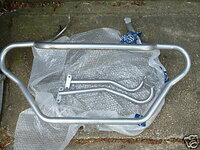
The engine bars go horizontally across the front of the engine. ( the thing with the finny bits which stick out the sides.
You will find round empty orifices in the flat bits [1] on the bars. These are called bolt holes.
Through these go bolts [2]. These are round rods with spirally shafts and a fat bit on the end. Sometimes hexagonal, sometimes round with a hexagonal hole in the top.
This accommodates a tool [4] which tightens the bolts onto a thing called a nut [3]. A nut is usually a hexagonal thing with a spirally hole in it, which the spirally shaft of the bolt [2] fits into when turned (usually clockwise, which is the same direction in which a the hands on a clock turn) Sounds complicated, but look at your clock for an hour and you will get the jist of it. ( It must not be a digital clock ).
The tool [4] is a device which either fits onto or into the fat bit on the bolt [2] or nut [3]. It provides more leverage to tighten things. Sometimes two tools [4] have to be used at the same time, which means one will have to be used in your 'less able' hand. This can be tricky, but easily mastered with practice.
When two of [1] have their holes lined up, and a bolt [2] is inserted through the holes, and a nut [3] is wound onto the bolt [2] and turned clockwise until it can go no further, and further tightened by the tool [4], it will fasten the two flat bits [1] together.
When several of these actions have taken place, in conjunction with fastening the assembly to an immovable part of the engine or framework which conveniently lines up with the remainder of the holes, the engine bars will provide protection to the engine in the event of the bike accidentally deviating from the horizontal and landing heavily on the ground.
Shit .... I forgot to mention washers.
Somebody tell him about washers please.




 onyack





