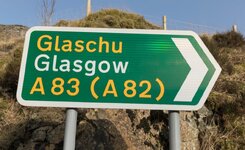
Gaelic, who ‘guards’ it?

Glasahu (I cant spell it) for Glasgow? OK, Most old Gaelic speakers I know just said Glasgow. Cumbernauld? WTF.
Close enough, .........Go Dtuga Dia deoch duit as an tobar nach Dtrànn - translated into English, May God give you a drink from the well that never runs dry.
 

Attachments

  • Glaschu.jpg
    Glaschu.jpg
    108.3 KB · Views: 1
Last edited:
My niece and nephew (in law, so to speak) are 12 and 8 respectively and both attend Irish Gaelic schools in Dublin - so the Irish language is safe and taught with vigorous enthusiasm

I seem to remember that primary children don’t start until 6 years old
My brother who lives in county Meath has two sons, both were taught Gaelic at school. Hopefully this continues and the language is kept going.
 
My niece and nephew (in law, so to speak) are 12 and 8 respectively and both attend Irish Gaelic schools in Dublin - so the Irish language is safe and taught with vigorous enthusiasm

I seem to remember that primary children don’t start until 6 years old
Back in the 60's. I lived in Harris, started school there. Most if not all the other kids were Gaelic speaking. Not me I picked up some, it wasn't encouraged at school. Later living in Glasgow it just wasn't something, I ever let on at all. Only reluctantly in the summer visiting. My Cousin also grew up with Gaelic speaking parents in Glasgow. Like me she knows a little but not enough.
She now lives in Oban and her daughters went to Gaelic immersion. Which is nice to know it is continuing. The interesting thing she found she was actually learning gaelic from them. It's one of those things you are lucky if it's available. Meanwhile, my Gaelic speaking cousin who is teacher. Her Gaelic speaking kids come home and complain if she speaks gaelic at home because they have to speak gaelic at school. Kids eh. :) When I had the opportunity to learn more, I wouldn't. I didn't understand what I was missing. Until most of the people I could have learned from were gone. It's a part of who you are, but you don't quite get it.
 
My brother who lives in county Meath has two sons, both were taught Gaelic at school. Hopefully this continues and the language is kept going.
They attend full Gaelic schools so as soon as they enter the gate, in the morning then only Irish Gaelic is spoken at all lessons
Maths/Science/PE/Geography
No ‘English’ is uttered during the school day - it’s full on Gaelic all day, rather than specific Gaelic language lessons for some parts of the week
 
They attend full Gaelic schools so as soon as they enter the gate, in the morning then only Irish Gaelic is spoken at all lessons
Maths/Science/PE/Geography
No ‘English’ is uttered during the school day - it’s full on Gaelic all day, rather than specific Gaelic language lessons for some parts of the week
Total immersion from early on is not only good for preserving the language , it's good for the intellectual development of the youngster. There's a lot of evidence around "brain plasticity" that this encourages cognitive development overall. That's why talking to your kids and (grandkids) at an early age is so important. It's also easier for the kid when he/she is younger anyway.
 
This thread has migrated a little - as they all do - from the initial post; I went to school in the ROI where I still live - now an OAP. Irish (Gaelic) was compulsory, I was subjected to it for 14 years but can not speak it. I'm possibly a slow learner? However the subject was not remotely appealing in that it was immersed in past miseries as I perceived it. I was too young to appreciate culture - beyond the Beatles; Shakespeare & poetry was challenging when I was a teenager but I caught up with him & Seamus Heaney in later years.
I moved to a new job & area in 1984. Enrolling for adult Irish classes ticked two boxes; meeting new people & learning how to string the Irish words I had into coherent sentences. The class was dominated of hard line zealots who would not pay their TV licence as there was insufficient Irish language programming. I & many others drifted away & my ability to speak Irish was unfilled.
I'm gratified to hear that it is being thought to young folk & hopefully with a current vibrancy rather than a historical hardship focus. As said earlier, TG4 - the Irish language station (not there in 1984) - appears vibrant & sexy for want of a better word. Perhaps that is an alternate approach to the Irish language or it is an era defined "thing". The black & white 1950's were not sexy - come to think of it, as a teenager in the 60's Irish had no great provenance for me. It lacked the vocabulary that peppered pubescent conversation - it was over immersed in its own purity. Do they teach Gaelic curse words?
 
Do they teach Gaelic curse words?
Only curse words widely used in Scots Gaelic possibly same in Irish Gaelic also, is " póg mo thóin " or spelt and spoken as Pogue Mahone, which suprisely enough is the seventh and final studio album by the Pogues, released in February 1996. The title is a variant of the Irish phrase póg mo thóin, meaning "kiss my arse", from which the band's name is derived.
 
I believe the Welsh are the only true descendants of the English people. Slowly driven west by the influx of the Saxons and the Vikings. So to that end is Welsh really old English?
Old English - Friesen Eddie Izzard buys cow

 
This thread has migrated a little - as they all do - from the initial post; I went to school in the ROI where I still live - now an OAP. Irish (Gaelic) was compulsory, I was subjected to it for 14 years but can not speak it. I'm possibly a slow learner? However the subject was not remotely appealing in that it was immersed in past miseries as I perceived it. I was too young to appreciate culture - beyond the Beatles; Shakespeare & poetry was challenging when I was a teenager but I caught up with him & Seamus Heaney in later years.
I moved to a new job & area in 1984. Enrolling for adult Irish classes ticked two boxes; meeting new people & learning how to string the Irish words I had into coherent sentences. The class was dominated of hard line zealots who would not pay their TV licence as there was insufficient Irish language programming. I & many others drifted away & my ability to speak Irish was unfilled.
I'm gratified to hear that it is being thought to young folk & hopefully with a current vibrancy rather than a historical hardship focus. As said earlier, TG4 - the Irish language station (not there in 1984) - appears vibrant & sexy for want of a better word. Perhaps that is an alternate approach to the Irish language or it is an era defined "thing". The black & white 1950's were not sexy - come to think of it, as a teenager in the 60's Irish had no great provenance for me. It lacked the vocabulary that peppered pubescent conversation - it was over immersed in its own purity. Do they teach Gaelic curse words?

I don't think they are taught.
A couple of years ago I saw a Little book of rude gaelic. Which I bought and read. It was quite funny, most of it I had never heard before. Some I had.
There's are certain Glaswegian term which is not polite. Again my spelling probably wrong. Not something you see written. You just hear it. "Ceich" Its the same in Gaelic only more of an "A" sound rather than the Glaswegian "E". All Glaswegians are familiar with it. So my guess is It's quite similar in Irish.
Which is the most common I have heard. Generally not polite.
My wife as a young Canadian girl on a visit "home" with her mum. While with her mums old aunts. Mentioned the strong farm smell. Here Aunt apologized to her mum saying she's only been here 5 minutes and she is learning all the rude words already.
I can't quite remember how this phrase goes. Even though I used to hear it. Definitely can't spell it. "Son of the Devil" I've annoyed someone.
Occasional an old aunt used to look at me shake her head. It sounded like Oh Yiah Yiah I think it was "Dia Dia". "Oh God." I done something wrong again.
So what little I know it's kind of like french. Insults, Sewaring tend to be church or barnyard.

Back when I was in School, They didn't teach english swear words either. They sure got mad at you when you used them though. When you got a dictionary you looked them up anyway.
 
This thread has migrated a little - as they all do - from the initial post; I went to school in the ROI where I still live - now an OAP. Irish (Gaelic) was compulsory, I was subjected to it for 14 years but can not speak it. I'm possibly a slow learner? However the subject was not remotely appealing in that it was immersed in past miseries as I perceived it. I was too young to appreciate culture - beyond the Beatles; Shakespeare & poetry was challenging when I was a teenager but I caught up with him & Seamus Heaney in later years.
I moved to a new job & area in 1984. Enrolling for adult Irish classes ticked two boxes; meeting new people & learning how to string the Irish words I had into coherent sentences. The class was dominated of hard line zealots who would not pay their TV licence as there was insufficient Irish language programming. I & many others drifted away & my ability to speak Irish was unfilled.
I'm gratified to hear that it is being thought to young folk & hopefully with a current vibrancy rather than a historical hardship focus. As said earlier, TG4 - the Irish language station (not there in 1984) - appears vibrant & sexy for want of a better word. Perhaps that is an alternate approach to the Irish language or it is an era defined "thing". The black & white 1950's were not sexy - come to think of it, as a teenager in the 60's Irish had no great provenance for me. It lacked the vocabulary that peppered pubescent conversation - it was over immersed in its own purity. Do they teach Gaelic curse words?
I think like anything else motivation and immersive practice are the keys. I had an uncle who ended his days in Salthill and died in 2019 at age 85. He'd been in the textile industry all his life and lived in NI, Malta, the United States then back to Ireland. His last job starting in the Early 90's when he was in his fifties was as business director of Údarás na Gaeltachta, based in Furbogh just outside Galway, administering business grants in the Gaeltacht areas. Part of his remit was that he had to speak Irish fluently within 6 months of taking up the post. The old bugger managed it with enough fluency to be interviewed by RTÉ Raidió na Gaeltachta when he was about 9 months in. I knew he'd got the job when he sent me e-mails at work with the Irish version of his name......I reckon he did OK for a former Presbyterian from Co. Antrim :D

 
I suppose a bit like Hindi or Urdu? I find it funny when you hear them speaking to each other at nineteen to the dozen with a fair smattering of perfectly pronounced English words.
You get that in Wales too. I was in a shop where a customer was shopping in Welsh, but then asked for Welsh Cakes in English in the middle of a Welsh sentence.
 
You get that in Wales too. I was in a shop where a customer was shopping in Welsh, but then asked for Welsh Cakes in English in the middle of a Welsh sentence.
I remember being in North Wales in the early 80's and being in shops where the assistants would be speaking in Welsh then seamlessly just speak to me in English. I can barely manage to get fed or ask for directions in French and only speak a smattering of Spanish words. I know a few Irish words......but only rude ones :D
 
I can't quite remember how this phrase goes. Even though I used to hear it. Definitely can't spell it. "Son of the Devil" I've annoyed someone.
Son of a devil = Mac an Diabhail? ... or full sentence "Son of the Devil, I've annoyed someone".
Would be, "Mac an Diabhail Tha mi air dragh a chuir air cuideigin."

I am not a fluent Gaelic speaker, but some words I know, down to living with my father, who spoke Gaelic fluently well, and had his higher Gaelic since his high school days.
 
Last edited:
You get that in Wales too. I was in a shop where a customer was shopping in Welsh, but then asked for Welsh Cakes in English in the middle of a Welsh sentence.

I work with a bunch of Latin American colleagues, who do the same. I asked if there was no word(s) in Spanish for the equivalent word in English. They explained that sometimes there really wasn’t an equivalent Spanish word or, sometimes, it would take say three (or more) Spanish words to say the same thing, when one English word did it more easily.

We of course do the same. For example, when we use the French word cul-de-sac, rather than saying: “The road is closed at its end and has no exit”. A Swedish colleague of mine, had never heard the French expression, used in English. The Swedes, I think he told me, have their own word for it.

 
I work with a bunch of Latin American colleagues, who do the same. I asked if there was no word(s) in Spanish for the equivalent word in English. They explained that sometimes there really wasn’t an equivalent Spanish word or, sometimes, it would take say three (or more) Spanish words to say the same thing, when one English word did it more easily.

We of course do the same. For example, when we use the French word cul-de-sac, rather than saying: “The road is closed at its end and has no exit”. A Swedish colleague of mine, had never heard the French expression, used in English. The Swedes, I think he told me, have their own word for it.
I think the direct translation of cul-de-sac is arse of bag.
 
Aberdeen in Gaelic = "Obar Dheathain" and in Doric = "Aburdein" commonly called = "Shit'ole" by some :D
 
I reckon he did OK for a former Presbyterian from Co. Antrim :D

I firmly believe that the language belongs to all of us and I am saddened that it has become politicised here in the north. Gusty Spence former leader of the UVF (or was it the UDA) learned Irish in Long Kesh and was I believe a fluent speaker.
I took Irish at secondary school and was semi-fluent achieving a Silver Fáinne and Grade A at O level, both written and spoken. Sadly in the intervening years I have lost much of it but I still have a grá for our national tongue.
 
I firmly believe that the language belongs to all of us and I am saddened that it has become politicised here in the north. Gusty Spence former leader of the UVF (or was it the UDA) learned Irish in Long Kesh and was I believe a fluent speaker.
I took Irish at secondary school and was semi-fluent achieving a Silver Fáinne and Grade A at O level, both written and spoken. Sadly in the intervening years I have lost much of it but I still have a grá for our national tongue.
I believe the same thing Aidan and Linda Ervine has done her best to promote the language in predominantly Unionist East Belfast. I was brought up in the C of I (I have no religion now) but had two sets of cousins in Dublin and Shannon raised in the ROI and Catholic church. It was strange in the 1970's when I was a kid. We made regular trips to Dublin and Shannon during the summer to see our Cousins, including spending a month in Shannon in August 1975 when my mum took my sister and I down to look after my uncle Jim and aunt Agnes's kids. They had gone to America for Uncle Jim's business. I was 14. We were sworn to secrecy and couldn't tell our friends where we had been when we came home as we lived in a unionist area, and as you know at that time it could have been dangerous.

Still I had another perspective at a very dark time and must have been the only kid in Ballybeen Estate who had been to mass (my ma promised my aunt she'd make everyone go much to their disappointment), and played with a hurl in a handball court with his cousins :D


Back
Top Bottom