We seem to have lost the Technical Sub-section, so I'll just start another Techie thread here.
I recently rebuilt 'Bumpmuncher's' R100GS Gearbox as it was knackered and thought that some pics and thoughts might be of general interest.
From the symptoms described, it sounded as though the front output shaft bearing was worn. One cause of this is the fact that under certain conditions, the propshaft can draw the output shaft back, pulling the shaft through the front bearing.
The bearings are pressed onto the shafts and the bearings are shrunk into the end cases, so hauling the shaft back against the rear case leaves a lot of axial preload on the bearings.
Ball bearings are designed to take radial load so this side force causes them to fail. The tell tale signs being steel swarf in the oil and on the magnetic drain plug.
When stripping the box, the speedo drive and output drive flange are removed and then the 5mm socket-headed set screws around the rear cover are removed. If there is excessive pre-load on the bearings the end cover will pop open at this point.
Bumpmuncher's cover didn't do this.
After heating the end cover, removing the gear selector mechanism and heating the front of the box, I was able to remove all the shafts.
The front bearing had moved and there was about 1mm of clearance between the rear of the front bearing and the shoulder that it bears against. The reason that there was no pre-load was apparent - the bearing was like a baby's rattle . The box had a lot of swarf in it as well. Given that we shim these boxes to 0.05mm clearance, having 1mm of float is bad news.
The front bearing on the Intermediate shaft was worn as well, but wasn't as bad as that on the Output Shaft.
The 'cure' for this is to fit a circlip into the Output Shaft, outboard of the front bearing. This prevents the shaft being drawn back.
My local Engineering works ground a circlip groove in the shaft for me. They must look forward to my visits as this was the 4th they have done - at £50 a time (When I get my lathe up and running I intend to do this myself).
This is the finished product, The groove can be seen and there is still some Engineers Blue on the shaft:

When the Output Shaft is assembled, the modified front looks like this:

One problem with the front bearing shifting is that it allows fifth gear to float on the shaft. Fifth gear is fixed and third gear is moved into and out of engagement with it by one of the three selector forks. Having excess clearance means that the engagement dogs are not fully 'home' and are therefore under increased pressure.
Bumpmuncher was lucky, his gear pinions were OK. however to show what can happen, here is a pair of pinions from my spare box. The bearings had worn to the extent that fifth gear was machining the inside of the case and the rider was having to hold the bike in gear on the lever. The 3rd gear / 5th gear dogs are shot and the selector fork was blackened with heat. Not nice.

You can see how the edges of the webs in the 3rd gear pinion (on the left) have worn to a 45 drgree angle and the edges of the 5th gear dogs are similarly worn.
A tip I picked up from one of the 'Gearbox rebuild' sites is to replace the nylon Indexing Roller on the selector mechanism with a pukka bearing. This is a Type 6882Z bearing of 8mm (ID), 16mm (OD), 5mm (Depth). Its supposed to give crisper changes and is a mod I've done on both my gearboxes.
I'll be interested to hear Bumpmuncher's opinion (I did clear it with him first).
I also replaced three of the selector springs while I was in there.
The completed selector mechanism. The Indexing ball bearing can be seen located in the First Gear detent on the right.

Now a question for the experts
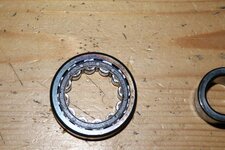
The roller cage on the Input Shaft front bearing on Bumpmuncher's box appear to show signs of overheating - see below.

It looks as though the rollers have overheated and their pins that engage in the bearing cage have heated the cage.
Any ideas about the cause ? ? ?
I have replaced four of these roller bearings and the other three don't exhibit these marks:

Possibly 'burning the clutch' would cause this as there were no signs of lack of oil in the box. In fact, the internals were in very good condition.
This bearing sits just behind the input shaft clutch splines, with an oil seal in between, so I think that is the most likely cause.
The oil seal looked OK (I replaced all seals as a matter of course).
I await the collective response with interest.
Bob
I recently rebuilt 'Bumpmuncher's' R100GS Gearbox as it was knackered and thought that some pics and thoughts might be of general interest.
From the symptoms described, it sounded as though the front output shaft bearing was worn. One cause of this is the fact that under certain conditions, the propshaft can draw the output shaft back, pulling the shaft through the front bearing.
The bearings are pressed onto the shafts and the bearings are shrunk into the end cases, so hauling the shaft back against the rear case leaves a lot of axial preload on the bearings.
Ball bearings are designed to take radial load so this side force causes them to fail. The tell tale signs being steel swarf in the oil and on the magnetic drain plug.
When stripping the box, the speedo drive and output drive flange are removed and then the 5mm socket-headed set screws around the rear cover are removed. If there is excessive pre-load on the bearings the end cover will pop open at this point.
Bumpmuncher's cover didn't do this.
After heating the end cover, removing the gear selector mechanism and heating the front of the box, I was able to remove all the shafts.
The front bearing had moved and there was about 1mm of clearance between the rear of the front bearing and the shoulder that it bears against. The reason that there was no pre-load was apparent - the bearing was like a baby's rattle
. The box had a lot of swarf in it as well. Given that we shim these boxes to 0.05mm clearance, having 1mm of float is bad news. The front bearing on the Intermediate shaft was worn as well, but wasn't as bad as that on the Output Shaft.
The 'cure' for this is to fit a circlip into the Output Shaft, outboard of the front bearing. This prevents the shaft being drawn back.
My local Engineering works ground a circlip groove in the shaft for me. They must look forward to my visits as this was the 4th they have done - at £50 a time
(When I get my lathe up and running I intend to do this myself).This is the finished product, The groove can be seen and there is still some Engineers Blue on the shaft:
When the Output Shaft is assembled, the modified front looks like this:
One problem with the front bearing shifting is that it allows fifth gear to float on the shaft. Fifth gear is fixed and third gear is moved into and out of engagement with it by one of the three selector forks. Having excess clearance means that the engagement dogs are not fully 'home' and are therefore under increased pressure.
Bumpmuncher was lucky, his gear pinions were OK. however to show what can happen, here is a pair of pinions from my spare box. The bearings had worn to the extent that fifth gear was machining the inside of the case and the rider was having to hold the bike in gear on the lever. The 3rd gear / 5th gear dogs are shot and the selector fork was blackened with heat. Not nice.
You can see how the edges of the webs in the 3rd gear pinion (on the left) have worn to a 45 drgree angle and the edges of the 5th gear dogs are similarly worn.
A tip I picked up from one of the 'Gearbox rebuild' sites is to replace the nylon Indexing Roller on the selector mechanism with a pukka bearing. This is a Type 6882Z bearing of 8mm (ID), 16mm (OD), 5mm (Depth). Its supposed to give crisper changes and is a mod I've done on both my gearboxes.
I'll be interested to hear Bumpmuncher's opinion (I did clear it with him first
).I also replaced three of the selector springs while I was in there.
The completed selector mechanism. The Indexing ball bearing can be seen located in the First Gear detent on the right.
Now a question for the experts
The roller cage on the Input Shaft front bearing on Bumpmuncher's box appear to show signs of overheating - see below.
It looks as though the rollers have overheated and their pins that engage in the bearing cage have heated the cage.
Any ideas about the cause ? ? ?
I have replaced four of these roller bearings and the other three don't exhibit these marks:
Possibly 'burning the clutch' would cause this as there were no signs of lack of oil in the box. In fact, the internals were in very good condition.
This bearing sits just behind the input shaft clutch splines, with an oil seal in between, so I think that is the most likely cause.
The oil seal looked OK (I replaced all seals as a matter of course).
I await the collective response with interest.
Bob