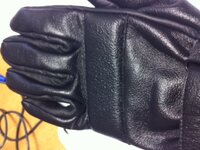
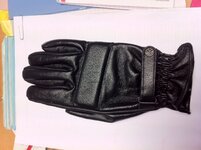
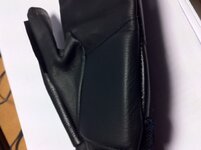
Well finally I have the gloves. It took so long due to the fact that suppliers in this country do not want to experiment. The leather came from a German supplier : 1mm thick TFL (
http://www.tfl.com/web/eng/tfl-cool-system_23137.aspx ) kangaroo leather.
The reason I went for roo leather:
"Studies conducted by the Australian Commonwealth Scientific and Industrial Research Organisation (CSIRO) confirm that kangaroo is one of the strongest leathers of similar substance available.[5][9]
Similarly when split into thinner substances kangaroo retains considerably more of the original tensile strength of the unsplit leather than does calf. When split to 20% of original thickness kangaroo retains between 30 to 60% of the tensile strength of the unsplit hide. Calf on the other hand split to 20% of original thickness retains only 1-4% of original strength.[9]
Kangaroo leather is lighter and stronger than the hide of a cow or goat. It has 10 times the tensile strength of cowhide and is 50% stronger than goatskin.[10]
Studies of the morphology of kangaroo leather help explain its particular properties.
The collagen fibre bundles in cattle hide are arranged in a complex weaving pattern. The fibres are often at angles as much as 90 degrees to the skin surface. Cattle hide also contain sweat glands, erector pili muscles and a distinct gradation in elastin levels, concentrated in the upper part of the skin. Kangaroo on the other hand has been shown to have a highly uniform orientation of fibre bundles in parallel with the skin surface. It does not contain sweat glands or erector pili muscles and elastin is evenly distributed throughout the skin thickness.[11] This structural uniformity explains both the greater tensile strength of the whole leather and the greater retention of strength in splits. Bovine skin is much more complex in cross section. Hence in whole section it has many more weak points from which tears can start when placed under tension. In addition when sliced into splits the collagen fibres running at significant angles to the skin surface will be cut. These then become weak points in the structural strength.
Armour was provided from Austria 3 mm thick .
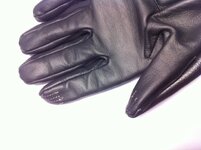
Conductive thread was sourced by the glove maker ( they just adopted the idea in a range of they own gloves ).
The Union Jack badge with also acts as a pull tab was made in the UK.
Finally the gloves was put together in last year with the finished product turning up a few months ago in 3 versions .Two are the same but one has the red,blue and white in the badge, the third pair has the stitching on the outside.
The final glove came out just as I wanted , CHESTER JEFFERIES done a cracking job. Thanks for Greg and Mark for the help .
It is well put together and solid , you can hardly feel the inside stitching ( which is double ) and it does the job for which was meant to do.
But there is a but.
The leather even at 1 mm thickens is stiff and it will take time to break in, the armour ( a rubber/foam composite ) is to thick over the knuckles, but feels ok over the palm . The conductive thread works well when the phone is not in a protective case ( even with a protective case is working, but only with the thumb ).
I had no chance to try the rubber wiper , but looks it will work.
Finally the cost....
I went and got the best materials that I could find at the time, to find a manufacture for the badge I must have called 20 factories. Was done at a cost.
Been sample gloves , each glove cost around £120 . Even with the scale of numbers the cost will hoover in £100 mark ( materials,labour ) . I do not believe anyone is prepared to pay £100+ for what is in essence a roper glove. Especially coming untested from a company you never heard of before.
No wonder BKS are charging over £300 for they gloves.
I have the gloves that I wanted , but they are not commercial viable .



 .
. thanks Zoltan