Help - contact breaker

Wanderer

Registered user
Joined
Dec 6, 2004
Messages
1,549
Reaction score
0
Location
Wandering
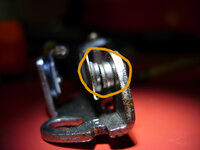
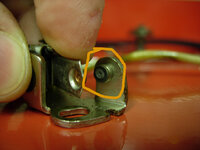
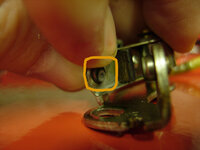
Following my post of last night (R90S won't start), on Proff's advice I started with the contact breaker. This evening I took the breaker off and need some help please re interpreting its condition. It doesn't look too healthy to me. As can be seen in the attached pictures, the breaker doesn't align and the surfaces appear to be pitted on one side and pointy on the other (?). Any comments re whether this is obviously buggered and could be the cause of no sparks to either plug.

Thanks, Will
 

Attachments

  • DSCN0710-(small).jpg
    DSCN0710-(small).jpg
    96.6 KB · Views: 83
  • DSCN0711-(small).jpg
    DSCN0711-(small).jpg
    96.6 KB · Views: 86
  • wr.jpg
    wr.jpg
    98.3 KB · Views: 72
The points are fecked. Change them and also the condenser, then with a little bit of luck all will be fine. :thumb
 
Will, when you fit the new points, spend a bit of time getting the gap just right. Turn the engine over a few times and re check. Then take a long hard look to make sure that both parts are sitting square and even against each other. If they are a bit angled wrong or not sitting flat together in the closed position, with a pair of long nosed pliers, gently bend the thin section to make them a perfect match. Recheck the gap and proper job done.
 
DO NOT overtighten the nut that's on the end of the camshaft. i.e. secures the advance retard unit.
 
DO NOT overtighten the nut that's on the end of the camshaft. i.e. secures the advance retard unit.

Wish to Feck I'd known you 24 years ago :augie

I'd have cleaned and reset them after replacing condenser, they are only a little furry, as I thought they'd be..
Mechanics fix bits:thumb2
fitters replace bits without attempting to fix :mad:
 
Mechanics fix bits:thumb2
fitters replace bits without attempting to fix :mad:

Interesting point (no pun intended!) Proff. The Clymer manual states that if the points are badly pitted then chuck them in the bin (or words to that effect). Would you try to fix these? And if so how?
 
Interesting point (no pun intended!) Proff. The Clymer manual states that if the points are badly pitted then chuck them in the bin (or words to that effect). Would you try to fix these? And if so how?

Piece of wet and dry, or emery, rub them till smooth, drop of vaseline on the pivot.
touch of high melting point grease on the heel of the fibre [where it rubs against cam] set gap at 15 thou' at highest point of said cam.
Then remove timing bung, shine torch in 'ole line up static timing mark switch on ignition and move points backplate till you hear a slight tic/crack/ spark as the points START to open, tighten [not too much] and Bobs yer mothers brother.:thumb2

IF you ain't got points handy you have to do the above to get bloody home :augie...
If you have new ones, replace, but to see if it 's the cause do the above and give the old starter a whirr
 
Piece of wet and dry, or emery, rub them till smooth, drop of vaseline on the pivot.
touch of high melting point grease on the heel of the fibre [where it rubs against cam] set gap at 15 thou' at highest point of said cam.
Then remove timing bung, shine torch in 'ole line up static timing mark switch on ignition and move points backplate till you hear a slight tic/crack/ spark as the points START to open, tighten [not too much] and Bobs yer mothers brother.:thumb2

IF you ain't got points handy you have to do the above to get bloody home :augie...
If you have new ones, replace, but to see if it 's the cause do the above and give the old starter a whirr

Fantastic, thanks very much:thumb2
 
Mechanics fix bits, fitters replace bits without attempting to fix

Agree with that, but its all down to cost now. When I was spannering what you say was correct. We even had a neat little grindy things for re-sufacing points. But they are no longer made of Platignum, and who could afford to be paying current labour charges that would far exede the cheap replacement option.

We used to make big end shells from white metal poured in and then scraped to fit. Once the shells were available in any size required, all that time consuming practice stopped dead. I used to make panels for cars, turning flat steel sheets into curved panels, welding, cutting, rolling, leaded joints etc. Now the most intricate panels are stamped out repeatedly with no skill by the machine operator.

Its great to have the time and knowledge to be able to repair our machinery as we know how but these skills are now unfortunatly slowly being lost.

Anyways lets not start bickering amungst ourselves, theres loads of cheque book riders out there to take the piss out of. :rob
 
She's alive!

After 18 months on the mend, and then once back together but with no spark, I followed the great advice given here and tonight she fired up first time! Brilliant:bounce1

Many thanks again all. Time to get an MOT and back out on the road.


Back
Top Bottom