I don't want a flamewar, Just information.

Not if you believe in Ohm’s law it doesn’t.
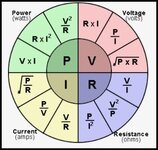
Not Ohms law but Watts law

If you have a starter that requires 1Kw to turn as designed

Watts law............ power = volts x current in amps

In this instance Power/volts = current

At 12 volts its 1000 / 12 and amps = 83.33 in this instance

But if your battery is 10.5 v that current surges to 95.24

Below 10v its 100 amps

Have none of you noticed how Warm/hot that the motors get when the battery is low and continuous cranking
 
Last edited:
Not Ohms law but Watts law

If you have a starter that requires 1Kw to turn as designed

Watts law power = volts x current in amps

At 12 volts its 1000 / 12 to calc amps 83.33 in this instance

But if your battery is 10.5 v that current surges to 95.24

Below 10v its 100 amps

Have none of you noticed how Warm/hot that the motors get when the battery is low and continuius cranking
The heat is from the duration of current flow.

More amps flow but at a slower rate. Hence more heat from volume of amps not amperage.

See post above about resistance
 
Watts law perhaps ?

With lower voltage you need more amps. And And vice versa.

Off the top of my tired head
Ohms law. Volts = amps x resistance.

If the volts go down and the resistance doesn’t change, then the amps go down too.

Watts = volts x amps.

If the volts go down, the amps must go down, so the watts go down more, which is why it doesn’t start the engine.
 
Not Ohms law but Watts law

If you have a starter that requires 1Kw to turn as designed

Watts law............ power = volts x current in amps

In this instance Power/volts = current

At 12 volts its 1000 / 12 and amps = 83.33 in this instance

But if your battery is 10.5 v that current surges to 95.24

Below 10v its 100 amps

Have none of you noticed how Warm/hot that the motors get when the battery is low and continuous cranking

You’re simply wrong - you’re assuming the motor will make its rated power whatever voltage you supply.

You start with a resistance that you can’t change, and whatever volts your battery gives. The current is the result of those, and the power is the product of the volts and the current.

The motor might be designed to produce a kilowatt, but if you don’t feed it, it won’t.

And yes, it’ll get hot eventually, but it would get a lot hotter a lot sooner if the voltage were higher, it doesn’t because the time is limited, because the engine starts.
 
Last edited:
I really wish I could get my head around electricity 😂. I’m not the brightest spark lol

 
I really wish I could get my head around electricity 😂. I’m not the brightest spark lol
And it started about oil...!😂😂 It all makes sense but nonetheless my brain refuses to meaningfully engage... A bit like a bad starter with a low voltage battery...😆👌😂
 
I really wish I could get my head around electricity 😂. I’m not the brightest spark lol
Do you do plumbing? Voltage is pressure, resistance is pipe diameter and current is the flow rate. Power, watts, is the output. All are related in a similar way to electricity
 
  • Like
Reactions: SBD
I do plumbing! Indeed this morning was was fixing a leak. I put the washing machine on a pressurised feed due to need. I didn’t have the pipes secured and …

Thanks for the explanation. Makes sense. Sort of 😂😂
 
To slightly refine @wessie simile, resistance increases as the pipe gets longer, or thinner, and decreases as it gets wider or shorter.
 
Here is a thought:
Maybe give Tim at OPIE OILS a call?
no connection aside from being a satisfied customer.
 
That's actually more sense than many answers on this oil thread...👌😂


Back
Top Bottom