Lead additives

(RIP) Tunneruk

Well-known member
UKGSer Subscriber
Joined
Jun 7, 2007
Messages
6,446
Reaction score
4
Location
Maidstone
So my understanding is that Pre 85 Airheads require a lead replacement additive. I've just bought an R100CS which has been off the road since there was good old 4* at the pumps :eek: So it's never had to put up with modern petrol.

Having had a read up it looks like Castrol Valvemaster hits the spot although I now find that there's a 'PLUS' version :nenau

What do you guys use? If it's the Castrol stuff do you use the standard or the plus?
I originally thought I'd just buy some additive and bung it in every tank, however I'd really like to get it right!!

Cheers!
 
The one that did best in classic tests was Millers VSP Plus, replaces lead in fuel and boosts the octane rating , used to use it in an old vw scirocco which could only run on unleaded with a retarded ignition timing and loss of about 20 bhp.

Using Millers and the standard ignition timing there was no pinking , no valve recession problems over 20,000 miles and an increase in performance over unleaded and the old LRP fuel .

Thoroughly recommended
 
A lot of the "lead replacement" story is hype. Everyone wanted to sell you their magic potion and so the threat of instant valve recession and engine destruction was severely overplayed. I had an R80/7 and a 1972 Triumph Trident when leaded petrol was withdrawn and I went through the gamut of different additives.

Of course, you can't tell whether they are doing the job or not, it's like the old "lion dung keeps the elephants away" joke.

I then came across some sound advice which is demonstrably valid. Check the valve clearances and just run the bike as normal. For the first few thousand miles, check them frequently (maybe every 500 - 1000 miles or so) then, when you are happy that all is well, revert to normal service intervals. Remember you are looking for exhaust valve seat wear caused by the valve microscopically "sticking" to the seat at high temperatures and the absence of the protective coating of lead. This cannot affect the inlet valves. If you see wear, signalled by rapid closing-up of the clearences, then maybe you should consider an additive.

I'll place a large bet that you have no problems. If you do, there can be only one replacement for lead: http://tetraboost.com/info/

HTH :thumby:
 
Well this thread has thrown the cat amongst the pigeons ... I was sure it was a case of finding the best or right additive for the job, now there's the added question last to whether at use additive at all!! :blast

Cheers for the comments above guys!
 
in my mind the simple thing to do is to ride as normal (using highest octane fuel you can when you are out) and check valve clearances frequently in the initial period

If the gap closes then whip the heads off and go get valve seats done, at less that £20 for headgaskets and new pushrod tube rubbers (they'll be well 'ard now) and maybe add stainless pushrod tubes

Job will be done forever :thumb

P.S. You do know about not forcing the exhaust nuts to turn but to drill a line of small holes front to rear and split them with a chisel and replace with good used or new??
 
When I was riding the ST as a commuter, I just used the highest quality pump fuel I could get. I got valve seat recession on one cylinder but not the other!

As someone else suggested - run it and check whether you have a problem before you try to resolve one. I mean, how many miles are you likely to do on it?

If it turns out it doesn't like modern unleaded, then just whip the heads off and get the seats done - then it's sorted once and for all. Maybe wait until you've saved up for a few meals first though! :)
 
The problem is they don't always just recede. My mate was very lucky when his cracked. New exhaust seats are around £50 each fitted so if you're planning on running the bike is it worth taking the risk for £100 + a top end gasket set? You'll soon run that cost up in additives.

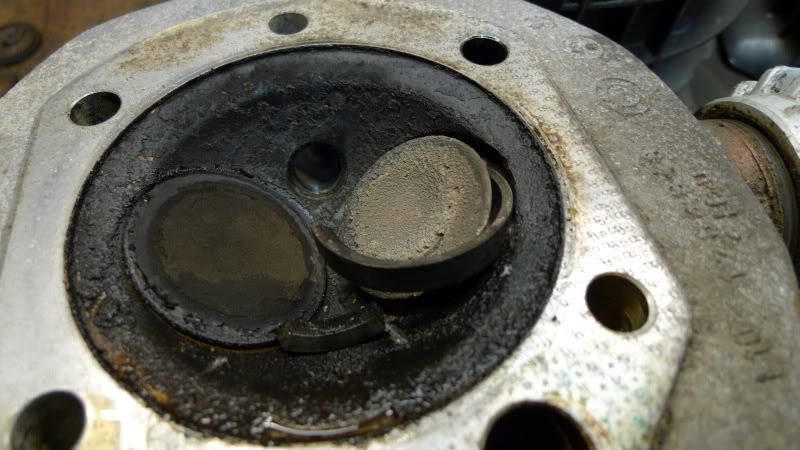
RobbiesCylinderhead.jpg
 
The bike runs absolutely beautifully and I'm keen to keep it that way. I don't really want to just run it on unleaded and wait to see if the valve seats start deteriorating and then do something about it, I'd rather just either use an additive to prevent any seat erosion or have the heads done. I certainly don't want to 'suck it and see'

Rob - Ref The photo above. I've never seen seats actually fall out like that, was that a reaction to heat or did they crack and fall out?
 
The bike runs absolutely beautifully and I'm keen to keep it that way. I don't really want to just run it on unleaded and wait to see if the valve seats start deteriorating and then do something about it, I'd rather just either use an additive to prevent any seat erosion or have the heads done. I certainly don't want to 'suck it and see'

Rob - Ref The photo above. I've never seen seats actually fall out like that, was that a reaction to heat or did they crack and fall out?

In that case I'd just do as Rob says and get the heads done.
 
The bike runs absolutely beautifully and I'm keen to keep it that way. I don't really want to just run it on unleaded and wait to see if the valve seats start deteriorating and then do something about it, I'd rather just either use an additive to prevent any seat erosion or have the heads done. I certainly don't want to 'suck it and see'

Rob - Ref The photo above. I've never seen seats actually fall out like that, was that a reaction to heat or did they crack and fall out?

It cracked and fell out, fortunately the first he knew of it was the bike wouldn't turn over. If it had gone at speed it doesn't things would have been much worse.

I used to be one of the ride it and see what happens camp but to be honest for what it costs I'd do it for peace of mind. There was an issue with valve guides in the early eighties, BMW had a couple of attempts at getting the unleaded seats right and I believe the latest design is spot on in terms of seat durability. The best advice really would be to talk to Richie Moore and take his advice on the matter. Not sure of the mileage but if you are anywhere around the 40k + mark then a new set of exhaust guides and valves may as well go in at the same time. Again Richie is your man.

I know its a pain when you have just bought the bike but a few quid now will get you through the know issues and keep the bike running well for years.
 
I never bother, just run them as normal, figure if they go, then replace them, seemed the cheapest way, I never thrash them for great distances anyway!
 
Chris, I have five airheads including a CS and have been riding them for years with no additives and I have had no problem. According to Scriminger Eng it is not an issue unless you are constantly ragging the bike. If you eventually burn an exhaust seat fix it then. As always I must tell you I know sweet FA.
 
My 1977 R75/7 is still on the original seats and the valve clearances are rock solid, haven't touched them at the last two services. I had a look when i swapped barrels and they looked perfect too.

But I have seen seats in 78 bikes which were trash within a couple of months of the end of unleaded, so it would seem that there is a bit of a unexplained variance.

If you have the bad seats they would probably have gone by now, and in any event you wont have to run it for long to find out.

And if you do decide to do it then it make sense to follow Robs advice to buy all the components from the guy who fits them - Richie Moore sells valves, seats and guides which he knows work together , and he has the knowledge and skill to fit them so that there will a decent improvement in performance which will almost justify the total cost.
And just ignore the bombastic loud mouthed big headed ignoramuses over on ADV - most of their stuff is pure crap.


Back
Top Bottom