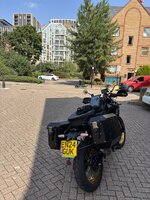
M’off…… Hurtgen Forest….. August

The book confirms that the battle was indeed on a First War scale of attrition.

What is interesting is the depleted state of the American army, raped of men and material in Normandy, the breakout and the dash to and through Belgium. Many of the divisions were at best 50% of their book strength, many were worse and desperately short of experienced junior officers and senior NCO’s.

There is a tale of a hard pressed mortar crew, who (having expended their stockpile fighting off a German counter attack) summoned up re-supply. This arrived, driven in a truck that had to come from Paris, 200 miles away. In the early days of the battle, the senior general, Hodges, had to summon up a minimum 3.000 tons of munitions. That figure would grow exponentially.

A key problem, besides any other, was how to destroy huge concrete bunkers, hidden deep in a forest. On D-day, they used shellfire from huge battleships, unavailable inland obviously. The air forces couldn’t see let alone hit them, the trees were simply too thick. They had to be subdued by combat engineers. It was almost Medieval, akin to soldiers undermining a castle; only the explosive power differed….
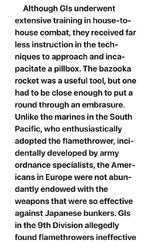
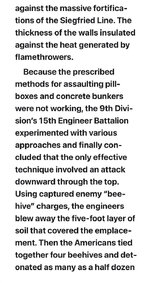
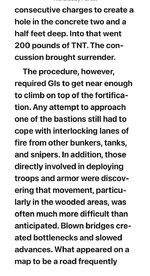

IMG_4740.jpeg
IMG_4741.jpeg
IMG_4744.jpeg
IMG_4743.jpeg
 
Last edited:
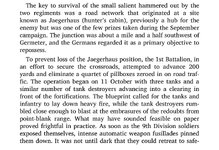
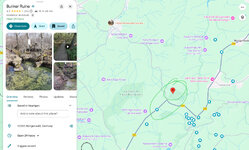
I quite like standing at places ‘Where things happened’. The book has details of small (it’s a relative term) but very important engagements. You can sometimes identify the spot, almost exactly, just from the description or find it on Google maps. A good example is the ‘Hunter’s cabin’ engagement:

IMG_1128.jpegIMG_1129.jpeg

The location of the ‘Hunter’s Cabin’ is marked already in Google maps, which saved me working it out.

IMG_1130.jpeg

These might be the quartet of pillboxes, mentioned in the report. You can certainly see how the Y-shape junction would have been strategically important, even if the modern 399 road to the key town / village of Vossenack (at the head of the Krall Trail to the vital town of Schmidt) was probably nothing but an unmade road at the time. Likewise the logging trail, splitting north westward. It should be interesting to see.

IMG_1131.jpeg

I think I’ll go and stand there myself.

PS In an odd chance of fate, I found that, entirely by chance, I’d already placed a shaping point almost exactly on the spot, when I created the route in post #37. I should have been an American or German strategic planner.
 
Last edited:
I have three days in the Hurtgen.

One of the days I can usefully use, riding along the route I’ve created in post #37. A part of another (it will have to be the Sunday) visiting the museum. Then spend a day and a half, on a mixture of bike and foot, walking the Kall Trail and trying to find the other spots I’ve saved using Google maps.
 
The amateur historian’s video on ‘Hill 400’:


I’ll take it in during my trip. Oddly, it was missing as a point on the Liberation Route itinerary, so I have added it in.
Watching that, you really have to wonder at the strategy of sending troops into that kind of locale. The gradient on that hill must have been close to 30%. It's a miracle the Ranger battalion suffered (relatively speaking) so few casualties and actually took the objective.

I suppose the weather may well have limited air support from Typhoons etc? Let us know what you discover please.
 
I will do.

The geography is dominated by the dense forest, part man cultivated in neat lines, part wild and part having been felled for timber. Let alone the densely packed trees (making orientation all but impossible) the land is composed almost entirely of the steep hills and valleys. The video on the Krall Trail in post #34 (from roughly 18:23) shows this very clearly. The cleared spaces were all zeroed in by the Germans and became killing grounds of their own, separate from the slaughter in the trees, where air burst shells in the tree tops, created a blizzard of wood splinters. To survive, the GI’s learned not to ‘hit the ground’ but to stand and literally become ‘tree huggers’, narrowing the outline of their bodies as they clasped a tree. They had to learn this the very hard way, untrained as they were in forest combat.

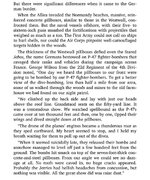
Airstrikes, when a target could even by seen through the trees, were largely ineffectual against the bunkers. There’s a piece in the book where a GI and mates, crawls up onto a roof to watch such a strike from very close quarters, which resulted in nothing:

IMG_1132.jpeg


The entire ‘meat grinder’ battle, which lasted the better part of three months in an area of just 60 square miles, defied any kind of accepted military logic. Men, were literally fed in to die. The final irony was that, those few that survived were moved to Belgium to rest and refit in a quiet spot in the line. They were soon due to be steamrollered by the massive German counter attack in the Ardennes; the Battle of the Bulge had started!

As only one example, of the roughly 2,300 men fed into the Kall Trail to try to take Schmidt, only about 300 finished up unscathed. The rest? Killed, wounded or missing in action. That’s an attrition rate of just under 90%.

PS One other thing I have learned from the book, which I suppose is accurate. Established US tactical philosophy was that, to take bunkers, required a ratio in the attacker’s favour of 3:1 in men, The corresponding philosophy from German tactical experts, was a ratio of 6:1. In short, double. If you start with half of the number required and face withering small arms, mortars and artillery shell fire, then the odds of success are stacked entirely against you.
 
Last edited:
I have found a reasonably interesting video documentary, detailing the aftermath of the battle in the Hurtgen and the successful crushing of the German counter attack in the Belgian Ardennes.

It shows the taking of Duren, which might well I’ll be in or close to during my visit next month. The scale of destruction is almost beyond belief. It was filmed but 12 years before I was born, almost to the day:


It would make an interesting tour to follow the line of the American advance into Germany.
 
My attempt to map out and save the various sites into one folder. Slowly but surely I am hopefully getting the hang of Google’s map’s powers.

 
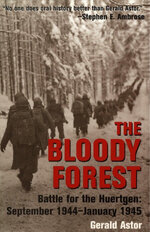
I am all but finished reading what is perhaps the best book, dedicated all but exclusively to the battle of the Hurtgen Forest:

IMG_1195.jpeg

The chances of surviving as a junior officer or senior NCO? Probably less than on the Somme or Ypres. The American and German battalions were decimated and the Americans more so.

From it I can get the oral stories behind the places marked on my Google map.
 
M’off now…


Back
Top Bottom