Must see engine corrosion...

Pipster

Registered user
Joined
Mar 28, 2005
Messages
1,230
Reaction score
0
Location
north west
Given all the threads on engine cover corrosion (my bike included), I thought that I would investigate.

I thought 'there must be a reason that these covers keep corroding'. Bearing in mind that my bike is a Feb '06 model with 12k miles and suffers from corrosion issues apparent for several years now.

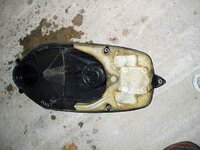
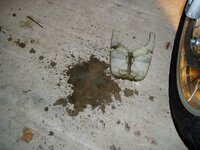
I ventured into the garage, camera in hand, and removed the plastic cover. See Photo 1; inside the plastic cover there is a foam sponge (to stop dirt perhaps), on removal of the sponge which is sodden, I wrung it onto the floor (Photo 2) and about 1/2 a litre of water came out.

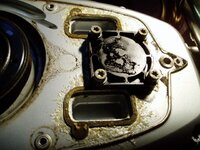
Now for Photo 3, a story unto itself; I've come to the conclusion that these engine covers corrode not because of the paint, but the damp environment that is created by the sponge which holds water and has no means of escape (the last time my bike was ridden or washed was a month ago). Unless you're riding your bike after the sponge has got wet, it can't dry out. So, in the winter, when it might be parked up for longer periods, it is bound to corrode.

Does the sponge perform a purpose ? Could it be removed to create a dry environment ? Maybe take the cover off and spray the actual engine cover behind the plastic with wax oil... I don't know.

The GS1200 has had issues with this problem since release and are still coming out of the factory with the same design.:(
 

Attachments

  • cover 1.jpg
    cover 1.jpg
    55 KB · Views: 1,989
Still corrodes like a bastard without the sponge.
 
I've just had my cover replaced, just before the warranty expires this month. The service lady at William's that first looked at the cover said that they usually remove the sponge on the delivery checks to their bikes. Mine came from Rainbow in Rotherham.

I had no idea what the insides looked like Pipster, and I'm quite amazed at the size of the sponge pad and the extent of the corrosion inside the cover.

I just hope they took the sponge out like they said! It's only to do with Noise Vibration and Harshness suppression. I can honestly say I didn't notice a change, so perhaps they put it back in :nenau

It is a bad design without question. They could have at least tried a closed cell foam to try and stop the sodden effects. If the cover was a known trap, then it should have a drain fitted, with a secondary seal further away from the joint. There must surely be a better solution?
 
Given all the threads on engine cover corrosion (my bike included), I thought that I would investigate.

I thought 'there must be a reason that these covers keep corroding'. Bearing in mind that my bike is a Feb '06 model with 12k miles and suffers from corrosion issues apparent for several years now.

I ventured into the garage, camera in hand, and removed the plastic cover. See Photo 1; inside the plastic cover there is a foam sponge (to stop dirt perhaps), on removal of the sponge which is sodden, I wrung it onto the floor (Photo 2) and about 1/2 a litre of water came out.

Now for Photo 3, a story unto itself; I've come to the conclusion that these engine covers corrode not because of the paint, but the damp environment that is created by the sponge which holds water and has no means of escape (the last time my bike was ridden or washed was a month ago). Unless you're riding your bike after the sponge has got wet, it can't dry out. So, in the winter, when it might be parked up for longer periods, it is bound to corrode.

Does the sponge perform a purpose ? Could it be removed to create a dry environment ? Maybe take the cover off and spray the actual engine cover behind the plastic with wax oil... I don't know.

The GS1200 has had issues with this problem since release and are still coming out of the factory with the same design.:(

My April 2005 bike does not have this sponge - done almost 20,000 miles and not a speck of corrosion. I took the cover of the other week and put a bit of grease around the area of the bottom fixing screw - just in case.
 
Pipster, (or anyone who knows),
is it just a case of removing 5 bolts from the black cover & lifting it off?

Any gaskets or things that can fall off inside? :nenau

I've got the urge to remove my sponge too. :thumb2
 
Pipster, (or anyone who knows),
is it just a case of removing 5 bolts from the black cover & lifting it off?

Any gaskets or things that can fall off inside? :nenau

I've got the urge to remove my sponge too. :thumb2

Yes three larger torx at bottom and two smaller ones at top and it comes off :thumb2
 
Cheers Pipster, between my last post & this one I've removed the cover, cleaned the area & replaced it. Very easy to do! :thumb2

A few things to report back..

1.The sponge was already removed, I assume the previous owner was already aware of the corrosion problem.

2. A lot of mud/dirt had collected at the bottom.

3. More worryingly, a large piece of glass fell out when I removed the cover. At first I though "How the hell did that get in there?" I could see no means of entry. Upon closer inspection it was possible to feed the glass through one of the upper slits. Wow, that's a million to 1 chance of that happening on the move & it got me thinking that someone may have tried to sabotage the bike earlier in it's life.....but the slits are behind the front shock & not clearly visible. Very strange that one.

Removing the belt cover is a very easy job to do & will now be a part of my cleaning ritual.

Thanks Pipster. :clap
 
It's been well documented on here that the corrosion is a combination of:

(1) Less effective "VOC free" water-based paints.
(2) Dissimilar metals causing galvanic corrosion on untreated aluminium surfaces.
(3) That stupid sponge which everyone should take out and put in the bin.

You can't do much about (1) above except repaint the engine.
For (2) do a search on starbrite or duralac.
Fixing (3) speaks for itself.
 
It's been well documented on here that the corrosion is a combination of:

(1) Less effective "VOC free" water-based paints.
(2) Dissimilar metals causing galvanic corrosion on untreated aluminium surfaces.
(3) That stupid sponge which everyone should take out and put in the bin.

You can't do much about (1) above except repaint the engine.
For (2) do a search on starbrite or duralac.
Fixing (3) speaks for itself.

We are moy alone, go and look at any new bike they are all like that coz of bl**dy Greenpeace and their environmental nagging:hide
 
Thanks for posting, Pipster; I'll remove mine to give it a good clean and maybe a little grease. (Presumably grease on the alternator belt isn't a good thing...)

Do the screws require threadlock ar anything? Torque settings?
 
FRONT COVER RUBBER/FOAM?

Hi,
following this thread, I removed the cover on my May 07 GS to have a look. It was dry inside, and the foam that is described in this thread, on my bike is not really foam, but a dark grey sort of rubber that looks impervious to moisture. Whilst not being a plastics expert, it looks to me like this stuff is waterproof and non-absorbent?
More worryingly, the torx bolts that I removed were all showing white powdery corrosion type deposits, so I replaced with stainless allens. Perhaps this is the source of the corrosion starting?

Cheers

Eng

:Motomartin
 
The white powder is very likely aluminium oxide, which is most likely due to galvanic corrosion cell from the aluminium of the cover to the steel of the torx screw. If memory serves you've not really solved the corrosion of the alloy of the cover by substituting stainless steel for high tensile steel, the only advantage is that it should no longer stick to the alloy corrosion. You ideally want a none conductive layer between the two metals.

I'll be honest and say that I could be wrong, but you may try alloy bolts or titanium (but I would have to dig out a galvanic cell table out from somewhere) I wonder if a plastic screw would take the torque... second thoughts, it probably wouldn't take any heat :nenau

Put a dab of copperslip on the stainless steel, should at least slow it down?
 
Eng

If you look at photo 3 theres no corrsion at all on the bolt holes ...I seem to have a different sponge, you can see the amount of water i
squeezed from it :nenau
 
the only advantage is that it should no longer stick to the alloy corrosion. You ideally want a none conductive layer between the two metals.
As someone who's designed a lot of stuff out of SS and marine aluminium for use in the ocean, I can say without doubt that when you get enough aluminum oxide, the bolts stick in the (now much smaller) hole just fine... very difficult to get out... the compressive stress makes for a very lousy day...

I used a product call blue goo... which started life as a stainless steel anti spall compound, but trial and error revealed that it did a great job of protecting the aluminum from the SS hardware...

Anti-seize would be my choice... if I had some of this blue goo stuff, I'd use that...

Al...


Back
Top Bottom