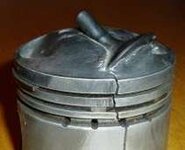
OH, Goody - a broken valve

If the problem was being caused by over-revving (unlikely in itself I would have thought, given the nature of the bike) then we would be seeing the valve and piston failures on both sides equally.

We're not.


Occam's Razor :)
 
A down change at the wrong time causing too much engine breaking is a commom reason for a dropped valve on any engine, hence the use of slipper clutches on sports bikes, I was suprised when the HP2 sports did not have a slipper clutch.
 
Over revving?

For what it's worth I'm with Fanum on this. My 05 1200GS dropped a valve on the R/S under modest acceleration well below the rev. limiter.

I know 1100 and 1150 owners mutter darkly about the 1200 being a development too far. Perhaps there's some truth in it. Since mine 'went' I've met a lot of other members of the dropped valve club.:nenau
 
You may not accept it or like it, but it does seem to be the most likely contributary factor.

The side yours went on....it was the opposite side from the side stand wasn't it?:augie

It does seem to be a design fault and oil starvation has been blamed in a lot of cases- yours isn't an isoltaed one by any means :(

BTW It's not acceptable I agree...you absolutely SHOULD be able to leave it on the side stand without it causing this sort of problem, I agree.


Go on, let us know- was it the 'high' side valves that went?? :popcorn

Interesting... during that period that 10/40 was the oil of choice during service, I used to get a really nasty knock on start up - it only lasted a second or so, but it really wasnt a health engine sound. I pretty sure I asked a dealer and was told it wasnt anything to worry about, just a bit of cam chain slap while the oil was recirculated

Funny enough I dont get the same problem with 20/50.
 
Now, think about this. If you over rev (and I accept you can on the downchange or a really crap shift) then the problem is with the valve closing. on a non-desmo engine, at high revs, the valve may be clear of the cam and slams shut under spring alone with a nice big bang. which means the seats could be shot?

that's called valve float, and is often harmless until the valve floats into the piston when the stem bends so it won't go back in causing damage to the piston, or the piston pushes the valve back faster than the spring and the collets fall off the other end, the valve drops into the combustion chamber again causing damage to the piston etc.

damage to the valve seats is the least of your problems :)
 
that's called valve float, and is often harmless until the valve floats into the piston when the stem bends so it won't go back in causing damage to the piston, or the piston pushes the valve back faster than the spring and the collets fall off the other end, the valve drops into the combustion chamber again causing damage to the piston etc.

damage to the valve seats is the least of your problems :)
Thanks, that's oddly reassuring. Like being told in the middle of a tornado that your tie is still straight. although, in my case, that would be a worry as I haven't worn a tie for five years.

So, summing up, the perceived wisdom is:-

DON'T leave it on the side stand
DON'T start the engine
DON'T change gear
DON'T Rev it up
DO use axle grease instead of engine oil.

Is there anything I've missed?
Is it alright to just look at it dreamily while polishing it?
 
Not leaving them on the side stand is probably right- and not revving it when you initially start it is just basic common sense......

As for looking at it dreamily? It's a 1200, why would you want to :blast:augie

:hide
 
have i missed something?

how does leaving the bike on the side stand cause engine failure again?
 
have i missed something?

how does leaving the bike on the side stand cause engine failure again?

It would seem that for the first critical seconds after starting, the 'top' end is too dry and suffers damage.

There have been too many failures on the 'dry' side reported here and elsewhere- in all (that I've asked about anyway), the bike has been left on the side stand often.

I know it's not quite the same, but I've always had puffs of smoke when I've started my 1150 off the side stand- that to me at least says that the oil flow isn't very well designed and my woolly headed logic tells me that if oil's getting into the combustion chamber on the 'low' side enough to cause smoking, the 'high' side may well be too dry.

Ok, not scientific, but neither is my theory about Optimates and people who keep their batteries on charge all the time and I'm right about that too...you'll see ;)
 
It would seem that for the first critical seconds after starting, the 'top' end is too dry and suffers damage.

There have been too many failures on the 'dry' side reported here and elsewhere- in all (that I've asked about anyway), the bike has been left on the side stand often.

I know it's not quite the same, but I've always had puffs of smoke when I've started my 1150 off the side stand- that to me at least says that the oil flow isn't very well designed and my woolly headed logic tells me that if oil's getting into the combustion chamber on the 'low' side enough to cause smoking, the 'high' side may well be too dry.

Ok, not scientific, but neither is my theory about Optimates and people who keep their batteries on charge all the time and I'm right about that too...you'll see ;)

I agree that you should always let an engine have a few seconds to get its wits together before doing anything. Allows oil to start circulating - sortof first coffee and a fag.

Now, to be scientific, what we need is a volunteer to try not using either stand, just lay the beast down on the right hand side and then see if the left hand side goes clatter clatter bang bang after six months. Sorted.
 
This supposed 'dry' side ?

in a car engine with the heads at the top - aren't they all 'dry' ?

Valves come apart at the head/neck interface - usually caused by the design of the valve head being 'just' that too much mass for the cam and valve stem to control.

Usually its the inlet valve as they are a bigger diameter than the exhaust - and as cookie says if the engine is near he redline and the valve is floating - then its the piston that clouts it, knocks it off centre slightly. This then fatigues the valve stem after a number of up/down cycles and eventually falls off.

You could have bent the stem weeks / days / hours ago - depending on the amount of damage initially caused.

I don't subscribe to the 'dry' side theory - although it seems to be more prevalent.
 
Thanks, that's oddly reassuring. Like being told in the middle of a tornado that your tie is still straight. although, in my case, that would be a worry as I haven't worn a tie for five years.

So, summing up, the perceived wisdom is:-

DON'T leave it on the side stand
DON'T start the engine
DON'T change gear
DON'T Rev it up
DO use axle grease instead of engine oil.

Is there anything I've missed?
Is it alright to just look at it dreamily while polishing it?


***Is it alright to just look at it dreamily while polishing it?***

Noooooooo yer can't do that the paint will fall off:D
 
This supposed 'dry' side ?

in a car engine with the heads at the top - aren't they all 'dry' ?

*snipped*

I don't subscribe to the 'dry' side theory - although it seems to be more prevalent.

Yes they are....but equally so (in most engine designs) so that the wear is even.

Also, oil channels run drekkly to the top, so within a second or so, it's at least partially lubricated- it seems that on the boxer twin, and particularly with the 1200 version, it takes rather longer for it to get wet and the difference between wear in the 'dry' and 'wet' side is particularly marked.

It's to much of a coincidence, to many going bang on the 'dry' side :nenau

Unless they're just making the valves out of a different sort of cheese :nenau
 
It has been known to happen on the old Airhead Beemers as well, Valves on the Dinosaurs have a finite valve life, usually around the K40.000 mile mark :blast
 

Attachments

  • Rseries Valve snap.jpg
    Rseries Valve snap.jpg
    5.1 KB · Views: 661
This dry side thing doesn't ring true for me either.

Having spent more than a while looking at the innards of the heads on my 1100 recently (head currently at an engineers for skimming, hopefully curing a persistent head gasket leak), I can't see how the valves would be affected (even if the side stand did leave one side with less residual oil). I know that we are talking about the 1200 here, but (electronics aside), I believe they're pretty much the same under the skin.

In a rather clever piece of design (IMO), the cam carrier / rocker end cap assembly is cup shaped and traps oil so that the cam and followers are actually submerged when the engine starts (this is what pours all over the place when you remove a head - I always refill this cup when refitting the head) . This will be true on both sides (although it's conceivable that one side might trap slightly less oil, they'll both trap enough to keep the cam and followers wet during start-up). However, this has no effect on the actual valves which are effectively dry when the engine isn't running. You only get a teaspoon of oil out of the rocker covers when you remove them - whichever side they're on (perhaps a fraction more out of the downhill one due to the rocker cover forming a slight cup). There seems to be a suggestion that the downhill rocker case is somehow full of oil and the uphill one is dry when the bike has been parked - this isn't the case. Smoking after starting (the bike having been on its side stand) is probably due to oil seeping down the cylinder past the piston rings on the downhill cylinder (my 1100 does that).

So, I can't see how parking the bike on its side stand could make any difference to valve stem lubrication (they have stem seals anyway). However, I could potentially see an issue if the bike is allowed to idle on its side stand (which I believe led to an instruction to the police not to do this?). The exhaust port area has a high(er) flow large 'cooling' oilway - I could conceive that the oil cooling circuit could slightly starve the uphill cylinder (there's no great pressure in the cooling circuit). On the lean (and hot) running 1200 this could lead to overheating of the exhaust valves?

Dunno - just thinking aloud :rolleyes:
 
valves in guides should be pretty much dry anyway. some designs have seals on top remember.

IIRC the phosphor bronze of the valve guide retains a smidge of oil which does the lubricating.

i can't explain why it's always the right hand side though :nenau
 
It would be helpful to know which valves tend to drop - exhaust or inlet, top or bottom.
 
If I recall correctly a lot of these failures, certainly as regards RTs, have been down to Police bikes which have been left on tickover for too long on the side stand. Coppers have to do this sometimes to keep juice flowing to the blue lights at accident scenes. This would be more to do with overheating than any weakness in the lubrication system I would have thought...

Having said that when parking my GSA for any length of time I always use the centre stand.

If parking on the side stand IS going to be the cause, then what about all those 1200Ses which don't come with a centre stand in any case???:nenau


Back
Top Bottom