rechip bmw 1150's

good to hear! got a stage 4 for my standard r1150rt twin spark and a stage 6 for my r1150gsa se twin spark fit them next month starting with the rt! see how it goes.
 
Would that apply to John’s chip too - and also do you mean that any gain would be temporary before you were back to ‘normal’ performance i.e. prior to any product added?

R

Any fueling changes to the Motronic chip are worked back to stock values (if you have a stock O2 sensor) in the cruising area (the closed loop area). Below is a chart that shows how broad the Closed Loop area is for the R1150. The data is based on many motorcycles and many riders and was collected with the GS-911.

What is interesting in the chart is that Closed Loop is up to about 40 degrees throttle (80 degrees is full throttle) and up to about 6,000 RPM. The other interesting things is that light-loads, off-idle (the area below and to the right of the RED line) is not Closed Loop.

To compound the problem, there are two more issues:
1) If you add fuel to the Closed Loop area, the average fuel added is removed by a Long Term Trim. That Long Term Trim is applied to all Open Loop values.
2) This means that if you make a chip that adds for example 6% fuel to the Closed Loop area, a long term trim with a value of 0.94 is applied to the whole Open Loop area. So your Open Loop fueling gets leaner by that long term trim factor.

Any timing changes made to the Motronic chip do not get negated. But, the timing map is very complex and any changes made should be by an expert in engine timing.

R1150ClosedLoop4.jpg
 
I've installed almost every type of product on my bike: LC-1, AF-XIED, BoosterPlug, PowerCommander, Techlusion EJK, Fuel Pressure increases and recently a custom Motronic replacement chip. Then I've measured and documented the tests in the above threads. What I have documented is that no matter which approach you take, if the stock O2 sensor remains connected, the Motronic ALWAYS returns fueling to stock settings.

RB

So how do you explain everyone that has used John's chip reports smoother running better throttle response and improved mpg ?

They cant all be wrong.
 
I'm kind of interested, although I believe that I have the only viable (type of) solution (always more ways of skinning a cat, of course).

I am running a Power Commander with replacement (so-called) "wide-band" lambda sensor. I have also replaced the cat with a Y-piece, and fitted a Laser Duo-Tech can and a K&N air filter.

I then had a couple of hours on a dyno, with an operator who knows what he's doing (LINKY N.B. other competent dyno operators are available). I asked for the fuelling to be adjusted for optimum tractability, torque, low-range pull, smoothness, with minimal consideration of mpg or max power.

The result is a bike that is a treat to ride. Maximum torque is available from about 2,500 rpm, the "running out of puff" feeling at about 6,000 rpm is gone, it pulls hard up to 7,500 rpm, although maximum power is around 6,750 rpm. Max bhp is the same at 75 (ish) and max torque is now up to about 85 N/m, more-or-less flat from 3,000 rpm up to 7,500rpm. MPG about 43-45 the way I ride, but I don't care, or I would ride a Honda 50.

How do you think this kind of thing can be achieved with a simple chip-change? Every bike is different, so the best you can realistically hope for is a removal of the leaner-than-optimum mixture which ensure compliance with the TuV emissions test parameters.

Am I missing something? :nenau
 
I'm kind of interested, although I believe that I have the only viable (type of) solution (always more ways of skinning a cat, of course).

I am running a Power Commander with replacement (so-called) "wide-band" lambda sensor. I have also replaced the cat with a Y-piece, and fitted a Laser Duo-Tech can and a K&N air filter.

I then had a couple of hours on a dyno, with an operator who knows what he's doing (LINKY N.B. other competent dyno operators are available). I asked for the fuelling to be adjusted for optimum tractability, torque, low-range pull, smoothness, with minimal consideration of mpg or max power.

The result is a bike that is a treat to ride. Maximum torque is available from about 2,500 rpm, the "running out of puff" feeling at about 6,000 rpm is gone, it pulls hard up to 7,500 rpm, although maximum power is around 6,750 rpm. Max bhp is the same at 75 (ish) and max torque is now up to about 85 N/m, more-or-less flat from 3,000 rpm up to 7,500rpm. MPG about 43-45 the way I ride, but I don't care, or I would ride a Honda 50.

How do you think this kind of thing can be achieved with a simple chip-change? Every bike is different, so the best you can realistically hope for is a removal of the leaner-than-optimum mixture which ensure compliance with the TuV emissions test parameters.

Am I missing something? :nenau

You're not missing anything. As long as the O2 is connected, everything up to about 50% throttle is controlled by the O2 sensor lambda value. Like the LC-1 or LC-2, the Wideband O2 part of the PC III for R11150 can have its AFR programmed.

Out of curiosity, what AFR do you have the PC Wideband set to? (My bike with LC-1 runs strongest between 13.5 and 13.8:1 and I usually run 13.8. And my report of its performance sounds just like yours. The R1150 runs very strong with the addition of some fuel.)

The PC III USB with Wideband O2 Sensor, by Dynojet, is actually two products in one. It is a standard PC III (which has to run Open Loop to work) plus the Dynojet Wideband O2 sensor. To make the two parts "play" together, they restrict the cells in the PC III that can be programmed (the small throttle deceleration area or 80% throttle and above, chart below). The cost is about equal to the sum of the two parts: $495 US.

Because there's not much you can do to the top end to increase power--the R1150 is already well fueled in that region--you don't really need the PC III part. The Wideband O2 does all the work of improving low and midrange torque and driveability. You also don't need Dyno time because the midrange cells in the PC III can't be programmed. The other thing is the Dynojet Wideband O2 doesn't have a realtime logging feature, a disadvantage compared to the LC-1 or LC-2.

For about $200 US you can get the same effect with either the addition of an AF-XIED to the stock O2 sensor (plug 'n play) or an Innovate Motorsports LC-2 which requires a small amount of wiring and programming. Either of these solutions will produce the same results as the PC III with Wideband O2 at half the price.

Here is a link to a couple reports I made (How the PC III USB with Wideband Operates, Powercommander Test R1150). Later, I got a PC III USB with Wideband from a friend, installed it in my second exhaust bung and compared it to the LC-1. It worked fine but as noted by an independent reviewer, it wasn't as accurate because, unlike the LC-1, it has no provision for calibration, which is needed for the Bosch LSU 4.2 sensor.

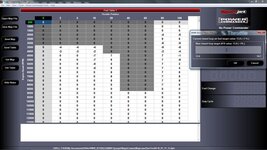
The dark grey part of the chart is the exclusion area for PC III tuning with a Wideband O2 connected:
pc3gasoline.jpg
 
So how do you explain everyone that has used John's chip reports smoother running better throttle response and improved mpg ?

They cant all be wrong.

Not everyone made a report of improvement. Some in fact, removed the chips. But still your question is valid. There is no way for me to comment on any one else's report. However, when air temperature shifters came to market many bought them, me included. There are still many who feel they make an improvement but I dont. All opinions.

My approach has been to look at the claims, for example that a given product richens the mixture. Then I try the product and measure if it does the thing it claims. If it does, good. If it doesn't, well, I don't know how to explain why someone else thinks it makes their bike run better.

In the case of chip replacement in the Motronic, perhaps slight shifts in spark timing are a benefit. I don't know.

What I do know is that more fuel in closed loop makes a better running engine. Chip replacement does not change closed loop fueling.
 
You're not missing anything. As long as the O2 is connected, everything up to about 50% throttle is controlled by the O2 sensor lambda value. Like the LC-1 or LC-2, the Wideband O2 part of the PC III for R11150 can have its AFR programmed.

Out of curiosity, what AFR do you have the PC Wideband set to? (My bike with LC-1 runs strongest between 13.5 and 13.8:1 and I usually run 13.8. And my report of its performance sounds just like yours. The R1150 runs very strong with the addition of some fuel.)

Hi Roger, I followed your thread with interest and I learned a lot. I may have misinterpreted though...

My understanding is that the PC3 overrides the Motronic and simply sends it fuelling instructions based on the fuel table and the PC's reading of the new wide-band lambda. In other words, reducing the fuelling function of the Motronic to simply "doing as it's told" by the PC3. So the grey area on the table is closed-loop, set on mine to 13.8 same as yours.

However, outside the closed-loop area (where you need best performance - high RPMs and wide throttle opening) the dyno setting has been used to maintain optimum fuelling (interestingly somewhat leaner than stock in my case). My fuel table below - how come yours has numbers ther than zero in the closed-loop part?
 

Attachments

  • Fuel table.jpg
    Fuel table.jpg
    61.2 KB · Views: 501
Hi Roger, I followed your thread with interest and I learned a lot. I may have misinterpreted though...

My understanding is that the PC3 overrides the Motronic and simply sends it fuelling instructions based on the fuel table and the PC's reading of the new wide-band lambda. In other words, reducing the fuelling function of the Motronic to simply "doing as it's told" by the PC3. So the grey area on the table is closed-loop, set on mine to 13.8 same as yours.

However, outside the closed-loop area (where you need best performance - high RPMs and wide throttle opening) the dyno setting has been used to maintain optimum fuelling (interestingly somewhat leaner than stock in my case). My fuel table below - how come yours has numbers ther than zero in the closed-loop part?

Hi Cook1e, The PC III does not do anything with the Wideband O2. The Wideband O2 merely outputs a signal that gets sent to the Motronic narrowband input. This is exactly how AF-XIED plus Narrowband and Innovate LC-1/2 function with the Motronic.

To your question, I don't know why there is a value in a grey cell. I got this chart from the Dynojet site. When I tested the PC III with Wideband, it wouldn't let me put a value in those cells.

If you follow the links in my prior post backwards, you will see that I also had a misunderstanding of how the PCIII with Wideband O2 worked. This misunderstanding is due the fact that there's almost no information on how it operates from Dynojet. They didn't produce this configuration for many bikes other than the R1150 and don't know how to explain its function. The block diagram that I made (below) shows how the pieces work.

Using the PC III correctly is a bit confusing because the Wideband O2 function interacts with the Motronic's Mixture Adaptation algorithms.

In the grey area (and actually Dynojet has the wrong closed loop area) or more accurately the full Closed Loop area (in my chart earlier in this thread) the Wideband O2 fully controls fueling. In any area that is not grey (on the Dynojet graph) but is inside my chart of the Closed Loop area you can program a cell changes with the PC III but the Wideband O2 Closed Loop control will negate that value. Worse yet, if you program one of those cells, the corrections the Motronic makes will become Long Term Trims and affect the true Open Loop area. So you want to make sure not to program in the Grey Area or the Closed Loop area from my chart.

I saw the negative values in your table, but in my experience the R1150 is correctly fueled at Wide throttle angles. I say this based on measuring AFR on the road with a Wideband sensor. Inertial Dyno's don't do as good a job of loading the engine as road conditions. I wouldn't remove fuel unless you've done something that has reduced the air (and hence the power) getting into the engine (e.g. detuning the intake or exhaust).

motronicpc1.jpg
 
Hi Cook1e, The PC III does not do anything with the Wideband O2. The Wideband O2 merely outputs a signal that gets sent to the Motronic narrowband input. This is exactly how AF-XIED plus Narrowband and Innovate LC-1/2 function with the Motronic.

Using the PC III correctly is a bit confusing because the Wideband O2 function interacts with the Motronic's Mixture Adaptation algorithms.

If this is true, why bother with a wideband lambda sensor? All I know is that the wideband lambda sensor connects to the PC3, which then sends an output to the Motronic's lambda input. I naively assumed that the voltage sent to the Motronic's lambda input by the PC3 functions to over-ride the Motronic's maps/programme. Or, as you put it "the Wideband O2 function interacts with the Motronic's Mixture Adaptation algorithms".

I saw the negative values in your table, but in my experience the R1150 is correctly fuelled at Wide throttle angles. I say this based on measuring AFR on the road with a Wideband sensor. Inertial Dyno's don't do as good a job of loading the engine as road conditions. I wouldn't remove fuel unless you've done something that has reduced the air (and hence the power) getting into the engine (e.g. detuning the intake or exhaust).

The map was set on the dyno using the dyno's own exhaust sensor, which I believe reads HC, CO2 and O2. My bike is non-standard in that it has a free-flowing exhaust, no cat and a K&N in the airbox. Outside the closed-loop area, the numbers are additions or subtractions from the Motronic maps, I think, though I don't know the units. Percent, perhaps?

Anyway, whilst this is fascinating and I would like to understand it better, the bottom line is that the bike's nicer to ride :green gri
 
If this is true, why bother with a wideband lambda sensor? All I know is that the wideband lambda sensor connects to the PC3, which then sends an output to the Motronic's lambda input. I naively assumed that the voltage sent to the Motronic's lambda input by the PC3 functions to over-ride the Motronic's maps/programme. Or, as you put it "the Wideband O2 function interacts with the Motronic's Mixture Adaptation algorithms".

It is true, and what the Wideband does for you is the best part. And I've measured how the PC III with Wideband functions, with an independent system (my LC-1 and GS-911) so this isn't guessing.

It is what's gotten you the stronger pull from 1800 to 4500 RPM. When you program the Wideband to 13.8, the Motronic uses the new O2 signal and adds 6% to the fuel everywhere in the Closed Loop area, and then through the "magic" of Mixture Adaptation using Long & Short Term Trims, it also adds 6% to all the Open Loop areas.

A better question is why bother with the PC III part. It only allows fuel to be modified in areas where the fueling is already pretty good. In your case, with mixture adaptation adding 6% to the Wide throttle angles, a negative value (in percent) is bring the fueling back toward what it was to begin with in the Open Loop areas.

In the other PC thread, Paul Young is running 13.2 AND adding fuel in the wide throttle areas!

The map was set on the dyno using the dyno's own exhaust sensor, which I believe reads HC, CO2 and O2. My bike is non-standard in that it has a free-flowing exhaust, no cat and a K&N in the airbox. Outside the closed-loop area, the numbers are additions or subtractions from the Motronic maps, I think, though I don't know the units. Percent, perhaps?

Anyway, whilst this is fascinating and I would like to understand it better, the bottom line is that the bike's nicer to ride :green gri

I have no doubt that your bike is much better riding. Setting the Wideband to 13.8 makes the R1150 a great performer, no surge and good muscle down to 1800-2000 RPM.
 
I have no doubt that your bike is much better riding. Setting the Wideband to 13.8 makes the R1150 a great performer, no surge and good muscle down to 1800-2000 RPM.

Thanks Roger, very edifying - does the PC3 then do anything that a re-map of the Motronic chip couldn't?
 
Thanks Roger, very edifying - does the PC3 then do anything that a re-map of the Motronic chip couldn't?

If you believe that the R1150 motor, with your mods, benefits from fueling changes then either a PC III or a re-map of the chip could be used to alter the cells.

That said, and even though I don't think that either is needed, I believe the PC III is a better approach IF you want to make changes. The reasons:
--Anyone changing the chip has to GUESS about the RPM and TPS axis in the chip. There is nothing published for the motorcycle Motronic. The current rechippers are making their best guess at the axis scale factors.
--Cell changes are a try/change/try/change process to dial in cells. Changes at high throttle angles may require several attempts. Do you really want to pull the chip in and out of the socket plus pull the bike apart to get to the Motronic for every change?
--Rechippers all seem to change things they don't understand that they heard about from another rechipper. Some of the tables they play around with don't do what they think.
--rechippers almost always change fuel cells in the Closed Loop area, a bad idea for the reasons I outlined earlier. The ratios between all cells in that area are critical for effective Mixture Adaptation.
--etc., you get the idea. ;)

For 99% of riders a simple shift of the O2 sensor lambda value with an AF-XIED, LC-2 or in your case Dynojet Wideband O2 is the most effective and reliable way to improve the mid-range and low-end.
 
If you believe that the R1150 motor, with your mods, benefits from fueling changes then either a PC III or a re-map of the chip could be used to alter the cells.

That said, and even though I don't think that either is needed, I believe the PC III is a better approach IF you want to make changes. The reasons:
--Anyone changing the chip has to GUESS about the RPM and TPS axis in the chip. There is nothing published for the motorcycle Motronic. The current rechippers are making their best guess at the axis scale factors.
--Cell changes are a try/change/try/change process to dial in cells. Changes at high throttle angles may require several attempts. Do you really want to pull the chip in and out of the socket plus pull the bike apart to get to the Motronic for every change?
--Rechippers all seem to change things they don't understand that they heard about from another rechipper. Some of the tables they play around with don't do what they think.
--rechippers almost always change fuel cells in the Closed Loop area, a bad idea for the reasons I outlined earlier. The ratios between all cells in that area are critical for effective Mixture Adaptation.
--etc., you get the idea. ;)

For 99% of riders a simple shift of the O2 sensor lambda value with an AF-XIED, LC-2 or in your case Dynojet Wideband O2 is the most effective and reliable way to improve the mid-range and low-end.

Can any rolling road do that for me?
 
I'll confess to not understanding any of the technical stuff that’s been posted here (and elsewhere) but what I do know is that I’ve had John’s chip in my bike now for quite a while and the difference is marked.

R
 
I'll confess to not understanding any of the technical stuff that’s been posted here (and elsewhere) but what I do know is that I’ve had John’s chip in my bike now for quite a while and the difference is marked.

R

I'm with you on this Ralphy, techno mumbo jumbo :P I'd like to see some dyno results on this.
 
Roger 04 RT Have you actually tried or tested one of John,s chips ?
 
If you believe that the R1150 motor, with your mods, benefits from fueling changes then either a PC III or a re-map of the chip could be used to alter the cells.

That said, and even though I don't think that either is needed, I believe the PC III is a better approach IF you want to make changes. The reasons:
--Anyone changing the chip has to GUESS about the RPM and TPS axis in the chip. There is nothing published for the motorcycle Motronic. The current rechippers are making their best guess at the axis scale factors.
--Cell changes are a try/change/try/change process to dial in cells. Changes at high throttle angles may require several attempts. Do you really want to pull the chip in and out of the socket plus pull the bike apart to get to the Motronic for every change?
--Rechippers all seem to change things they don't understand that they heard about from another rechipper. Some of the tables they play around with don't do what they think.
--rechippers almost always change fuel cells in the Closed Loop area, a bad idea for the reasons I outlined earlier. The ratios between all cells in that area are critical for effective Mixture Adaptation.
--etc., you get the idea. ;)

For 99% of riders a simple shift of the O2 sensor lambda value with an AF-XIED, LC-2 or in your case Dynojet Wideband O2 is the most effective and reliable way to improve the mid-range and low-end.
Roger,

How long does this regression via the lambda take after a say a chip change/remap...are we talking 10's of miles or 1000's miles?

I am assuming the more time you spend on closed loop the quicker the regression. Thus riding style and route will have an affect.
 
There is a confuse to a cold start maps and to warm-standard maps.
The Function of ECU is this one.
When start the bike for 1 min there is only a open loop (lambda ignored).
After 1 min the function is in close loop but the AFR is richer until the engine will be hot (lambda is not ingnored).

And after few miles when the engine is hot, the AFR is as the table in lambda maps in to the chip.

The standard stock chip the lambda adjust is "1".
The mod chip i give a little richer value, 0,92-0,97, that's all.
10256889_332269216933381_2307497182296827896_n.jpg


So when the value on map is "122" the engine works little richer at close loop and you can fit a K/N or after de-cat system exhaust.

Also there are many maps in to the chip for R1150GS.

When the CCP is yellow (correct for standard GS), the maps is little lean and works by narrow GS air intake tubes.
When the CCP is red the maps is little richer and works by the large intake air tubes from RT-RS.

If fit the red CCP by narrow standard air intake tubes GS, the AFR in to GS is little richer. So that is a tip for richer AFR and works fine by free air filter and free de-cat exhaust. I recomend this only for more power, not for better consumption.
The standard Yellow CCP by narrow air tubes from GS works better by more torque at middle and more better cosnumption.
And when connect the pin 86 the engine can burn low octane petrol.. anyway here is the table of factory CCP from BMW :

10590562_373070676186568_5230230818115340553_n.jpg


Edit : I can send a mod chip (with lambda maps) to anybody for try and shows what happen to AFR..
 
Roger 04 RT Have you actually tried or tested one of John,s chips ?

Hi OC, I try to work collegially with all the fueling enhancement providers since my role is testing and reports, which is a hobby for me. Although I did spec the AF-XIED for BMW for Nightrider, it's their product, not mine. Same goes for the Innovate Motorsports LC-2, on that I just tested and reported.

In the case of chips, I have opened my Motronic and replaced the chip. Then ridden and taken GS-911 and LC-1 data. The chip clearly added fuel initially, quite a lot in fact. However, the extra fuel was quickly countered by the Motronic's Closed Loop mixture adaptation. I have data and graphs which I hope to have time to post later this spring.

I try to keep my opinions out of this effort and just report the measurements and tests.


Back
Top Bottom