I'm kind of interested, although I believe that I have the only viable (type of) solution (always more ways of skinning a cat, of course).
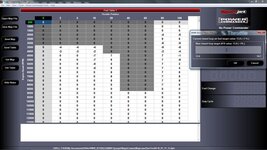
I am running a Power Commander with replacement (so-called) "wide-band" lambda sensor. I have also replaced the cat with a Y-piece, and fitted a Laser Duo-Tech can and a K&N air filter.
I then had a couple of hours on a dyno, with an operator who knows what he's doing (
LINKY N.B. other competent dyno operators are available). I asked for the fuelling to be adjusted for optimum tractability, torque, low-range pull, smoothness, with minimal consideration of mpg or max power.
The result is a bike that is a treat to ride. Maximum torque is available from about 2,500 rpm, the "running out of puff" feeling at about 6,000 rpm is gone, it pulls hard up to 7,500 rpm, although maximum power is around 6,750 rpm. Max bhp is the same at 75 (ish) and max torque is now up to about 85 N/m, more-or-less flat from 3,000 rpm up to 7,500rpm. MPG about 43-45 the way I ride, but I don't care, or I would ride a Honda 50.
How do you think this kind of thing can be achieved with a simple chip-change? Every bike is different, so the best you can realistically hope for is a removal of the leaner-than-optimum mixture which ensure compliance with the TuV emissions test parameters.
Am I missing something?






 I'd like to see some dyno results on this.





